How to Weaponize Your Own Mess

What links the working class elements of Brexit and anti-globalist American right is a belief the world order has exploited them. The messaging and thinking isn’t precise, because these are not informed opinions. David Ricardo has been right for the last 211 years, from 1815 to today. Trade makes both countries wealthier. What Ricardo didn’t say is how that wealth would be distributed (although I think he assumed it would be a broad lift in living standards). Also implicit in the reasoning around trades is that other aspects like environmental or human rights protections would be respected. In the ideal view, one country doesn’t become the efficient supplier of a good because it’s willing to work enslaved people to death in toxic conditions.

There’s an old economics joke. Stick your head in a 400 degree oven and your feet in liquid hydrogen. On average, you’re fine. A lot of inequality is elided away in mass averages. It comes to light when we break these statistics into quintiles, quartiles, or the top/bottom X percent. There are are so some synthetic measures, like the Gini co-efficient for the US is 41 while 29 for Germany, while the GDP per capital in the US is about 90,000 while Germany 57,000. On a per-capita basis it’s better to be an American. But the likelihood that you share in that wealth is lower. It’s kind of like people wax poetic about medieval times but forget that in all likelihood they were a peasant working as a near slave for the feudal lord.

What has happened in the UK and the US is that the distribution of benefits from trade have not been distributed evenly. There was a belief that the system would work it out in the end. You lose your job in the industrial North of the UK or the rust-belt of the US but something else comes along. Like you leave the assembly line and start designing AI accelerator chips or turn to writing software. In fact, what was needed, was a re-distribution of wealth by the state so the benefits of globalization were more evenly distributed. By the way, the Gini coefficient for the UK is about 35.

The benefits of trade were delivered unequally, benefiting capital more than labor. That capital also became militant about not raising taxes or wealth redistribution. After all, are you advocating for class warfare by asking billionaires to pay a reasonable tax rate? Why do you want to tear society apart this way? Go back to your squalid little pens and rejoice in the social order, you troglodytes. Oh, and breed more little troglodytes because we’re running out of consumers.

It cost Bezos a mere 75 million to produce the Melania movie as a not-so-under-the-covers bribe to the Trumps. That money was found when Jeff turned his couch over and collected what fell out. That’s how much money he has. He has been a principal beneficiary of freeing trade and intends to keep every red cent he’s ever earned from it. For Microsoft or Apple to put up money for vanity projects like the destruction of the East Wing of the White House to make way for a gaudy ballroom, it is not a sacrifice. These are companies that don’t worry about millions of dollars. That is a rounding error in their day to day change in capitalization, and the personal wealth of their founders and leaders.

But… But… But… Look at the tariffs! Those are anti-trade. True, but you also need to look how they’ve been turned into a patronage system (by offering individual companies a way out in exchange for obsequiousness or out-and-out bribes), and the loopholes and exemptions lower the effective tariff rate. But for the Trump backers, it means they will pay a lot less money in taxes. If a Harris presidency might mean an extra 50 million in taxes, spending 5 million on PACs is a reasonable investment. Which is how the rich view politicians. As investments. In fact, they got a boon with Trump.

Those same people who benefited from trade. Who were the main beneficiaries of the 2008 bailout, and seemed to wind up with the lion’s share of the COVID stimulus, have weaponized far right parties to prevent any attempt at redistribution. Making people so angry they put the party of the oligarchs and plutocrats in power is a master-stroke of genius. And all the while absolutely castrating the opposition, who is just as needful of their patronage. They are like the clever player that starts the NPCs combating with one another while they watch and plunder the resulting treasure. Exploiting the lack of social cohesion, and the politicians desperate for money, keeps them in effective power and keeps their money safe.

Before you start reaching for the revolutionary pitch-forks, keep in mind that a bulk of these folks seem to survive each revolution. They are the cockroaches during upheavals. Whether it was the Russian revolution, or the French revolution, or the American revolution, a lot of these folks wind up on top. Our best bet is not revolution. It’s putting aside our emotions, our clever memes and slogans, and our sense of “team” to actually look around. Using our clear-eyed view of the world around us to vote for change. I don’t expect a lot from Mamdani, but he is the result of the ‘establishment’ left foisting an unpopular candidate that preserves the status quo. People gave the establishment left the great, big, stanky middle finger rather than support a sex pest.

Take in the world with a fresh eye. Look at the fact Amazon and many other companies benefit handsomely from trade, that trade will bring in wealth, but maybe that wealth shouldn’t be concentrated into so few hands. Look at the private equity players who purchase companies with debt, load those companies with more debt, sell them, bank their proceeds as capital gains or income, to do it all over as those companies declare bankruptcy. Minting their income through debt, massively reducing their tax burden, but in the process devastating the lives of millions of individuals. And realize they’re the ones priming the coffers of groups like the Heritage foundation.

At the end of the day, nothing changes until we change. We continue to be the NPCs screaming at each other about this or that issue, while the players sit on the sideline and laugh. Red team versus Blue team, while the green players reap the rewards. If you want any better evidence, in the first Obama administration, the democrats had both congress and the White House could have easily fixed the loophole that allows private equity partners to earn their money at a top rate of 15%. They did not. Because the private equity partners are the people the phone banks staffed by your congress person call to raise money. Now those same groups have decided their future money interests are better served in an autocracy, and they’re using the misery of millions of Americans to do that. A misery they created in the first place.

Tech Bros Are Going to Lose Europe

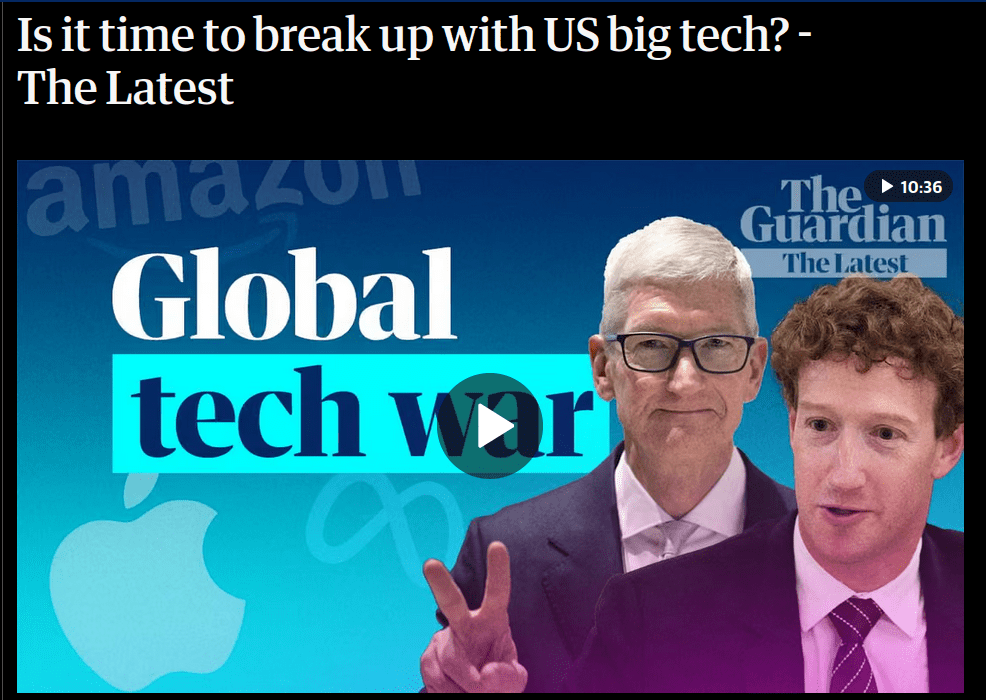
The Guardian asks. First off, it’s not that the European version of these services do not exist or need to be built from scratch. But that’s not the reason to switch. Until now, US elections, even 2016, produced reasonable outcomes for Europe. Now they have an agent of chaos more than an ally. A country that foments division among its alliances and has stated that a weaker Europe is in American interests. And so much of their communication is funneled through American companies. Companies that have shown a willingness to cooperate with an administration that shows a willingness to use the levers of government in a retaliatory manner. This retaliation could be illegal, but there has been little interest in the Republicans to stop it and there seems little ability (either talent or power) for the Democrats to put an end to it.

Even if the cost is a little higher (with the US being the low cost producer), it is the insurance you pay for having a functioning society. For the same reason you might choose the Grippen over the F-35. Maybe have some F-35s, along side a mix of other fighters. Should the relationship with the US result in a suspension of the contract for maintaining the F-35, or the US out-and-out prohibits their use in the defense of Europe, there is a plane Europe can fly. The resulting insurance against being effectively disarmed by America may be worth additional cost. As would be securing broader sources of many products and services.

But let’s say the 2028 election produces a left-of-center Democrat who is able to assume power. What is the guarantee they don’t pursue some of these policies because of political expediency? There are many instances where a policy unpopular with the winning voter coalition are continued. There is no guarantee that the new administration drops those policies on its first day in power. And what if it loses power to the ideological continuation of the Trump administration? What happens if, in four years, Marco Rubio decides it’s better to rule in hell as a populist autocrat than to serve in heaven? At this point, from an outside observer, I would imagine even Donald Trump Jr. would not be an impossible outcome in 2032.

But there is something coming with AI generated search results I think Europe underestimates. They can be primed to deliver answers that promote division and fringe movements. This could include AI summaries of documents or the generation of material from AI. These could be over-the-top, cringe inducing, obvious trolls to very subtle wording or choosing what information to present. And should Europe complain, threats of tariffs or outright cut-off of these services follows. Or EU leaders are sanctioned and cannot access their digital (or financial) assets.

So yes, Europe needs to figure out what would help. Making it cheaper to start businesses in Europe? Sure. Ensure these companies have guaranteed revenue through government contracts? Maybe. Changing the laws to withdraw from the anti-circumvention features foisted on the EU by previous trade negotiators? That’s a good idea. If Apple threatens to cut off iPhone access to the UK, for example, return the favor by making it legal to jail-break your iPhone and install alternate services. Tax the profits of tech companies to help pay for it? Even if you wind up taxing your own tech companies, the money might come back to them in other grants or contracts.

Right now the US companies have market dominance. Let’s say they have 95% of the office software market. The EU shouldn’t try to retake the 95% at once. It should just focus on reducing dependence on the US to 85%. From 85%, 75% feels possible. Because a lot of tech is based on network effects, as other companies plug in to the services of other companies, each tranche becomes an easier target. Just start with critical pieces, like your ability to share documents securely and e-mail. And start with the easiest part to control, your own bureaucracies. At some point you’ll need to worry about other cloud services, or even the content on social media, but it will be from a stronger place.

On Tap for Next Week

Next week is going to be a pretty news-heavy week.

  • Monday – Institute of Supply-chain Managers (ISM) manufacturing PMI
  • Tuesday – JOLTS
  • Wednesday – ISM services PMI
  • Friday – Payrolls, Unemployment Rate, Consumer Sentiment.

Outside the weekly unemployment claims (which may be a useless metric right now), I’m looking at the JOLTS number to see the level of openings. I think it’s exaggerated, as companies have openings for jobs that are unrelated to an actual job for which they would hire someone, the trend is important. And Friday, of course, we get the higher quality read on jobs. However, it has been plagued with data collection problems for the last few years (blame the respondents not turning in paperwork or delayed paperwork rather than “cooking the books”).

What I’m looking for in the ISM numbers is data related to prices. Do they indicate inflation pressures? If there are price pressures, I’m expecting to see price pressure on the CPI number week after next. That would mean short term rates should stay steady for now. That’s going to put upward pressure on long rates (over 10 years). The 10 year rate is the rate that has a clearer impact on economic activity. The Fed only has influence over short term rates. As we get to 5, 10, 20, and 30 years, their influence fades and other economic concerns (such as inflation or economic growth) come in play.

PPI Came in Hot

What we have now is the PPI coming in a little hot. What I’m looking at specifically is core PPI came in hot. (Stripped of the more volatile components. This is what I would expect from tariffs. We tend to think of tariffs as impacting just end user commodities, like wine or automobiles. But it also impacts goods used to make goods, such as the input steel or the machine needed to punch that steel.

Is it really from tariffs, which would definitely be a competing factor. There are multiple mechanics at play. One is how sticky producers expect tariffs to be. If you see a TACO moment coming, or a Supreme Court about to throw out the tariffs, you don’t want to annoy your customers with a sudden price hike. Especially if the court allows you to recoup your tariffs from the treasury. You could eat the costs and burn down the inventory built up prior to the tariff being applied, hoping to replenish it in a low or no tariff environment. This strategy has a limited life span. We’ll know February 20, whether it’s a realistic strategy.

Next is the swiss-cheese nature of the tariffs. There are significant exemptions or carve outs that lower the effective tariff rate well below the statutory rate. Just ask Apple. You say it’s a 25% tariff but then exempt several sub-products or specific companies, meaning the macro effect of the tariff might be 10%.

Then we have supply chains re-adjusting. Some companies may have imported part of something from China, like the motor, castings from Mexico, shipped it up to Canada for paint and assembly, and then back to the US for the electronics, partly imported from China and assembled in Mexico. They might look at that machine and decide it’s better to just make it in Canada and pay one import tariff.

Next, some companies just paused imports for a while, meaning you couldn’t buy the imported thing, as they were figuring out how to file the paperwork for the product. Now they’ve figured it out or adjusted their supply chains and can now start importing those goods.

There are a set of reasons as to why the tariffs may have had delayed impact. And those impacts sit on top of the month to month noise in the PPI. That noise is a product of both problems in data collection (with respondents more likely to be late in their replies) and just variability in behavior. It could very well be that the tariffs would have had a more noticeable impact over the last few months, except for noise. Or this month is the aberration and the actual tariff impacts have been swiss-cheesed into a nothing burger. And as we get 12 or 18 months of data, it will become more clear.

I Feel Like Tesla Analysts Are Insane

Listening to this idiot, it almost feels like he doesn’t even really care. Elon has lost his fucking marbles, scrambling his brain withe ketamine. The one Tesla product he had a strong hand in, the Cybertruck, is a worthless piece of crap. Sell side analysts will gladly tell you its raining while pissing on your leg, but even this is just cringe.

Back Door Default

The price of gold used to be fixed as a matter of law. The price for gold was set by the US at $20 an ounce. A one ounce gold coin was worth $20. During the depression, Roosevelt raised it to $35. That was not the same as a default on US debt. But it was a default on US debt. The day before the change you could trade $20 for an ounce of gold and an ounce of gold into French Francs. The day after, it would take $35 to buy the same amount of gold. Since the Franc had not been depreciated, it meant you could buy fewer French Francs. But international trade and finance was much smaller in 1933. If you were an American sitting on a pot gold, you were suddenly 75% richer, but you were forced to sell your gold to the US government at the stated price.

Within the United States it meant the Federal Reserve could print more money, as the same amount of specie backed 1.75x the amount of dollars. (At a time when the supply of dollars was fixed to the amount of gold held by the government). In addition, it made US exports cheaper, as the same amount of French Francs netted your more dollars to buy American made goods. The United States continued to pay the coupon on their debt. But, could do so with cheaper dollars. If I recall, this was eventually ruled by a court as a default, but it wasn’t a default in the sense you stop paying your bills. You just made it easier to pay your dollar denominated bills.

The US is a reserve currency. Meaning that instead of gold, countries are willing to hold dollar denominated assets (along with dollar deposits) as something freely convertible to Euros, Rials, Drachmas, Lira, or however the local Sheckel is denominated. There are few people or few countries that would not take the US dollar as they can sit on it or turn it over immediately for something else in a highly liquid market. And US issues government bonds are both dollar denominated and pay interest, accumulating more dollars. Holding gold as a reserve does not cause the gold molecules to generate more gold. In fact, the dollar gets more valuable when the Federal Reserve raises interest rates and more people demand more dollars to buy more US bonds. As long as the value of the dollar holds, the reserves are safe.

The problem is the United States is indebted to the tune of 125% of GDP (compared to Europe’s average 85% and Japan’s over 200%). There is no magic number that says X% of GDP is a threshold above which a reserve currency falters. And the rules of the United States (with the primary reserve currency) may be different than the reality for Japan’s Yen (when is in the ‘other reserves’ category). Since the US makes the dollars in which its debt is denominated, you don’t have a repayment risk like you have with, say, Argentina. Argentina can’t (legally) make more dollars to pay its dollar denominated debts. It has to trade real good for those dollars. Meaning a default and devaluation of the peso by Argentina largely makes the population poorer (as a whole) although some individuals (with big dollar holdings) richer.

This is why the analogy to a household budget or comparisons to Argentina don’t work with America. A household that could print its own currency, if widely accepted as a reserve currency, could borrow as much as it wants. Dad could buy a Mercedes Benz S class, promising to repay in “family bucks.” They family prints “family bucks” so repayment risk isn’t a problem. The problem is they flood the market with “family bucks” and the currency gets devalued. This also breaks down because the size of the market for US dollars is incredibly huge. It’s well beyond the needs of the United States, as China and Australia may use dollars in their trade (for example). It would be more akin to everyone everywhere using Family Bucks, so printing a few extra Family Bucks is not a problem. The market absorbs it like pissing in the ocean.

So the holders of US dollars and debt are perfectly safe, right? No, they are not. There are risks for investors. In order of my belief in their likelihood are devaluation through inflation, and a partial default. These are “cut off your nose to spite your face” solutions to America’s fiscal and social problems, but we have an administration that wakes up every day with a nose cutting cleaver in hand. Right now the world is searching around for alternate reserves. Gold has almost doubled in price in the last year. And as much as gold can skyrocket in value, it has also crashed. It is much more volatile than holding Euros or Swiss Francs. No sane person wants much gold exposure as a stable reserve, but the Euro and Yen aren’t ready to take over the dollar. So why are people moving away.

Let’s start with inflation, which I think is the more likely avenue. It’s not quite the same as the dollar being devalued against gold in 1933, but similar. Easy money and an inflation causes the value of the dollar to fall. For example, if you have 6% inflation, it will take about 12 years for goods and services to lose half their value. If you paid $30,000 for a car, in 12 years the same car would cost $60,000. (Your mileage may literally vary as different goods and services will respond differently). But it also means if you buy a 12 year bond for $1,000, it will only be worth $475 in current dollars at the time of redemption (when you get the face value of the bond back). By comparison, it would be worth $785 (in current dollars) if we stayed with 2% inflation.

When inflation risk is seen as a temporary aberration, interest rates do not move much. If bond buyers suspect sustained inflation they will need a combination of coupon payments an final redemption that is worth the risk. The US has no repayment risk. If bond buyers suddenly believe that inflation will be sustained and around 6%, they will pay a lot less than $1,000 for the bond. Or, if it’s a new bond, they will want a much higher interest rate on the bond. In the long run it is not a great strategy for dealing with debt. In the short run it is a way of reducing the value of the existing debt. But it would reduce the debt to GDP ratio as nominal GDP would expand much faster than real GDP. Inflation is up, interest rates are up, our exports are cheaper, and foreign imports more expensive.

As I’ve indicated, it’s assumed the US would always pay its bond interest and principal. (What actually happens to the principal is a new bond is issued to pay the principal). But the fact a default hasn’t happened in living memory does not mean it won’t happen tomorrow. The vast majority of US debt holders are US organizations or individuals. I hold some number of US bonds. But a portion are held by foreign governments, organizations, or persons. Sometimes it’s hard to determine if something is truly a “foreign holding,” but the government of France holding treasury bonds as a reserve is a pretty clear example. In this case, the nose severing instincts take over and interest payments to foreign holders are capped or stopped.

This doesn’t help with the over-all level of the debt, but the interest payments on that debt. It could cut those interest payments by as much as a 25%, if completely stopped. This would present a weird market situation, as a US buyer does not immediately see the value of their US bonds deteriorate. They bought the bond thinking a 4.5% rate was good enough for the next five years and that’s what they’ll get. A foreign buyer, however, sees an immediate impairment to the value of the bond. If they sold it to another foreign holder, that buyer would require a heavy discount on the bond. They would have to sell it to a US holder for the best price.

The destruction of value as a US bond holder would happen as foreign sellers cause the price of bonds to plummet and I need to hold to maturity to avoid a capital loss. Second, the foreign sellers would want to convert back to their local sheckel, meaning they sell dollars. They want to sell the US bond, for example, and buy Euro bonds or Korean bonds. (Japan is an interesting question right now). As they convert dollars to Euros, that drives down the value of the dollar and drives up the value of the Euro. This is another form of devaluation. Suddenly, our exports are cheaper, foreign imports are more expensive, interest rates are higher, but internally not much has changed.

Of course there’s nothing stopping them from pursuing both policies by destroying the independence of the Fed to lower rates and raise inflation, while capping foreign bond payments at 2%. Not to mention some bond holders may be afraid that if sanctions are applied for political reasons, as has happened to the ICC, they may not be able to access their reserves. In addition to the possibility the US economy may be impaired in the long term from civil unrest or a breakdown in the rule of law. In short, the once sober and boring US financial system is approaching shit-hole country chaos. That boring, law respecting, dullness helped make the US *the* reserve currency to hold in a world that has largely moved away from gold (other than a kind of last resort medium of exchange).

While the impact of import prices and export demand is not critical to the United States the same way it is for Germany (about 25% of US GDP is trade related versus 80% for Germany), it higher import prices are inflationary. US exporters would benefit, but would also face higher interest rates and higher prices for their input materials. Of course, all the US would feel the higher interest rates, driving up mortgage rates and car loan rates. I think it would be similar to the oil shock of the 1970s, which contributed to stagflation. In a strange way oil is like another currency (although you can’t hold it forever like gold). As the dollar devalued against oil, it helped stimulate inflation. (It was not the sole or primary cause – but it was a notable contributing factor). We might get stagflation or a recession we can’t spend our way out of (because of high debt levels) and nor can we stimulate using monetary policy (without risking hyper-inflation).

But at the end of the day, it only deals with existing debt. Newly issued debt would adjust to the new reality, with foreign holders seeking higher rates or avoiding the US. If we pursue either of these bad ideas (or some other policy that is effectively a devaluation that I’m missing right now), without reducing the persistent budget deficit, we will just wind up accelerating the slide to economic ruin. Not that it isn’t a long slide. There may be investors that still buy US assets, just ones that are inflation resistant and not bonds.

I don’t think people just switch to gold. For one thing there is the volatility of gold, which can have big swings relative to currency markets. Second, the supply of gold is fixed in the short term, meaning it’s possible to be unable to enter into a gold denominated transaction not because you lack the goods, but because no one can come up with the gold. This currency crunches would happen in the US prior to the adoption of modern banking and the Federal Reserve. People wound up trading scrip (IOUs) until enough currency returned to that region so they could settle the debts. It created unnecessary boom-bust cycles. But it can be recession inducing when these runs happen. What about 21st century gold? Crypto-currency is likewise fixed and even more volatile than gold, making it an even worse choice.

The current off-ramp may be the Euro, the Yen, and a basket of other currencies of other trading partners. It will likely need to be a diverse basked, since not everyone wants to hold some of these currencies. It will make transactions more expensive and balancing reserves trickier than it is today. And the dollar will continue to participate in that basket. It took decades for the British pound to stop being a widely held reserve currency from the time it was evident the UK was becoming a middle power. But it will mean the US will lose its cheap finance, its leverage, and its low interest rates.

Dollar is Slumping

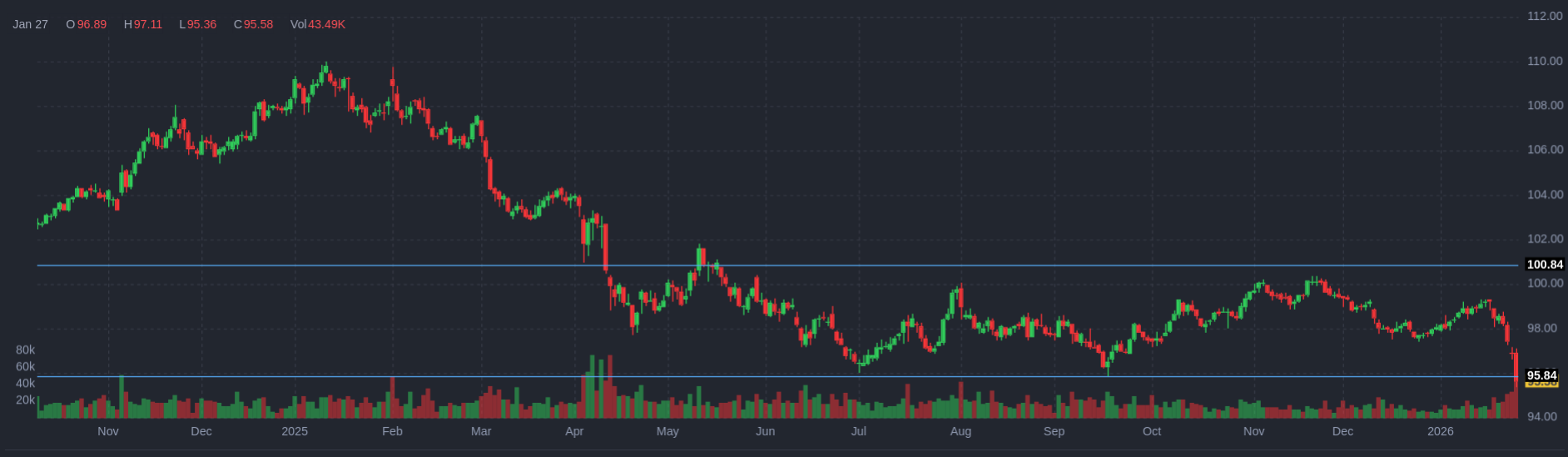
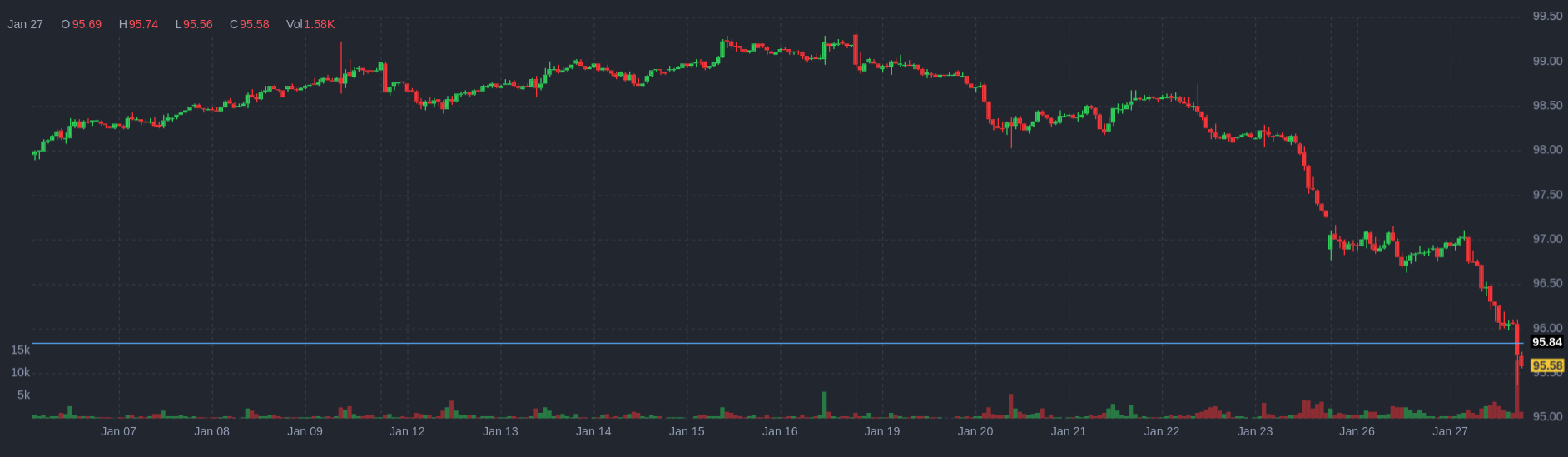
There are a lot of things going on, including a change in investors’s estimates of the risk of holding long Japanese bonds. But there is a “sell America” trade based on the erratic US policy. The way I read it, starting in April the dollar enters a trading range. That coincides with the bat-shit crazy tariff announcements. But it’s not an abandonment of the dollar in any way. However, with the President saying he’s fine in the dollar falling, that’s giving folks the green light to sell dollars.

This hourly chart shows how quick this has happened. As of the time I write this, it may not result in a ‘real’ breakout from the range. It could just be a reaction down and a reaction back up. But it does show there is real energy to pull the dollar down.

What happens when the dollar falls? Metals and oil tend to go up with a falling dollar. In a sense oil, gold, silver, and to a lesser degree copper, operate as a currency. As the dollar sinks against other currencies, those commodities become more expensive. As do imports, which are already tariffed. Which is pro-inflationary. However, it does help make US exports more attractive. Of course the real drop occurred because of the statement below by the orange moron.

It’s a Bleak Battle

I expect the administration was taken a little aback by Republican voices expressing discontent. I think the 40% that is the bottom of Trump’s approval probably excused the extra-judicial killing by paramilitary forces in Minneapolis. Many in the Republican party barely said a word about the rest of the brutality. I think the push-back was unanticipated and they weren’t ready for it. The canker-lipped spokesperson of the administration had a muted statement. They are regrouping, not defeated. They have flooded the zone with a sea of shit and this is like saving exactly one house from partial inundation. One mole whacked down as other pop up.

We’re back to the two party system of the Autocrats and Ineffectuals. The Autocrats want to rough-up blue areas of the country before the next election. Their goal is establish control, purge voter roles, and stifle turnout where possible. And while they had a setback in Minnesota, their continued success in building a system of patronage was on display at the Melania premier. With corporate executives finding clever ways to pump money directly into the hands of the Autocrat kingpin and his family. And as they take ownership of Tik-Tok, popular voices from the actual opposition are being banned. The platform was essentially handed to one of the regime backers.

Meanwhile the Ineffectuals will continue to send very strongly worded letters. But will seek to work with the administration where they can. Because it’s important they aren’t perceived poorly by Chuck Schumer’s imaginary friends. They must show they dutifully adhere to the old norms. However, these are difficult times so they may insist on some modifications to the funding bills to keep the government open. [Note that they may withhold votes to fund DHS unless “metro surge” is ended except ICE is enforcement is already mostly funded through the next few years.] Because it’s important to get concessions from a party that does not feel they need to honor any deals.

Gavin Newsom? Great haircut, but he is begging for money from the same people Trump is tithing. He talks a good talk, but no corporate dollars are really in danger at the end of the day. Does he have a “social media game?” Sure, maybe. But he’s the smart money bet by the Ineffectual establishment. Chances are he’ll flop like many of their other darling candidates. You know, the same political establishment that tried to foist Andrew Cuomo on the city of New York. A discredited sex pest. Of course they got Madmani … Mandady … Mamdani. Who seems like a nice enough guy but may be in over his head. And if it weren’t for the fact the establishment ran the worst candidate shy of Anthony Wiener, would still be enjoying his seat on the assembly.

It’s fucking dismal. It’s beginning to feel like the remaining Republicans don’t give a fuck, want to keep their heads down, and get through the next election. Although quite a few won’t. Or shouldn’t, given a reasonable election. I would say the possibility of Trump trying to cancel that next election is small. But I think they issue is we haven’t figured out how he challenges it. Trying to stop vote counting on January 6, 2021 to stay in power was a truly shit idea, but it wasn’t predicted. I think we just haven’t figure out what he’s going to do. And how the Ineffectuals will bumble and fumble the ball. Using a football analogy, we’ll see how far they get into the red zone before inevitably turning it over.

I would say, had we a real opposition, an attempt to subvert in election in 2026 should lead to a nationwide shutdown. Or at least a blue state/blue enclave shutdown. But more likely two or three hours of, middle aged people standing by the road, not blocking traffic, and waving signs, as honking cars drive by. Of course, that depends on how cold it is. But the Autocrats will dutifully line up behind imaginary election fraud, sacrificing our future as a democratic republic to try to maybe hold the Senate? Or maybe try to seat only some of the newly elected Ineffectuals? They don’t care about the future because the rapture is apparently right around the corner. And the Ineffectuals might send yet another strongly worded letter. Maybe Chuck Shumer’s imaginary friends have some insight on how to handle that crisis, should it come to pass?

Comply or Die [Kind of a Rant]

Tim Miller at the Bulwark said it best on a pod cast. The “Don’t Tread on Me,” Gadsden flag waving, concealed carry crowd has become the Comply or Die crowd. Right now people are hot and the longer the occupation of Minneapolis continues, the hotter they’ll get. And in a country that has more guns than people, where all 50 states have laws that allow people to carry concealed firearms, it’s almost guaranteed that ICE and CBP agents will come across armed people. It’s also possible someone just throws on some fatigues and and a mask and pretends to be ICE to do god knows what. (CBP appear to have more regular uniforms but some ICE members look like they showed up in their personal gear).

It’s a little over nine months until the next election. Although it seems impossible now, as a country we have the ability to forget the scenes of yet another extra-judicial killing by armed paramilitaries. After January 6, 2021, it seemed that Donald Trump was un-electable in the United States. And yet, here we are. I don’t think the pressure for mass deportations is going away and I don’t think the administration will let of the pedal for very long. I strongly suspect Steven Miller, that fucking ghoul, will be back demanding more arrests. That angry little fascist cosplayer, Bovino, is likely going to pop up some place else with some other gig. And I’m sure it will be just as cruel. He’s too “central casting” for this administration.

Friedman suggested we play a game “ICE or Hamas.” Try to figure out if the masked paramilitary is a terrorist or a US Federal employee. The truth is, they’re both terrorists. They’re both trying to terrorize populations into submission. This is clearly evident as the Federal Government makes demands in exchange for “letting up.” They both try to use brutality to try to instill that fear. Maybe they’ll go smaller and in more cities. Maybe they’ll just go to blue enclaves in red states. Maybe they’ll start raiding farms. Who knows? But to further the fascist state, you need to have thugs do intimidate the masses.

This is exactly the second amendment crowd’s wet dream. Masked federal gunmen coming in to take peoples’ rights. But the second amendment crowd has never been about all citizens’ rights to have firearms. Or about all citizens’ need to defend their rights. They wanted to show up at a protest, armed to the teeth, to try to intimidate the other side. This is yet one more example of the lying through their teeth we’ve seen from many of these rights absolutists. Just like the thinnest skins on freedom of speech are with people who demand you don’t censor their racist comments. They are liars.

Since Carney’s Speech

I’ve seen a lot of folks on the left glom onto an idea that wasn’t in Carney’s speech, that the entire post war system was a sham. It was far from perfect, but certainly not a sham. At its best, it saw respect for the rule of law to a degree that dictators could move their assets to the “West”, where they could defend them from seizure by the courts in those countries. Not because people in those countries especially like dictators, but because as gratifying as it would be to return their ill-gotten loot to the countries they looted, but because the rule of law was more important.

Of course there are many interpretation of the same series of events. We are biased against seeing what is counter to our narratives. Like the shooting of Alex Pretti demonstrates in real time, some people will always refuse to believe their lying eyes. They will discount 100% of the information they do not like and see the information they like as the totality of the truth. Just like I see many take the view Carney was saying the old international order was a sham. Was the post World War II based order flawed and subject to abuse? Yes, of course it was, just as people have abused every institution. And it’s hard to ignore the benefits of trade the post WWII order has brought to countries as large as the United States and as small as Singapore.

For decades, countries like Canada prospered under what we called the rules-based international order. We joined its institutions, we praised its principles, we benefited from its predictability. And because of that we could pursue values-based foreign policies under its protection.

We knew the story of the international rules-based order was partially false. That the strongest would exempt themselves when convenient. That trade rules were enforced asymmetrically. And we knew that international law applied with varying rigour depending on the identity of the accused or the victim.

When I listened to, and read, Mark Carney’s speech, I did not take away the admission by an insider that the system was a sham, but rather the imperfect but beneficial system was coming to an end. I would agree with Nesrine Malik, for example, that there were evident cracks in the system going for quite a while, and that a sitting US President justifying the use of forms of torture considered to have been war crimes in 1945, was one of those cracks. In Carney’s remarks there’s an acknowledgement of a system that functioned imperfectly, but not a wholesale condemndation. While the rules sometimes did not appear to apply to some countries, they did generally apply. And that facilitated trade, relations, and a growth in global wealth. The fact that imperfect system is dead is not a good thing, which I think is also implied by Carney. But maybe we need to think about how we got to this moment.

In 1945, most people in their 40’s, 50’s, and 60’s that were in power, had seen or fought in two horrible wars. In the first war, a generation of young men in Europe had been gutted. They were left dead in the mud in France and on the Italian border. There was a hope, in 1918, that such a horrible war would never happen again. If you were in your late 40’s or early 50’s, you might have served in the Great War or known someone who died, or a family who lost someone in those wars. It was hard to imagine anything worse. But in 1945 you find yourself left standing in an even more ruined, horrified, and murdered world. Something had to change.

That was why we initially put the signs in the window. Did it work? Most times it did, even if we had to stumble and find the way while not every country was a willing participant. It did not work well for every country in the world, but we developed an international system of commerce that has lifted billions of people out of poverty. India and China alone have seen the most brutal, horrible poverty fall off to a large degree. While much of Africa has not fared as well, many countries have see significant and sustained improvements for their populations. All made possible by secure sea lanes, mechanisms for settling international disputes in courts, and the ability to enforce their rights even in their offender’s courts. The French, English, Portuguese, and Spanish were forced to divest from their colonies, in part because of the United States1 as well as the Soviet Union.

What has broken down? The worst of the rot has been in China and America. I think if it is not clear at this point that China has no interest in the rule of law or international rule of law, you are horribly deluded. While their wealth was enabled by that system, now that they have wealth, they do not feel bound to that system. The experiment that a developed China would liberalize and join other nations in that order has been a devastating failure. Their trade policies and grossly self-serving foreign policy have made the US and all of Europe more than a little wary.

America’s break down is different, and the result of internal rot. And it is not without a counter-part in Europe. Much like the UK, America is very different depending where you reside. The “blue” parts enjoy longer life expectancy, better services, and more income. And to the degree these benefits are present in the wealthy parts of America, they are absent in much of he rest. The “reds” (rightfully or wrongly) see it as the by product of a system run by international elites and at the expense of their America. Not only has this caused many Americans to abandon their belief in trade and an international, rules-based order, they now question basic American rights and law. A vocal plurality of Americans want half the country arrested and shot or imprisoned by military courts This should be much more frightening and deserving of more attention. And I can’t see why more do not see a bright, clear line connecting it to both a new American Imperialism and a loss of confidence in the domestic system.

The last 25 years have seen once-in-a-lifetime economic crisis after crisis highlighting that few appear to benefit from the current order, while many pay. The 2008 financial crisis was especially damaging with no one facing any accountability2. Which Americans believe that rule of law, international alliances, and trans-national legal frameworks are the way forward? Mostly it’s older Americans, particularly in blue states and cities. They are the remaining beneficiaries of that world order, with many red state Americans and people under 40 seeing themselves as the losers3. That is not a winning coalition if you want to see American continue to be an enthusiastic supporter of a wider world order, even if it actually benefits America. Until that changes, America will not participate in that world order. Or at least not in a constructive manner. Much like climate change, US dependence becomes something middle powers need to mitigate.

Will this be a more just world? I have no idea. I’m certain economic development, if not retreating, will become slower and harder to come by. For Canada and Mexico, trade with America should be incredibly cheap. Nothing has to be shipped across a great ocean. Forging alliances with more distant countries requires more energy and work to exchange goods and secure trade routes. Middle powers are forced to choose the less efficient option because it provides a level of insurance when the hegemonic interests of China or America ask for too high a price. This diversity is not prosperity regardless of what the United States or China does, but it prevents complete collapse should the demands become too large. The same will be true for Europe, South America, and parts of Asia. Rather than trading with the lowest cost, most efficient partner, they will need to spend more on defense and infrastructure to fund that insurance.

But there is no alternative. China has little use for the old order, now that it is wealthy, and America is abandoning that order because of necrosis in its social tissues. While I doubt the remnants of NATO will have to fight America any time soon, I see no path to a better tomorrow. The people who knew the horror that begged them to build something better are gone. In fact, those who want to destroy the system adopt the symbols of the worst of the evil to chip away at the last deference to that old order. Whether it’s Stalinist or Nazi memes, the goal is to signify they no longer buy into the dying or dead international order. They are figuratively pissing on the graves of all those who tried to build a better world out of the horror of an older world. The great irony is the way forward may be more international order. That stronger institutions and more alliances are the way forward for middle powers. Until the United States and China suffer some calamity or deterioration that forces them to take a more equitable and less coercive position, I see no other way.

  1. The United States has a complicated relationship with colonialism. It doesn’t view Puerto Rico or (at one time) the Philippines as colonies, or US adventures in South America as colonialism, many Americans did not care for European style colonialism. â†Šī¸Ž
  2. In fact, the opposite of equity. The C-suite people sued to get their bonuses, payable because money was injected into their banks. Main street was billed for the losses, while Wall Street got to keep the gains. â†Šī¸Ž
  3. As do a number of Europeans who are not able to find a well paying job or afford a home. It might express itself slightly differently, but it’s the same “we’ve been had and exploited” mentality. â†Šī¸Ž