The Dollar’s Tight-Rope

The dollar is the most often used thing of value in which non-USA countries store their foreign currency reserve. First off, what’s a foreign currency reserve? These are often large sums of currency held by the central banks of various countries to stabilize their currencies. If there’s a sudden shock on the Swiss Franc, the government of Switzerland can buy or sell dollars to mitigate the shock. In some cases, the governments also use reserves to facilitate trade or government purchases. This was traditionally done with gold and silver. However, since 1974, it has largely been done with dollars. Dollars provided by a country that (until recently) was committed to international rules and institutions that facilitated trade and rule of law for disputes.

The dollar is not only a reserve, held by many countries including China and Russia, but also a preferred currency for many international exchanges. When you buy a barrel of oil, that contract is denominated in dollars. (Even though the Saudis did poke Joe Biden in the eye by executing some contracts with China in Yuan – it was a political move, not based economics). If a large bank, or a government, lends money to another country, it will generally do so in dollars. A German bank does not want useless Bolivars, Dinars, Pesos, Drachmas, or Rials. They want dollars, Euros, and Swiss Francs (probably in that order). The country or government receiving the loan also wants dollars. (Although Euros can be fine, as they translate quickly and easily into dollars).

This puts the United States in a unique position, as the world’s supplier of dollars. When we run a deficit, we borrow that money in dollars. If a German bank buys a US treasury bond (a loan to the United States government), it will be repaid in dollars. The repayment risk to the German bank is minimal, as the US can just print all the dollars it wants. The risk to the German bank is the US will be poorly managed, and the value of the dollar will be inflated away. Let’s say the German bank buys the treasury bond for $1,000, expecting to receive $50 in interest every year for the next five years and then the $1,000 principle. At a 2% inflation rate, that $1,000 will be worth about $900 in today’s money. But if the US engages in some very stupid decisions, and the inflation rate climes to 5%, that will be worth $775 in today’s money. Until recently, the US has had largely very sober, responsible economic managers, so the risk was minimal.

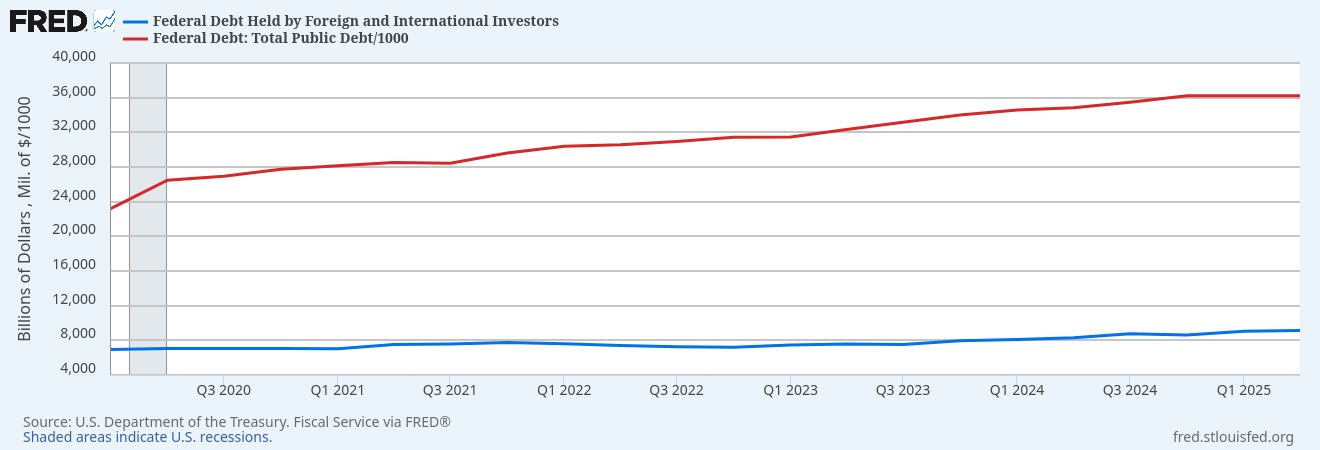
How bad can inflation get? We’ve had 5% inflation for short periods at numerous times. It didn’t really bother people that much, because it quickly fell back down. We had around 9% under Biden for a brief period and people lost their minds. But many places have seen inflation rates in the 20% or more range for prolonged periods of time. They still survived as countries. Even hyper-inflated countries have held together. At a 20% inflation rate, the German bank would see $325 returned in today’s money. If that bank had any real fear the US was going to 20% inflation, they’d avoid the bond until it had over a 20% interest rate. But most US debt is actually held by US individuals.
On net, this is a good position. If we want to buy something we make the magic tokens most people want to exchange. If we need more dollars, we can make more. We don’t even have to print them. We just put some numbers in a database. People are also willing to buy our debt, which we will pay back in those same magic tokens we make. Unless we do something stupid, that results in protracted, high inflation, we will continue to hold this unique position. The contenders for this rare status are the Euro and the Yen. No one wants Yuan or other BRICs currencies, not even the BRICS countries. Many countries hold a basket of currencies that include Yen, Euros, Swiss Francs, gold, and silver, but the US dollar is the workhorse currency.

There have been a couple of recent incidents, however, that may interfere with the dollar status. The first is seizing reserves. Specifically, a federal court seizing Argentine dollar reserves held in the US to pay creditors. For any country relying on the auspices of the Federal Reserve to hold their reserves (which many countries do), the chance they are seized by a US court has to be taken into consideration. (The US also holds the gold reserves of other countries as well). Unless you want to have palettes of $100 bills in a warehouse, you may want to hold bearer bonds, gold, and silver in your own country. Along with this was partially pushing Russia out of the financial system for the invasion of Ukraine. Although this was something I felt was necessary at the time, with the recent administration, European countries especially might be concerned. Could UK assets be seized if the UK does something that insults the orange idiot? Before now it was assumed that it would require a lot of legal mumbo-jumbo – but with the administration operating outside the law, it becomes a matter of fiat by the generalismo.

What would the world do? I really don’t know. The idea of crypto currencies stepping into this role is ridiculous. The volatility of any crypto makes holding it as a reserve nearly suicidal. Likewise, gold seems unable to handle the requirements of a much larger trading system than pre-1974 trade. It would also be a boon to the Russians, something many Europeans would rather avoid. However, as we’ve seen, gold has been been climbing steadily over the last year. And it’s hard to detach the timing from the chaotic nature of US policy. The Euro and the Yen are not there yet in peoples’ minds. The Yen may be closer to that role than the Euro, which seems too susceptible to political meddling from Europe. (Which should be a warning to the dollar).
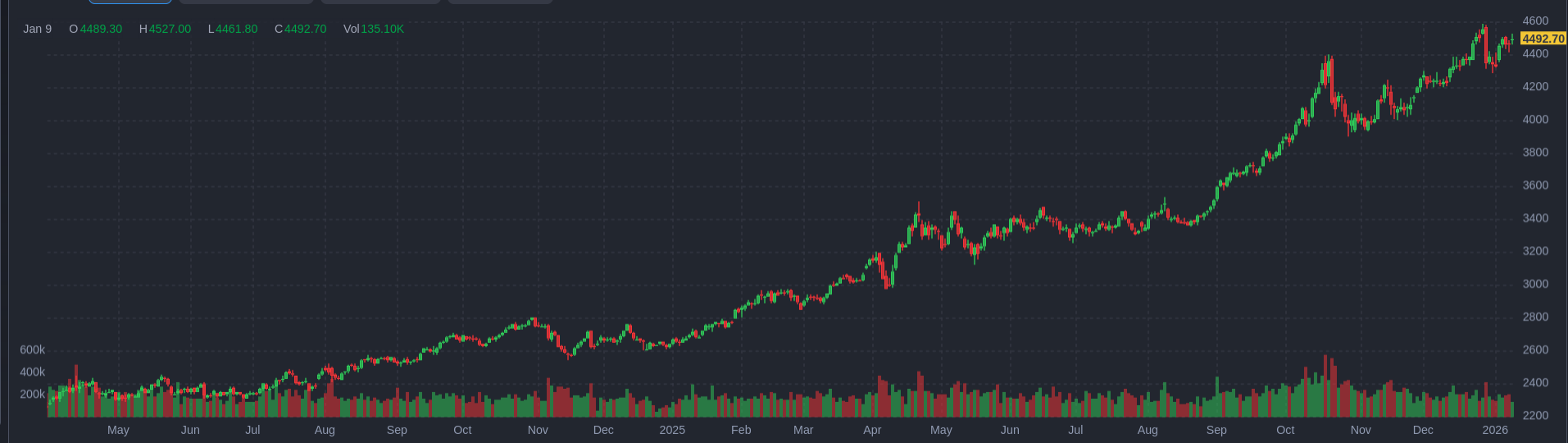
What would happen to the US if the dollar no longer occupied its current position? I think it matters how we get there. If we get there because of an orderly move to more balanced baskets of reserves, not much. But, if we get there because of dollar weaponization or severe inflation, that’s a different story. For one thing, we would be paying higher interest rates on US debt. If it’s an inflation story, both US and foreign bond holders would want higher interest payments. Somewhat less if it’s a weaponization story, but they still would want compensation for added risk. The dollar would fall in value as people demand less dollars. As a country that imports quite a bit of stuff, this would push inflation.

But I suspect the biggest change would be the world no longer has to “grin and bear it,” when the US does something they don’t like. On one side is a fall into policies that degrade the value of holding dollars On the other side is a fall into the world of inflation. Maybe it isn’t a tight rope. Maybe it’s more like a balance beam, with more room for error than I believe. But at the end of the day, the loss of the dollar’s special position would not make America great again.
The Quantum Job Market

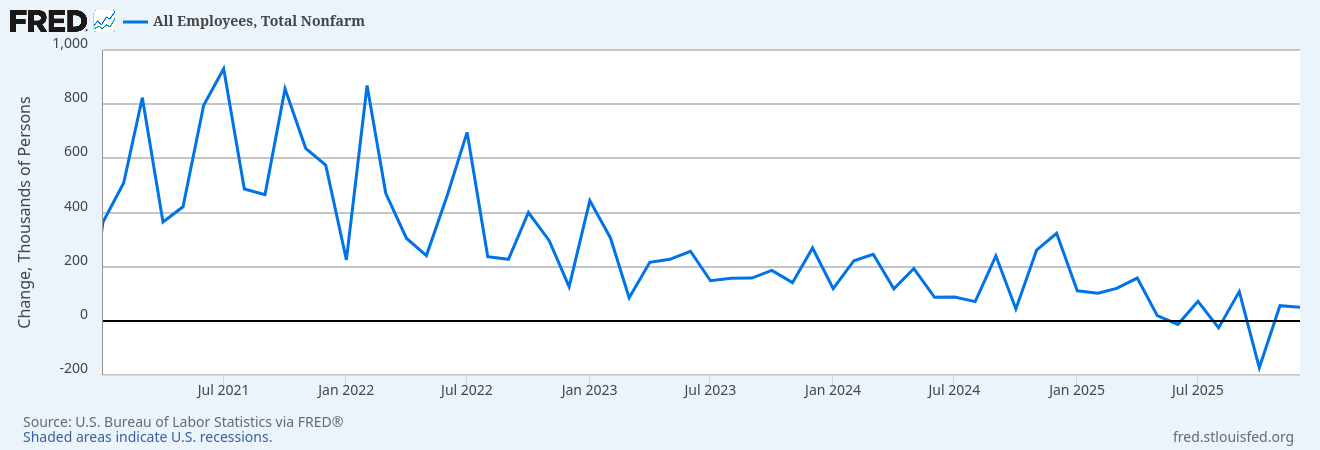
We have 3 numbers in fairly short order: JOLTS, first time claims, and the monthly jobs number. What do we have so far? The first time claims continue to come in well below ‘recession’ levels. From that number, the labor market looks tight. The JOLTS data, covered earlier, indicates a functioning labor market and not a great disconnect between people leaving jobs and people getting hired. And today we have the non-farm payrolls number. Let’s also add in the ADP number (which I do not think is as reliable as the payroll data). Both the payroll and the ADP number show a struggling labor market, according to historical metrics. Not a bad labor market, but a struggling labor market. Like most economic statistics, we care more about trends than the absolute number, but a non-farm payroll number indicative of a very healthy labor market would be above 150,000. Although it’s possible to get the occasional blip below 100,000.

Note the left hand side is the crazy period when the job market went nuts after COVID.

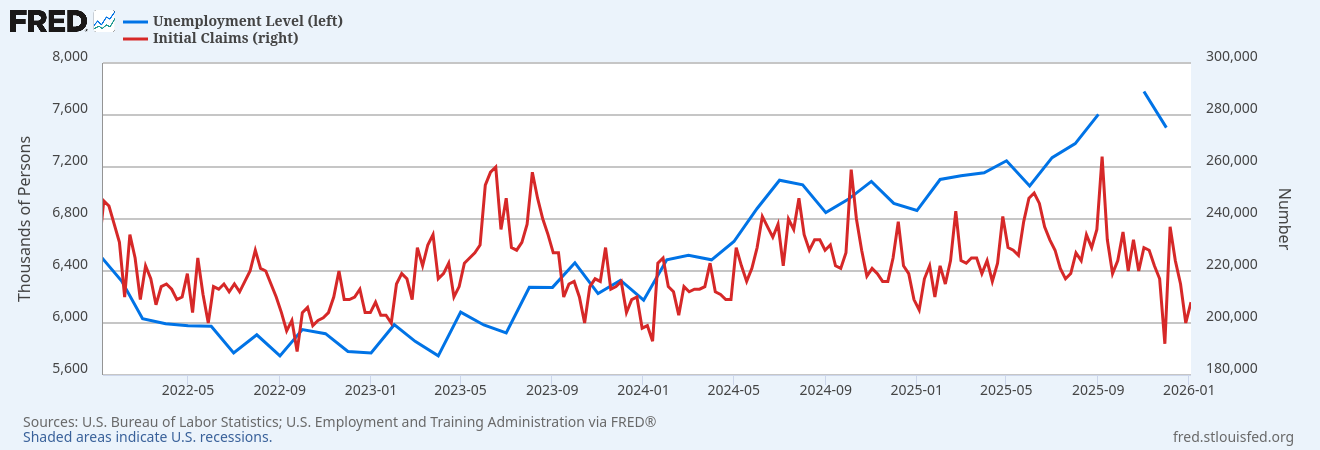
So far we’ve had about 160,000 jobs created over the last six months. That’s well below the number we need to absorb new entrants into the economy. The less reliable ADP number confirms the payroll data. The JOLTS data indicates a reasonable labor market and the first time climes show little job loss. This is where I think the first time claims may be under-reporting. If you lose your job, you might make slightly more money driving an Uber than collecting unemployment. I suspect other factors are depressing the actual number of people who would seek unemployment assistance. That’s not necessarily a bad thing, if you can make more money driving an Uber than collecting unemployment. You would be better off, even if you are grossly under-employed.

The red line represents initial unemployment claims, while the blue line is a survey of people looking for full time work.

This is why there is no magic single number, and no magic single sample of that number, that gives you a picture of the US economy. From the numbers, the labor market looks slack but not recessionary. It seems to back up the anecdotes of job hugging (where employers and employees may want to part ways but decide it’s better not to part ways right now), and new entrants having a difficult time finding a job. If it’s true that 70 million Americans engage in some kind of “gig” work, that’s nearly half the labor force (about 160 million participants). And maybe a weak jobs number isn’t as bad as it sounds if people can enter the gig economy instead of a “regular” job, and those people are under-counted. (Setting aside issues of job security, benefits, and the impact of under-employment). Is the labor market indicating recession?

There is something we need to acknowledge. Deficit spending is stimulative. At the end of the 2008 recession, there was a push-back on yet another democrat taxing and spending. And the stimulative policies were tempered by the resistance from republicans. (Although at levels that now seem quaint). That drew out the recovery period because fiscal policy was not injected into the problem. Spending more money than the amount removed through taxation stimulates activity and we may have ratcheted that up with the latest budget. We won’t know the final numbers until 2027. It will depend on actual receipts and actual outlays. There is some evidence the outlays will be higher than anticipated, with the DOGE effort showing an actual increase in government spending. If income tax receipts are weaker than offsets from tariffs, it could easily come in above estimates.

The current CBO estimates put the 2026 estimated deficit at 5.5% of GDP. The percentage of GDP is useful because it allows us to gauge what the real impact of the deficit, given the size of the economy. After all, a billion dollar deficit is a much bigger issue if the economy is only 10 billion dollars in size. The 2026 number may be above (likely) or below (unlikely) estimates given factors we won’t know until later. We won’t know until we actually see the impact of the new tax law, along with actual real spending.

The deficit coming down slows the economy in kind of a natural way, as activity boosts tax revenues and broader employment lowers spending on programs like SNAP and unemployment insurance. This natural brake pulls money out of the economy in higher tax revenues and lower spending, reducing the risk of the expansion becoming inflationary. However, we are doing two things that are expansionary for 2026, which are reducing tax rates and pushing the Fed to lower rates. In the face of already expansionary fiscal policy, this may push inflation for 2026. Unfortunately, it’s almost impossible to know the actual impact on inflation because we don’t know how the economy will react. The consumer in the lower 50% of income is in shambles. Most of the consumption is done by the top 20%, with half concentrated in the top 10%. There may not be the purchasing power for broad inflation, even if high end goods may see a level of inflation.

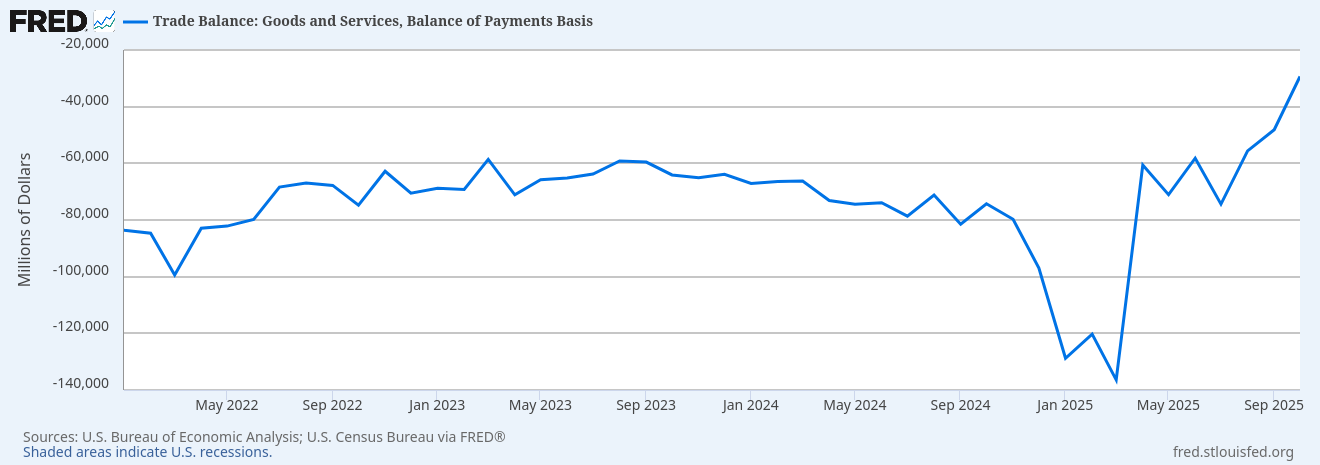
In addition, lower imports from tariffs boosts GDP, even if it means people are consuming less stuff. Could we be in a world where stagnation is masked as the GDP “increases” due to fewer imports? It’s mathematically possible. You could have patchy inflation depending on what goods you are measuring along with an improving GDP due to fewer imports. (You aren’t better off, you just don’t buy that sweater or bottle of wine, because it’s a little pricey). Combine this with jobs numbers being a less reliable measure of economic health (because workers don’t leverage unemployment insurance and transition to gig work), and you could have a stagnant economy, even if the numbers don’t look bad. You have low unemployment because of gig work and GDP growth from lower imports, even though you are under employed and just can’t afford things you used to buy.

Note that numbers are negative, so sloping up and right means the lower imports.

At the end of the day, the purpose of economics is to understand how these voluntary and sometimes emergent systems of interaction between people create well-being. The purpose of 2% inflation or a target of 4.5% unemployment isn’t because the number is important, but because the well-being of many people seems to change at around those inflection points. If inflation drops below 2%, that is usually because economic activity is slowing and over time we will be worse off. If it goes above 2%, that’s a level people feel it erodes their buying power and they are less well off. If unemployment is too low, there is inflation as wages are bid up, while if it is too high, people are out of work and can’t find jobs. The goal of the specific metric should be to indicate when a change in policy is necessary because people feel their well-being is falling.

But it feels like we’re too focused on the numbers, rather than what they mean. I can’t count how many times it feels like the number itself is the target or the policy is being gamed to meet the target number. This includes “patching up” numbers like the CPI so they under report inflation. (There is mixed evidence on this. But we would expect the CPI goods basket to change as the basket of goods and services from 1976 is less applicable in 2026). When the economy changes, the old metrics used to gauge the health of the economy no longer make sense. Following unemployment claims or number of jobs created, if people are shifting to gig work that isn’t reported through these numbers, may no longer provide a meaningful metric. And yet, we don’t have a widely accepted substitute. Like a quantum system isn’t in one state or another until it’s observed, our economy is both good and bad at the same time, because we lack the metrics to observe it.

My Porcine Aviation Era

I have not had great experiences with AI development tools. I’m not a Luddite, but if the tool takes me more time than just doing it by hand, and I get the same results, it’s not a tool I want to use. In some cases, the code had subtle bugs or logic little better than the naive implementation. Or in other cases, the code was not modular and well laid out. Or the autocomplete took more work to clean up than it saved in typing. And in some cases it would bring in dependencies, but the version numbers would date back from the early 2020s. They were out of date and didn’t match to current documentation. For the most part the code worked, but I knew if I accepted the code as is, I would open myself (or whoever followed me) to maintenance issues at some later date. One might argue that the AI would be much better then, and could do the yeoman’s work of making changes, but I wasn’t sold on that idea. (And I’m still skeptical).

I would turn on the AI features, use them for a while, but eventually turn them off. I found it helped me with libraries with which I wasn’t familiar. Give me a few working lines of code and a config to get me going, and I’ll fix it up. It would save me a search on the internet for an out-of-date Stack Overflow article, I guess. I used prompt files and tried to keep the requests narrow and focused. But sometimes, writing a hundred lines of markdown and a four sentence prompt to get a function, didn’t seem scalable.

Well, pigs are flying and I found something that appears to be working. First, it involves a specific product. At the time of writing Claude Opus/Sonnet 4.5 seem to be quite good. Second, I have a better way of incorporating prompt files in my workflow (more on that below). Third, language matters. I found Claude gave me the same problems listed above when working on a Jakarta EE code base. But Rust is great. (Rust also has the advantage of being strongly typed and eliminating some of the issues I’ve had when working with Python and LLMs). Fourth, I apply the advice about keeping changes small and focused. Fifth, I refactor the code to make it crisp and tight. (More on that below). Sixth, ask the LLM for a quick code review. (More on that below).

The first topic I’ll expand on is changing my relationship with prompt files. Instead of attempting to create prompt files for an existing code base, I started writing a prompt file for a brand new project. I had Claude generate a starter and then added my edits. I believe in design (at least enough to show you’ve thought about the problem). This actually dovetails with my need to think through the problem before coding. I still find writing prompt files for an existing code base tedious. But, if I have to sit down and think about my architecture and what pieces should do, the prompt file is as good a place as any.

The other thing I want to cover is refactoring what the LLM hath wrought. Claude generated serviceable code. It was on par with the examples provided for the Rust libraries I was using. (Which also happen to be very popular with plenty of on-line examples). Claude would have had access to rich training data and pulled in recent versions (although I had to help a little). But the code is not quite structured correctly. In this case I needed to move it out of the main function and into separate modules. But mostly it was cut and past and let the compiler tell me what’s broken. Next, in the refactor, is to minimize the publicly exposed elements. Now I have code that’s cohesive and loosely coupled. The LLM by itself does not do a great job at this. Taste is more a matter for meat minds than silicon minds at this stage.

The final thing I want to touch on is using the LLM to review the code after refactoring. This gives me another data point on the quality of my code and where I might have had blind spots during the refactoring. I work with lots of meat minds and we review each others’ code on every commit. There are some good reviews and there are some poor reviews. And reviewing code is harder, if you’re not familiar with the specific problem domain. But the machine can give a certain level of review prior to submitting the PR for team review.

So that’s what I’ve found works well so far: green-field projects, in highly popular frameworks and languages, performing design tasks in the prompt file, using LLM best practices, refactoring the code after it’s generated, and a code review before submitting the PR. Auto-complete is still off in the IDE. And I’ll see if this will scale well as code accumulates in the project. But for now, this seems to produce a product with which I am satisfied.

[A small addendum on the nature of invention and why I think this works].

Peoples’ ideas are not unique. As one of my relations by marriage pointed out years go, when he moved above 190th street in Manhattan, there seemed to be a sudden run to the tip of the island to find “affordable” housing. In a city of millions of people, even if very few people have the same idea at the same time, the demand quickly gobbles up the supply. Humans build ideas up mostly from the bits and pieces floating around in the ether. Even “revolutionary” ideas are often traced back to maybe a interesting recombination of existing ideas. Moreover, people have sometimes been doing that “revolutionary” thing before but didn’t connect it to some other need or didn’t bother repacking the idea. What’s more important about “ideas” is not the property of the idea but the execution of the idea.

There is still something about invention, even if it is largely derivative, that the LLMs don’t appear to posses. Nor do they have the ability to reason about problems from logical principles, as they are focused on the construction of language from statistical relationships. Some argue that enough statistics and you can approximate the logical reasoning as well as a human, but I haven’t seen solid examples to date. The LLM doesn’t understand what to create, but it does summarize all the relevant examples necessary to support the work of realizing the idea. But even then, there are gaps that we have to fill in with human intention. Does this revolutionize coding for me? No, I estimate it makes me some percentage more productive, but in the 5-15% range. And of the time and effort necessary to realize an idea, coding is maybe 1/3 or less of the effort. And I worry that we’ll never get to the point this technology will be available at a price point that makes the provider a profit while being affordable to most people. After all, there’s a limit to how much you would spend for a few percentage points of additional productivity.

This is Nuts

I’m not sure how the government will prevent private equity or other large investors from buying houses. This is a world-wide problem. Let’s say you bought a rental. You don’t hold it in your name. You form an LLC or corporation and that holds the property. That limits what people can collect to the holdings of the LLC or corporation. That limits any liability for claims to the corporation. Some people have a few rentals. In some cases they’re vacation rentals, which doesn’t directly impact the cost of housing for non-vacationers.

I’m not sure what the legal basis for this is. I’m also not sure how it solves the availability crisis. There is some evidence that landlords in places like New York will hold back inventory to keep rents high, and that software to help landlords estimate rents may serve as a defacto collusion between landlords, but I’m not sure what the concrete evidence is for Blackstone reducing affordability. In fact, this is a global phenomena, with unaffordable housing across Europe and Canada. But there is cheap housing, like the famous 1 euro homes in Italy or Ireland paying people to move to remote towns on their coastal islands. There are just no jobs there. And for all the ranting about left wing socialism, state control of investment decisions is right up there.

Is the Job Market Actually Good?

There is never just one number that gives you the whole economic picture. In some cases the number itself is bogus (CPI) and what we really care about is the change in the number over multiple periods. That’s why policy is rarely made on just one reading. As much as people are complaining about the job market, maybe the actual job market is still in good shape? Today we got the JOLTS (job openings and labor turnover survey) numbers for the last month.

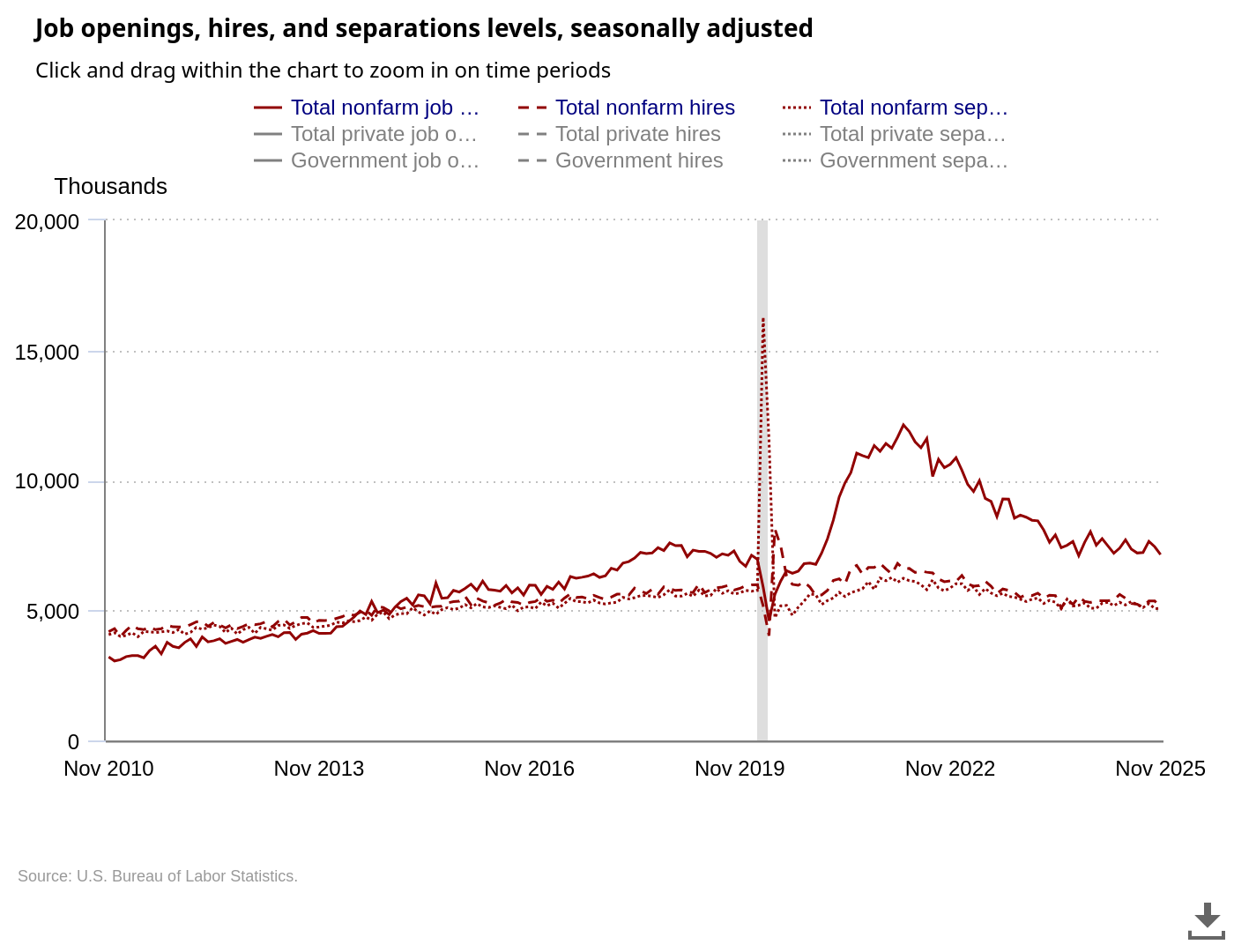
The chart from the BLS looks like it has a lot of openings, with the separations (layoffs and quits) slightly below hires. There is a giant grain of salt on the openings, in my humble opinion. There are a variety of reasons, but what I’ve seen personally are: 1) openings that are just trolling for resumes; 2) openings to justify H1-B visas; 3) ghost jobs; and 4) fishing.

The first are job openings that aren’t for ‘real’ jobs, they’re just to gather resumes from applicants. Who’s out there? What skills do they have? What are their compensation demands? Second are openings to justify H1-B visa requirements by demonstrating it can’t be filled by a current US worker. Third are the jobs posted to show a company is growing and exciting. And finally, they might get lucky and land a person that is way more qualified than they would normally be able to nab. I don’t trust the openings data to reveal important information, and instead I’m just going to focus on separations and hires over the last few months. The pandemic distorts the data.

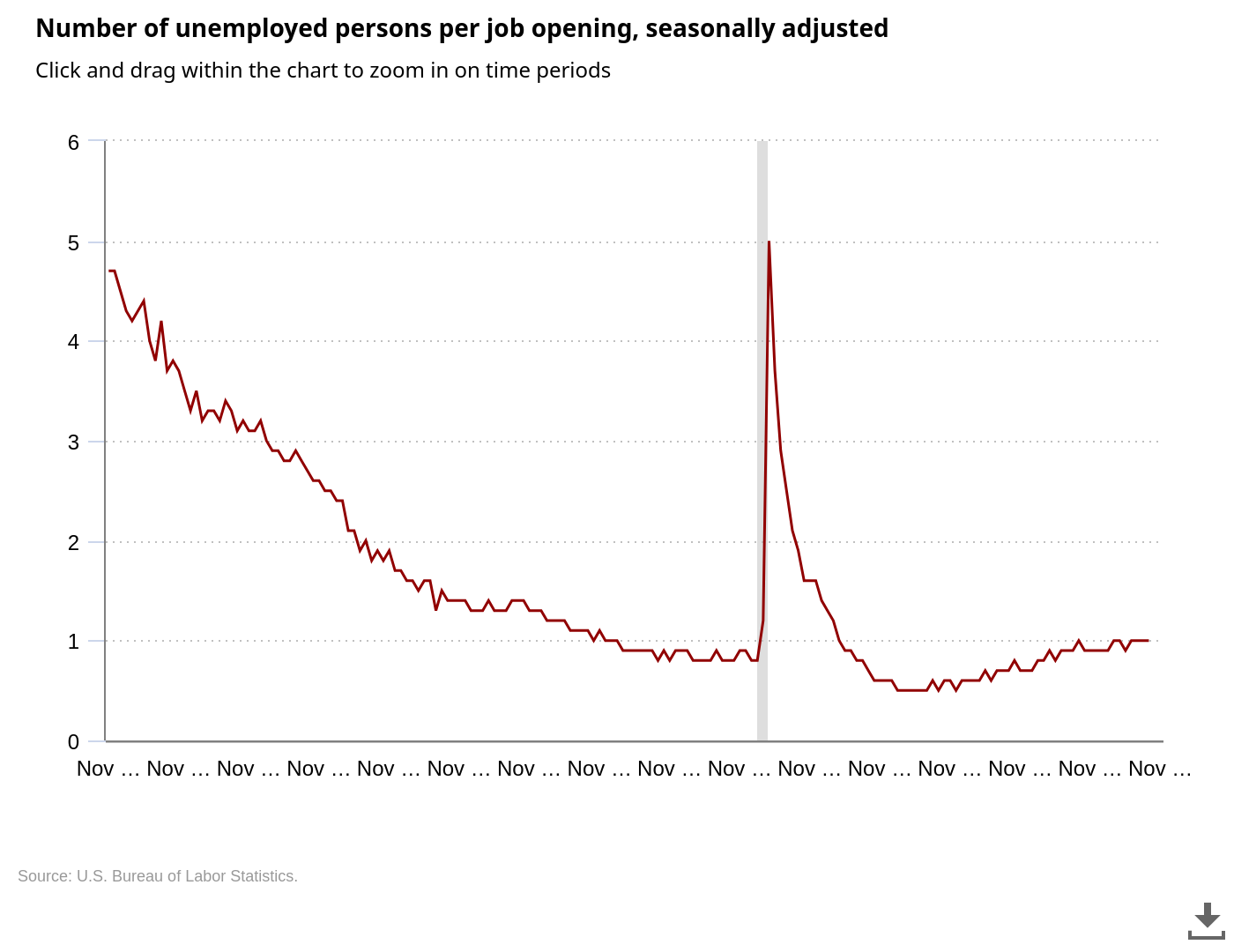
Here we see that both hires and separations are trending down. This would be consistent with the anecdotal stories of job hugging. Note that separations include both quits (which may often translate to an offsetting hire), and layoffs (which do not necessarily result in a hire). Looking at data from FRED, I suspect that quits have fallen off while layoffs are accelerating, but I haven’t done the math to validate that. However, we are pushing back toward more than one unemployed person per opening. And remembering my suspicion that a number of openings aren’t valid job openings, it means we are probably already more than 1 unemployed person per actual, real job openings.

Is the job market in good shape? I’m not sure it is, but I’m far from convinced it’s in bad shape. After all, it still appears we have slightly more hires than separations (which includes quits and layoffs). So if someone (on average) is getting hired when someone quits or is laid off, we are not in a bad state. And if we ignore the pandemic data, we see the number of unemployed people to open positions is much lower than the recovery after the 2008 recession. But we are certainly not in the post-pandemic world where we hit .7 unemployed people per opening. That was nuts. But if that’s all that you remember, and that’s your yardstick for the labor market, this middling to good labor market must seem like hell.