With the normal disclaimer that this does not constitute investment advice, it is provided purely for entertainment purposes, and contact a tax or investment professional before making any investment decisions, I’ll take a look at a stock.
Taking a look at Nvidia, we see the 50 day moving average peaked in December and has started a flat to modestly downward trend (yellow line is an eyeball of the trend). The price is approaching the 200 day moving average (orange circle). There is a floor around 170. So what events would I look at, from a technical perspective?
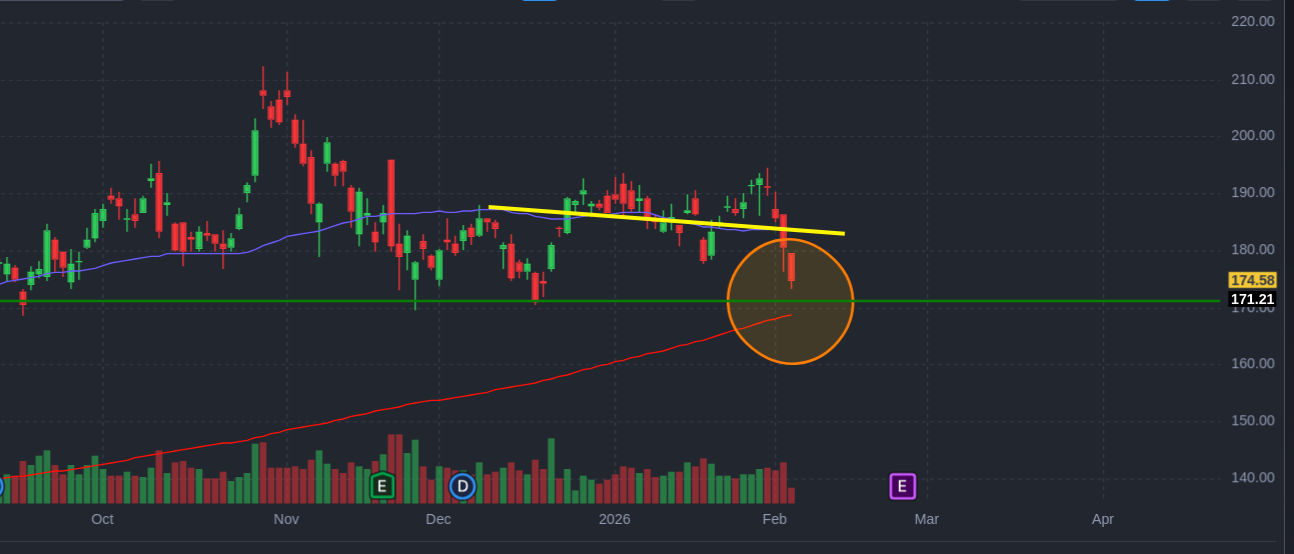
If the price drops below the support at 170, that is significant. In my thinking it’s more impactful than the price falling below the 200 day moving average. The 200 day average is going to continue to move up, even if the price declines, as it catches up to the historical price action. The violation of support that has been in place since September is more critical, in my opinion. As would as a steeper downward slope on the 50 day moving average.
Technical analysis isn’t just tea leaves for investment bros, if you look at it as a pattern of the expression of sentiment about a stock. What do we know about the broader context? For one thing, the current administration has shown a willingness to step in and make decisions that impact Nvidia’s sales. Second, the broader investment community is getting more concerned about circular deals. Third, investors are starting to ask where’s the beef on AI revenue. In the past, when the price has approached 170, buyers came in because they saw value in the stock. Above 190, more people did not see the value in the stock and sold. That range indicates people may be waiting for more information before making a move.

As we can see, all the revenue bump for Nvidia has been in AI accelerators. I’m assuming there’s a role for LLM style AI in the future. If anything, it makes sense for Microsoft to include it in Office to help with writing e-mails, writing Word docs, Spreadsheets, and Presentations. Likewise, Google’s office offerings would benefit. As would ad generation on Meta. The question is if the amount that needs to be spent in accelerators, data centers, and energy makes sense, given the revenue it produces. If it costs Meta $10 of cap-ex and $10 of lifetime energy costs to generate a lifetime revenue impact less than $20, it clearly doesn’t make sense.
What would happen to Nvidia if the GPU sales are cut in half. First, the multiple needs to come down because the expected future growth in sales is at a much lower sales volume. Let’s say it drops to 20 times earnings. Earnings are cut in half. That would mean a share price of around $45 for Nvidia. What does that do to the mag 7? Well, different parts of the Mag 7 are there for different reasons. Apple is not there because of AI sales. Microsoft, Amazon, Google, and Meta have AI exposure but won’t get destroyed. Tesla is a meme stock so this may not change anything for people who believe humanoid robots are a 10 trillion dollar TAM. But there are other stocks, like Oracle, Micron, and Broadcom that take a big gut-punch. (As is happening as I write this).
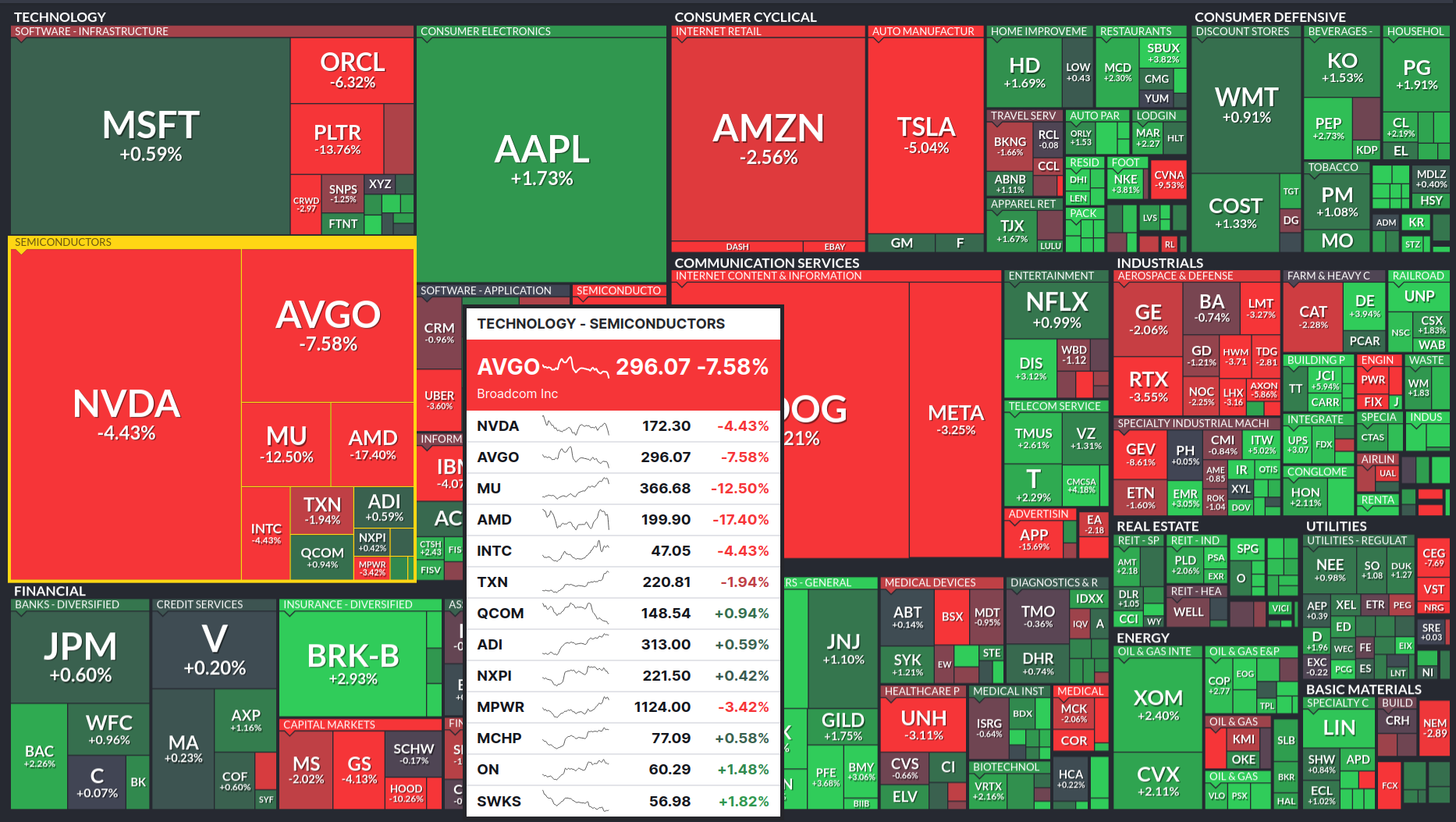
What may have an outsized impact is the wealth effect that’s given the top 10% to float half of all consumer spending. A drop in the Mag 7 would pull down the entire S&P 500. But it also flips psychology. It would also have an unquantifiable but negative impact on the private equity and banks that have lent money to AI startups and data center build outs. One estimate puts 20% of PE’s loan book on AI related loans. No bueno. Not to mention the hit to all sorts of venture funds and the investors in those funds.
Again, do your own research, consult a professional, this is only provided for entertainment purposes, and is not investment advice.
 I wish I was like you/easily amused