I can’t be arsed to watch Kid Rock. And it turns out what’s been panned as a half-baked alternate half-time show for religious fundamentalism meets misogynistic hedonism, wasn’t even live. What this has to do with the fact of the last four reads on consumer spending have been weak, will not be explained to your satisfaction. But I would say about a series of weaker than expected reads on consumer spending are notable. I would also say there’s no clear answer or indication from this number. No one at the Fed is wringing their hands over this (I hope). For meany reasons I’m bearish on the average consumer, but I think my belief is grounded in murky reality rather than just a fantasy I have great insight.
Which brings me to a meditation on the word “fantastic,” which today means “wonderful1” or “great.” But traditionally meant beyond belief. “That was the most fantastic story,” wouldn’t have meant it was a great story, but that it was wild and fully of unbelievable things. A fantasist is a person who lives in fantasies or promotes them as fact. Someone can be a fantasist can be a fantasist for several reasons. They may actual believe the ideas or not believe the fantastic ideas, and for a variety of reasons. They could range from a poor education to a calculated grift perpetrated on others who find the fantastic ideas alluring.
Which is why we always need to find a yard-stick of reality against which to measure the thing we believe or would like to believe. For example, that idea that Kid Rock has any mass appeal in 2026 and be compared with whether or not he sells albums and sells out large shows. He does not, and his listeners are mostly white younger Gen-X or older millennials. Whereas Bad Bunny (Malevolent Rabbit when he grows up?) has a clear, broad appeal.
Is the weak consumer fantastical thinking on my part? Looking at month over month consumer spending, for the last few months, I think the consumer is weaker than many expect. Profit warnings from consumer exposed companies like McDonalds and Pepsi reinforce this thinking. If we sum up the actual changes, month over month, for the last quarter, we get 0.6. The sum of the expected is 0.9, or about 2/3 of expected. That’s not a bright, flashing light saying the bottom is dropping out of the consumer market. Rather it’s an indication the bias of professionals is toward the upside.
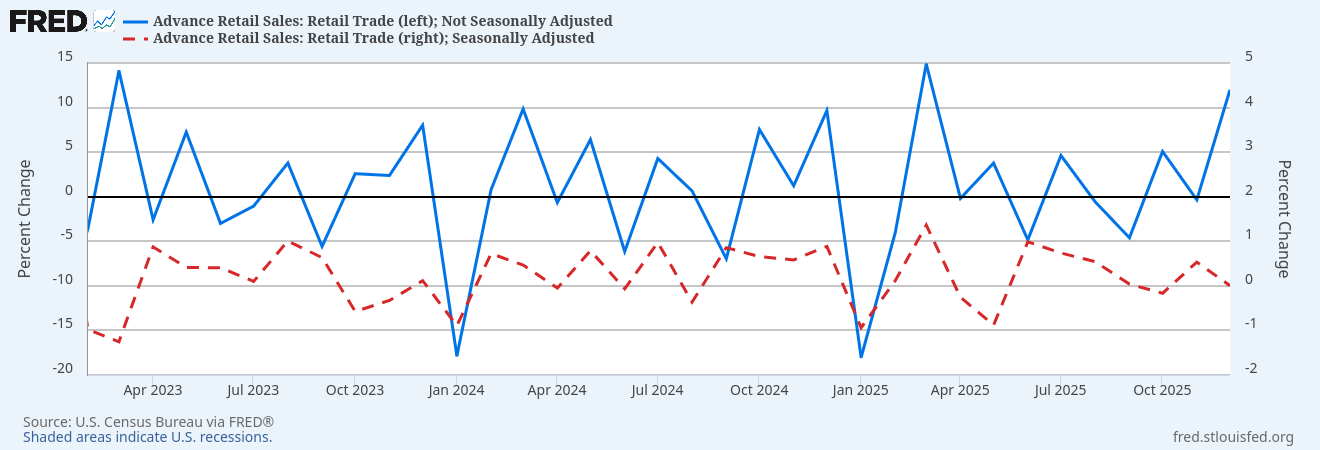
Note that it’s a really noisy number with a lot of seasonal adjustment. The line in blue is the unadjusted number, which can jump around from -17 or -18 percent to +15 percent. The axis for the adjusted number (in dashed red) is on the right, so it’s not “negative”, but it is visually below the unadjusted numbers. Picking three months out of a noisy number is not a great basis for making predictions (especially about the future). And companies like to lower the expectations bar so they can play the “let’s all surprise to the upside” game. Maybe Pepsi, Starbucks, McDonalds and so on are just trying to set a lower target to beat. I could be wrong about the consumer, but if I am it’s not because my thinking is fantastic. Rather I just see the tea leaves slightly differently.
There is a perma-bear grift economy (or perma-bull). On YouTube you can find plenty of “the consumer is collapsing, buy bitcoin now using my proven three step method” videos. Or a depression is coming, buy emergency food for your bunker pantry. I have to think the Venn diagram of people who think a broad audience would really want to watch the TP USA half time show and the people who would buy into a trading grift have a high degree of overlap. They don’t want to see the world as it is, but as they would like the world to be. I’m not happy the consumer is weakening, and I would rather live with broad prosperity, but I don’t think the numbers are lying. Maybe a little misleading, but something is up.
- As “wonderful” also once meant full of wonders or amazing things. A wunderkammer is a room full of amazing curiosities, like rare or beautiful specimens. ↩︎
 I wish I was like you/easily amused