The fun thing about the jobs report is re-interpreting it to better suit your political leanings. “Yes, but they’re not good jobs.” Estimates were in the 70k ballpark and the number came in at 130k. There was also slight wage inflation. This makes a rate cut less likely in the next few months, Warsh or no Warsh. The bulk of the jobs came in health care and education, with the government losing jobs. We’ve been assuming that the interest rates have been a drag on the jobs market but the economy may have adjusted to having any number other than zero as an interest rate. In fact, there’s a case for an interest rate increase in the coming year.
- The last mile on inflation is sticky, which may mean rates are not high enough.
- If the economy is expanding and pushing up wages at 3.5% funds rate, the neutral rate may be higher.
- Inflation may accelerate if GDP continues at its current clip and wage pressure continues to rise.
- Aggressive spending (like a 45% increase in the DoD budget) may fuel more inflation.
But here’s the thing. Don’t read too much into one report. Next month could surprise down by 50k. Who knows why – there are some long-standing data collection issues. The numbers will bounce around, especially as they get revised. There’s the table of year end revisions to the 2025 reports and it’s illuminating.
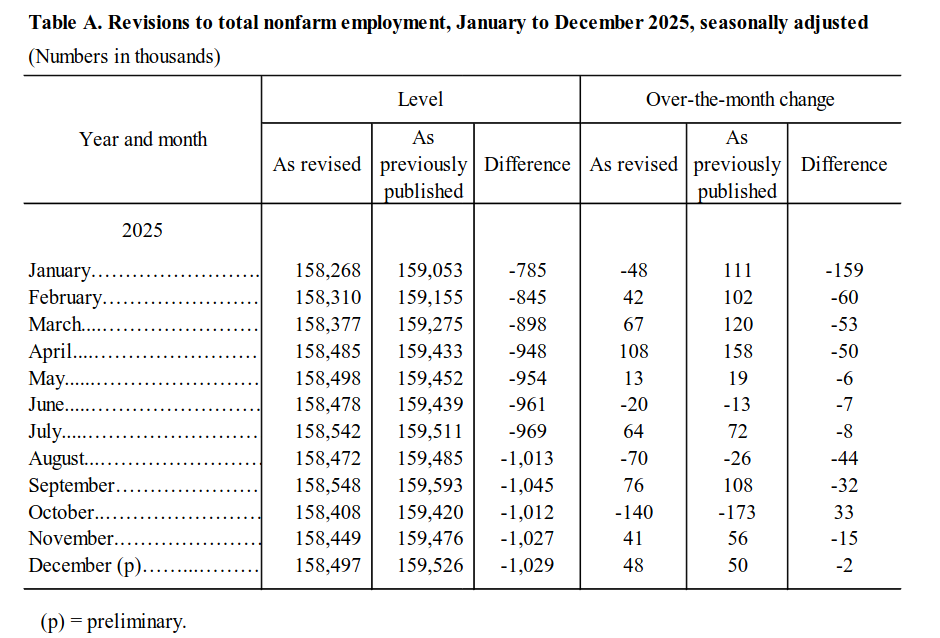
We created (revised) 181k jobs net last year. Maybe the yardstick of over 100k per month for a growing economy doesn’t make sense in a country that may start to experience population declines (as we shut off the immigration flows). That’s been the number I’ve used to evaluate jobs reports, but net migration to the US (by policy) is intended to be zero. We’re not fucking enough to make enough new kids. In fact, if the population isn’t growing, and it’s just aging. Wouldn’t slight job losses, but more jobs concentrated in healthcare, be a good jobs report? Maybe the yardstick should be net zero jobs near full employment? And only shrinking and growing during recession or post-recession recovery?
As I think about this, I start to think about the elasticity of wages with respect to growth. Once we push up against full employment, wages need to rise to get more workers into the job market. How much do wages need to rise once we get more workers into the job market? If we go from 4.3% unemployment to 4% unemployment (very low, historically), do we see wages shoot up enough to drive inflation? But if we get not much more slack than 4.5%, do we see wages falling? That would suggest wages are inelastic with respect to employment near full employment. I suspect the same isn’t true in a recession, if unemployment spikes to 7% or 8%, and much smaller (if any) increase in wages are needed to bring down unemployment. We go from having a Philips curve to a Philips hockey-stick.
It also has some implications on growth. A shrinking population suggests that growth that’s slightly too fast results in inflation. With a growing population, part of growth simply goes to absorbing new workers. You need to grow, otherwise you quickly accumulate large masses of unemployed people. And I suspect it favors younger, less experienced workers, as you can hire more of them to replace older workers. They are cheaper and plenty of them. But what if a shrinking population size makes you risk averse, preferring to stay with proven workers rather than bringing in new, lower return, unproven workers from a smaller (and therefore not much cheaper) pool? Maybe that’s why Europe has had a persistent youth unemployment problem?
Hear me out on this brain fart. In a fixed population (or shrinking population), you basically trade one worker for another. When Bob retires, Alice steps in. You knew what to expect with Bob. Bob was very well trained. In Bob’s cohort, unemployment is like 2%. To balance that, in Alice’s cohort, unemployment needs to be higher, say 10%, so on average, we have that magic non-inflationary level of unemployment. But Bob is old and Alice is young. Alice would be much cheaper, if we had a larger pool of Alices than Bobs.
But there aren’t a ton of Alices sitting at home, vaping and playing Call of Duty. Alice is a risk. You could bring in Alice, train Alice, and then lose Alice as she’s offered a better job by your competitor. In addition to the fact you need (say) 1.5 Alices to equal one Bob until Alice gets a few years of experience. Whereas they are not likely to poach Bob, and Bob would probably not get a better deal if he moved. You have an incentive to hold on to Bob and only hire Alice, if Bob leaves. And if one Bob leaves, a slightly younger Bob would be preferable.
Once Alice’s cohort comes into jobs, their unemployment also drops to some low number. But in order for that to work, the unemployment among new workers has to stay fairly high. Maybe I just made a realization labor economists have known for years. In any case, I think we’re going to have to get used to flat jobs reports and more of our workforce moving into healthcare. Otherwise you wind up with inflation pressure and Boomers dying on the side of the road.
 I wish I was like you/easily amused