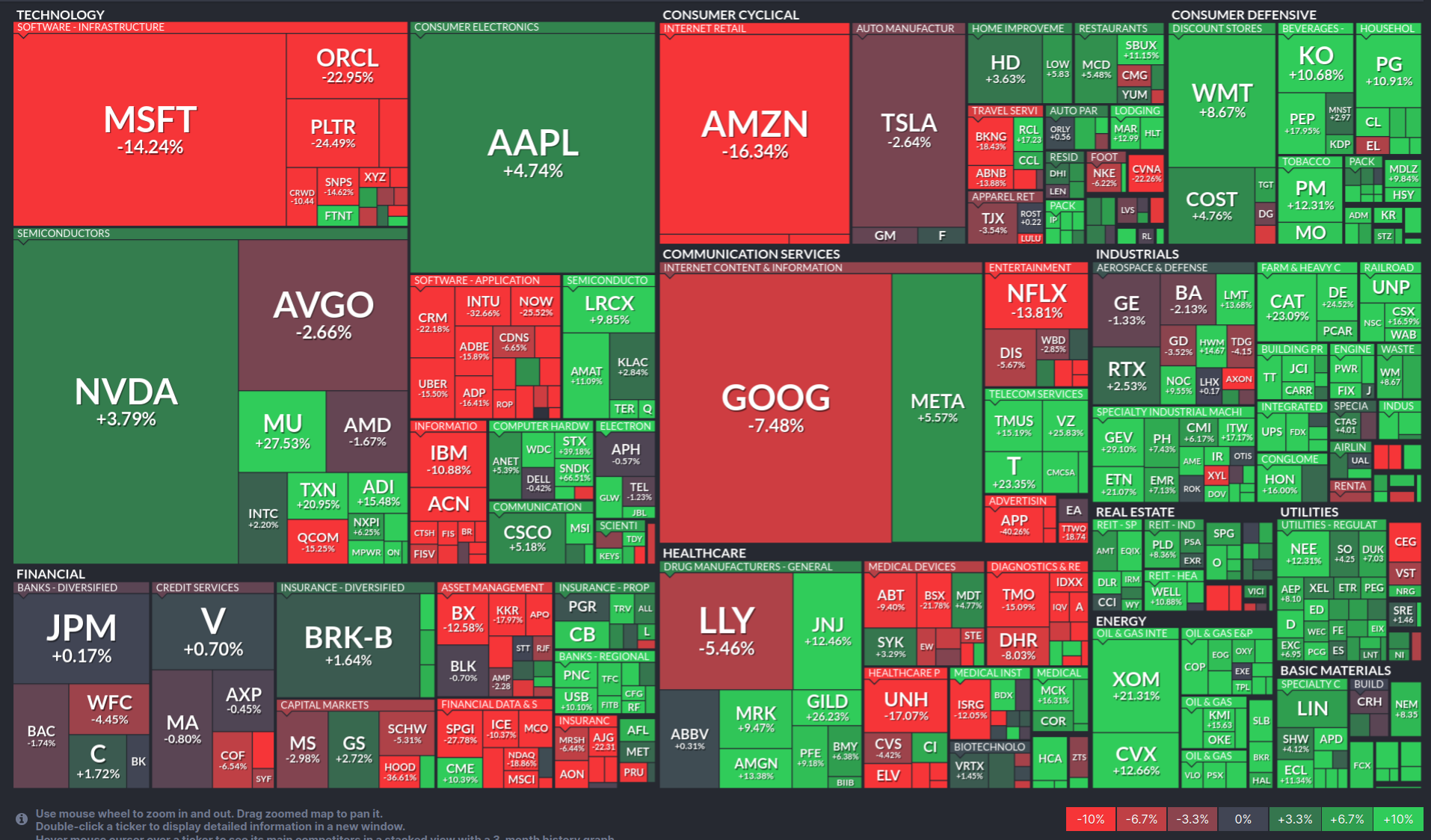
Looking at the 1 month S&P 500 performance, we see money coming out of Software on the left side and heading to the right side into defensives, industrials, real estate, utilities, basic materials, and pharma. It’s coming out of software and hyper-scale cloud operators.
Is Oracle a software company? Meh… sort of? They make more money from infrastructure like clouds and data center builds than they do from software. Remember when they sold databases? They’re racking up debt to build data centers. A pullback in AI would likely be an event that kicks them into re-organization, as they restructure that debt. The cost of insuring their debt has risen as people are getting worried the data center boom is unnecessary and circular.
Proper software is getting hammered because people think you’ll just query the AI for stuff. Except I don’t want a hallucination when I ask a tax question. Or, if the software makers offer AI assistance, it will be a cost they face but not a differentiator. Companies will have to add that support and pay for the service, but it’s because everyone else has it.
There’s greater concern that the investments made by the hyper-scalers will ever come back in terms of revenue. Rather than paving a road to a bright new future, a good portion of a 200 billion dollar capex spend may just be lighting cash on fire. But if they don’t, they will get left behind. If you look at the chart of the S&P 500, you see for the last month or so, it’s flat. Suggesting new money isn’t moving in, but money is just sloshing around.
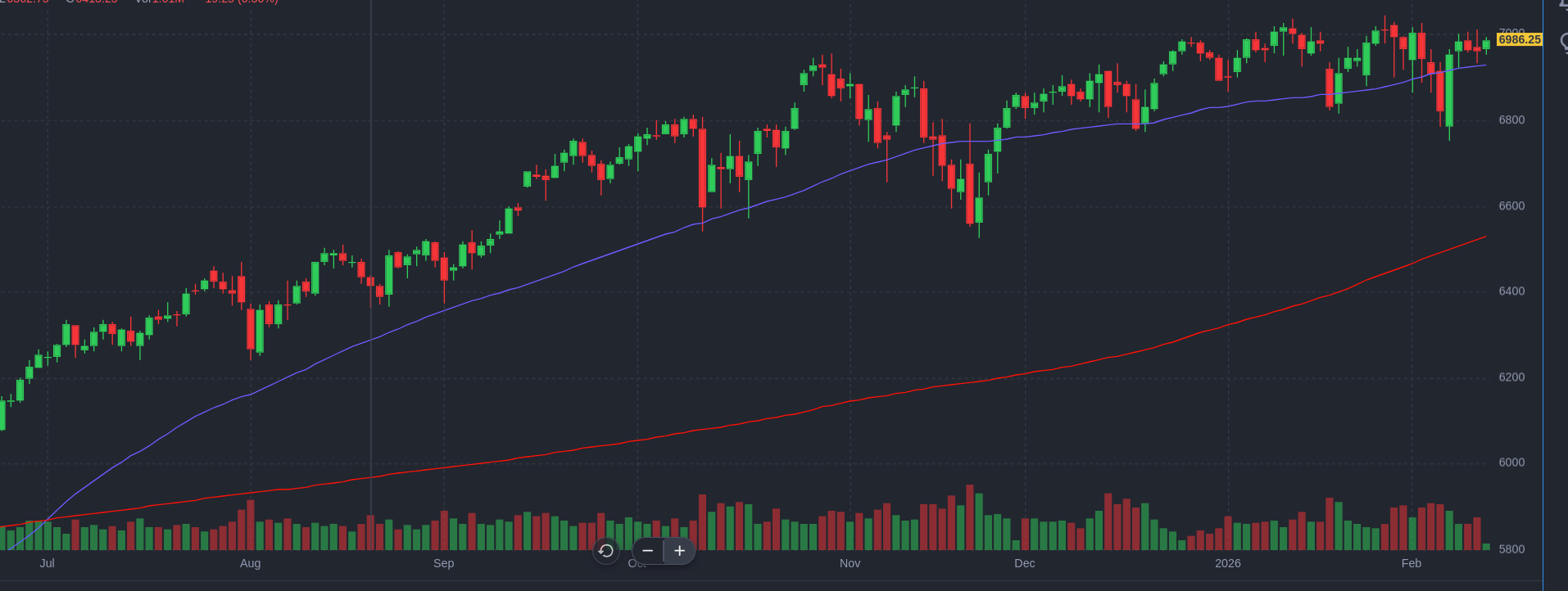
But what I’m not seeing is a clear message, other than the ball of money looking for someplace else to wallow. A rotation away from growth (like technology) to defensive sectors (like consumer staples), indicates a belief the economy is due for a pullback. You focus on the things people have to buy, rather than the things businesses buy or are optional.
But, if you take a look at consumer discretionary, and remove Tesla1 and Amazon, you see people are buying both counter and pro-cyclical segments. At the same time they’re buying energy producers (pro-cyclical), they’re also buying utilities (counter-cyclical). People and businesses use less gas and other energy during a pull back, while they still have to keep the lights on. It’s not a thesis about the health of the economy, but rather just a re-jiggering of their portfolios.
And while the “vibes” aren’t great, the numbers don’t indicate an imminent collapse. Yes, the jobs numbers for all of last year were low, but the available workforce did not grow that much. There were about 1.7 million new people in America (0.5% growth all from immigration), and assuming they have the same labor participation rate as the broad population, you only needed to create about a million new jobs at the high side (because we’re also aging). We created about 181,000 jobs (20% of that number), but guys in front of a home depot don’t show up in the jobs number. So the economy is probably doing somewhere between “okay” and “well,” with some sticky inflation.
There will come a point where the large areas in the heat map transfer money to smaller areas, bringing up their “multiples,” or the price of the company. It won’t be based on earnings, but rather because you’re trying to fit a big wad of money in a smaller place. It feels like if we had less money sloshing around, we wouldn’t get ridiculous valuations. And maybe the relief value for all this is money moves overseas, pushing the dollar down and other currencies up. But I’m just guessing. My crystal ball is at the shop.
And this is not investing or investment advice to you, or anyone. It’s is provided for your entertainment purposes only. And if you are investing, contact a professional before making any decisions. Buying and selling stocks, futures, or any investment is a risky activity and can cause you to lose money, including the principal which you invest.
- Every time someone makes the case for Tesla, I become ever more convinced it’s either a meme stock or a religious conviction. But it’s not based on their actual revenue. ↩︎
 I wish I was like you/easily amused