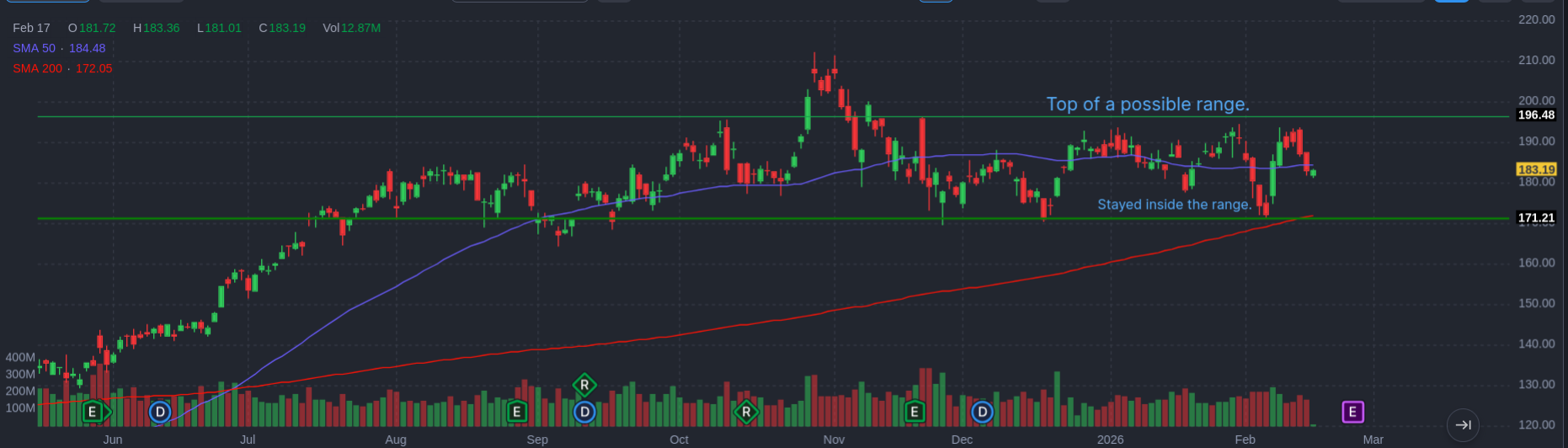
NVDA is going to announce earnings on Feb. 25. Like everyone else, I think I’m more interested in the forward guidance on sales than sales over the last quarter. I think we’re all looking for an indication of any pull-back in AI capex spending. This would not just be an issue for Nvidia, but also for companies ranging from turbine generator suppliers to utility and real estate companies. Looking at current levels for the NASDAQ, the recent high was about 26,000. A historically normal bear market pull back takes us to just under 21,000. That’s at the bottom end of a congestion area from last December. The S&P 500’s recent high was just above 7,000, meaning it’s 20% retracement is in the 5,600 ballpark.
The difference between a regular bear market pullback, that cleans out some of the deadwood, and something bigger is only visible in the rear view mirror. When the stock market started dipping before the GFC, a lot of people thought this is just about clearing some deadwood from the system. Once it’s done, the infinite money glitch will restart. Jim Cramer gets a lot of shit for the “Buy Bear Stearns” call just before it went tits up. But he wasn’t the only one who genuinely believed Bear Stearns was in a bind but would find its way out. In part because they didn’t have all the information necessary to make that call. They did not know what Bear and its counter-parties knew. They have opinions on dozens of individual stocks and are not specialists who follow just one company. As Bear kept dipping, they thought it was time to buy. The bias sell side analysts have toward buying just made them look that much dopier when it happened.
Contrast what happened with the sharp pullback and return during the start of the COVID lockdown. The S&P 500 went from almost 3,400 to 2,200, well over 20% and came back fairly quickly. In six months it was pushing new highs as we sat around swimming pools, masks on, glaring at the neighbor jogging by without their mask. Okay, that was one stock versus a whole market, but after the 1929 crash, the stock market came back in what’s called a bull trap. Price came back, people bought in, and then resumed their slide. In fact, the prices came back to nearly the 1929 top.
I don’t know, Jim Cramer doesn’t know, and no one knows if Nvidia’s earnings announcement will cause investors to double down, pull back, or continue to waffle in the trading range. Or pull back for a couple of months, come down 20%, and then come back. As Yogi Berra said, predictions are hard, especially about the future.
But it’s good to clear out the deadwood. For example, the zero days till expiration options trading may be contributing nothing more than volume, income for brokers, and some volatility. I would say it would be nice to wash those folks out of the market, but I suspect a majority are not professional traders. They think they are, but they’re just gambling on whatever free broker they’re using. It would also be nice to nip the prediction markets betting on the market in the bud. But again, that’s not done by people whose wealth moves by six or seven figures on a daily basis. It’s done by people who can’t replace their fridge, if it breaks.
But then again, other than time horizon and belief, what makes someone betting Tesla will move up at least half a percent today, different from me? I have a longer timeline. And for the last 100 years, we’ve seen the US economy grow and wealth accumulate in assets like stocks. Over a long enough time-line (with an important asterisk there about when you buy in and when you cash out), people have generally done well. But we wouldn’t be the first example of a country killing its golden goose for the dumbest of reasons. London has played second fiddle to New York for some time, but Brexit has accelerated its trajectory into irrelevance. Now, its best financial innovation is possibly loosening laws to become more like Dubai, where it’s anything goes (including fraud). Once, even after the US economy eclipsed the British Empire, London was the financial and insurance center of the world.
At some point, the hyper-scalers will need to stop buying Nvidia hardware unless they figure out profits from AI. The market is already giving Google, Amazon, and Microsoft the side eye for heavy capital spending to support AI. The punishment by the street for not investing in AI might be worse right now. But at some point, if AI isn’t making real money (and not just redeeming credits issued in exchange for ownership in Open AI or Anthropic), money spent on AI chips or data centers would be better used to buy back stock. At that point Pinchai, Nadella, and Jassy might decide to stop advertising their AI capex spend, as it would be driving down the stock, and focus on “core competency.” They will pivot by laying off a bunch of people and fucking over a bunch of contractors who anticipated the completion of additional data centers. Oh well. Somewhere between now and that possibly distant future, I expect to break Nvidia to break down from its trading range. Unless it doesn’t.
This is not investing or investment advice to you, or anyone. It’s is provided for your entertainment purposes only. And if you are investing, contact a professional before making any decisions. Buying and selling stocks, futures, or any investment is a risky activity and can cause you to lose money, including the principal which you invest.
 I wish I was like you/easily amused