PART I – TEA LEAVES
There is a giant problem with trading, and that’s exogenous events. A piece of bad or good news (like a super-strong or super-weak jobs number) create their own instability. Sometimes these blips represent buying opportunities. The initial reaction is almost always to read too much into one reading, which may get revised in a future month. I’m not suggesting you do that, but rather don’t retire early or panic because of one number. The bigger problem are singular events that come of the blue (or nearly out of the blue) and create lasting impacts in the system. These are hard to model and can blow up your ideas pretty quickly. So, what’s my thinking on the Iran war… I mean incursion… whatever. Normally these events happen, they change things, and we move on. But now we’re stuck in limbo.
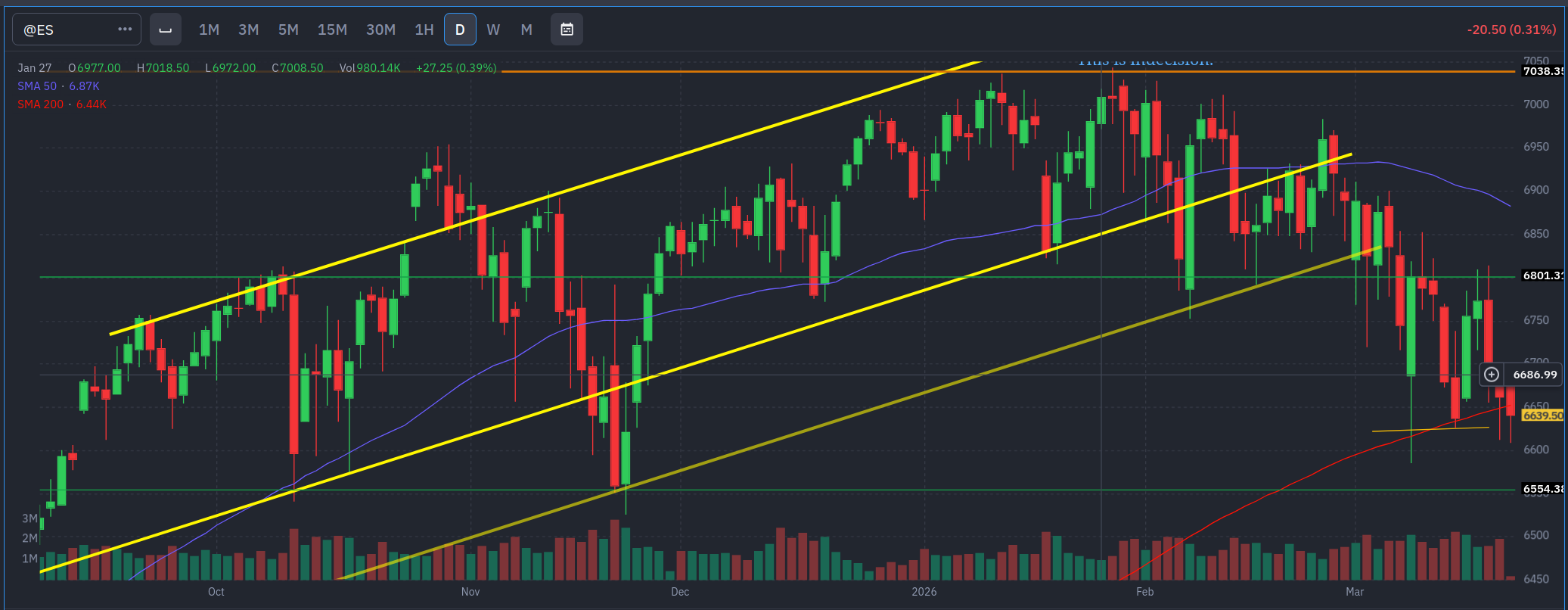
My first take, back in February, on the S&P 500 was we were in a trend channel. I drew the original channel as the bright yellow lines sometime in lat 2025. These are not exact but, when we get to the top of the channel, buyers tend to lose enthusiasm and they come back when we’re toward the bottom of the channel. it’s okay when drawing these lines not to include all the price action and to move them so they capture the majority of the price action. It’s also okay to re-draw them as the evolve. They represent rules of thumb as to when investors think it’s gone to far up or dropped too low. Although I had serious concerns about the labor market and the concentration in the Mag 7, the chart is telling me the rest of the market did not.
Then, the S&P 500 failed to make a higher high in February, which is when I added the orange (brown) line signalling resistance. That was at the end of January, when we get to 7,000 and then back off. However, selling seemed to crap out as well, with buyers stepping in around 6,800, so we have a support line in green. Now we’ve transitioned from an upward trend channel to a likely range between 6,800 and 7,000. There’s no evidence on the chart we’ve reversed trends. In February I didn’t now if this was a double-top (possible) or just consolidation after many consecutive months of upward travel. I tend to be more pessimistic, so I thought we might be rolling over. But the support line was holding through February. That’s the chart telling me the market wasn’t ready for a pull-back.
We have Schrodinger’s labor market, which is doing okay or poorly depending on when you look at it. Through February we’re just wandering around in the range. I attribute this period of indecision to the mixed number we’re getting and the first pangs of worry about AI build-out costs. The Fed doesn’t have to lower rates if the job market is doing well and the “last mile” on inflation is proving to be sticky. The inflation from tariffs hasn’t materialized in the way I anticipated (and I think others as well). But there are reasons why it may be working its way through the system. Therefore rates aren’t going to go up, but the likelihood of a cut is very low. These mixed messages makes a side-ways period seem completely logical. And barring any big change…
We attack on the 3rd, but the S&P stays in a range until March 6. At that point the attacks have gone long enough that it dawns on investors it won’t be just a series of air strikes. With oil going up, we drop out of the range. Now, that support at 6,800 tends to act as resistance. I’m not sure why that happens more often then not, but it’s a decent rule of thumb. Then I add a little line, marking what might be a new level of support around 6,600, where buyers seem to show up. I don’t think this will hold, but I’m watching it.
What does a chart do for me? It helps me understand market psychology. Every day the beliefs of millions of investors are reflected in the market prices. Some are doing nothing more than buying index funds in their 401(k) accounts. Some are gambling on 0 days to expiration options contracts. But their collective behavior comes together to set a price. I don’t expect a pattern to “play out” just because I see it forming. I expect to see the market behave and if I match it to a common pattern, anticipate what buying and selling pressures may be coming int he future. Some call it horoscopes for bros, but only if you treat (mistakenly) the pattern as constraining or predicting the future. All it tells me, is where the buying and selling pressure may lie. And if I can correlate that to other data, maybe get a better interpretation of how that information is moving the markets.
PART II – POLITICAL ECONOMY
I personally think that the Iran war isn’t going the way the Administration hoped. I think they expected the regime to be much weaker than it actually is and that US popular opinion would rally around the strikes. When the line at 6,600 continued to provide support at the outset of the war, I took it to mean that other investors also thought this might be over in a day or two. In my mind, and likely in the minds of others, that made this a buying opportunity, which is why the support worked. It’s only until we got signals this war… incursion… might last for longer, do we start to make new plans.
The problem with is there is no clear goal. And every day it drags on is another day that Iran can adapt to US tactics. Or Russia could smuggle in some shoulder-launched anti-air missiles (ManPADs). Or Iran gets super lucky and manages to seriously damage a US warship. Or we wind up with a bunch of Marines on the ground that can’t safely leave until hostilities cease, which this administration won’t do until Iran “surrenders.1” It could be over tomorrow or a year from now. We just don’t know because we don’t know what we hope to achieve by being there. And every day of elevated oil prices is a day that both stokes inflation and dampens economic activity.
Are we looking at a buying opportunity, which it would be if hostilities cease quickly. The less damage to oil production, the faster fuel prices will move lower. I’m not an oil expert, but what I’ve read indicates that fields that stop production may take weeks or months to return to their full output. And the longer they’re stopped, the longer it takes to turn them on. And the more they’re bombed, the longer it will take to repair those fields. As I understand it, a one day interruption is no big deal. A one week interruption will leave a mark. Longer periods require a degree of rebuilding. But I don’t know that it will cease today, tomorrow, or next week.
It could be this drags on for many months. Especially if Russia is able to supply Iran with weapons. Fortunately, Russia is bogged down in Ukraine and can’t spare the materiel. China could covertly send arms, with the intention of creating a quagmire to pin down the US. They targeted 2027 as their “readiness” date for Taiwan, but this might present a unique opportunity, especially if they damage enough F-35s (which take months to repair). North Korea might want to arm Iran, but I’m not sure how they get arms there. The Houthis might start firing missiles again. But who knows? Shaheds are easy to make and the launcher isn’t much more than a couple of hours of welding tube steel, according to many sources. In addition to the fact many regional governments are easily bribed to look the other way while Iran smuggles in Western electronics for the Shaheds.
In fact, the weakness this ware demonstrates is the inability of the US to spin up production of key munitions. The excuse “we gave it to Ukraine,” is mostly bullshit as we gave older, sometimes about to be de-commissioned, equipment to Ukraine. And we didn’t have to pay to properly dispose of it, as the side of a Russian tank is a fine disposal sight. All China needs to do in a fight for Taiwan is to make through an initial period and then our destroyers are running home to port, to reload their vertical launch tubes (which we can no longer do at sea). And once the current stockpile is gone, new rounds only trickle in. And airplanes that are either lost permanently, as we no longer make that air frame, or take months of painstaking care to repair their stealth exteriors. In some cases it will take years for production to restart on a key munition.
War fighting aside, what do I do? Buying opportunity, prep for recession, or prep for stagflation. Who knows? Each one is essentially unpredictable. I’m mostly sticking tight, but I’m picking up some ex-US funds here and there. Mostly because this is likely to cause even further damage with our allies. Who we don’t need, but should totally come and help us out? Not sure how that works, especially since we did not consult with them and the energy costs are hitting Europe harder. That makes the long-term prospects for the dollar less bright, which is also what the administration wants. However, people did seem to buy dollars as a safe haven, as gold did not jump, and money moved out of the Euro. But if they did buy anything, it had to be short term debt, because the longer term yields are rising.
Also, I’m not seeing positive trends in US politics. The Republicans have largely abandoned rule of law at a broad, constitutional level. An extra-legal, internal power struggle will have lasting, permanent damage to the US economy and the status of the US as an economic engine. I don’t mean revolution, I just mean it’s decided outside legal norms with protests to force action and lawsuits to compel following the law. If there is a serious attempt to suppress voting, or invalidate entire House and Senate races, US politics could be seriously broken. Countries lend money to the US and people come here to start businesses because the US has been a rule of law country with business friendly policies. If that reputation is seriously damaged, the US ceases to be the cleanest shirt in the laundry. And that has implications for US interest rates, the dollar, and future US growth.
That would mean a defensive short term horizon, even though short term bonds are not paying enough to cover taxes and inflation. Long term bonds would loose even more value, as long rates move up. That will depress economic activity, especially if the dollar isn’t as valuable and fails to appreciate, given the higher rates. Nothing meaningful is being done on the deficit, and if the economy slips into a recession, we could exceed 7% of GDP in deficit spending. That limits the ability of the US to stimulate the economy other than to reduce rates. That will drive up asset prices (good for stocks) but will be fighting the higher rates implied by higher inflation and more instability. That might mean the Fed as to perform non open-market actions, such as buying securities or injecting money through the repo markets. Liquidity actions tend to be inflationary.
Sitting in cash through money-market accounts doesn’t look so bad until you consider the inflation risk if the Warsh Fed decides to lower rates and that stokes inflation. You would do better than stuffing it in your mattress, but it’s likely you would not keep pace with inflation. And your purchasing power would erode. If interest rates are low, that’s going to inflate the value of assets, like land. Housing prices would stop their slow slide and start going up again. However, holding and buying land requires a rule of law country. If you don’t have that, how can you be sure your claim to a piece of land would be honored. REITs with deep pockets would be the way to mitigate that risk, as they would be better connected to make any necessary bribes.
Wow, as I work through it, this is what I think investing as a citizen of a country like Argentina must look like. The investing world outside the US is starting to look better than the options inside the US. Just like many countries find their internal markets are not as lucrative as external markets. If only we’d had a long tradition of being a rule of law country we could fall back on…
This is not investing or investment advice to you, or anyone. It’s is provided for your entertainment purposes only. And if you are investing, contact a professional before making any decisions. Buying and selling stocks, futures, or any investment is a risky activity and can cause you to lose money, including the principal which you invest.
- I genuinely think they don’t understand what this means. I think they say “unconditional surrender” because it sounds cool at that’s what we did in what they thin of as the mega-awesome WWII. ↩︎
 I wish I was like you/easily amused