Will the US Strike Iran?

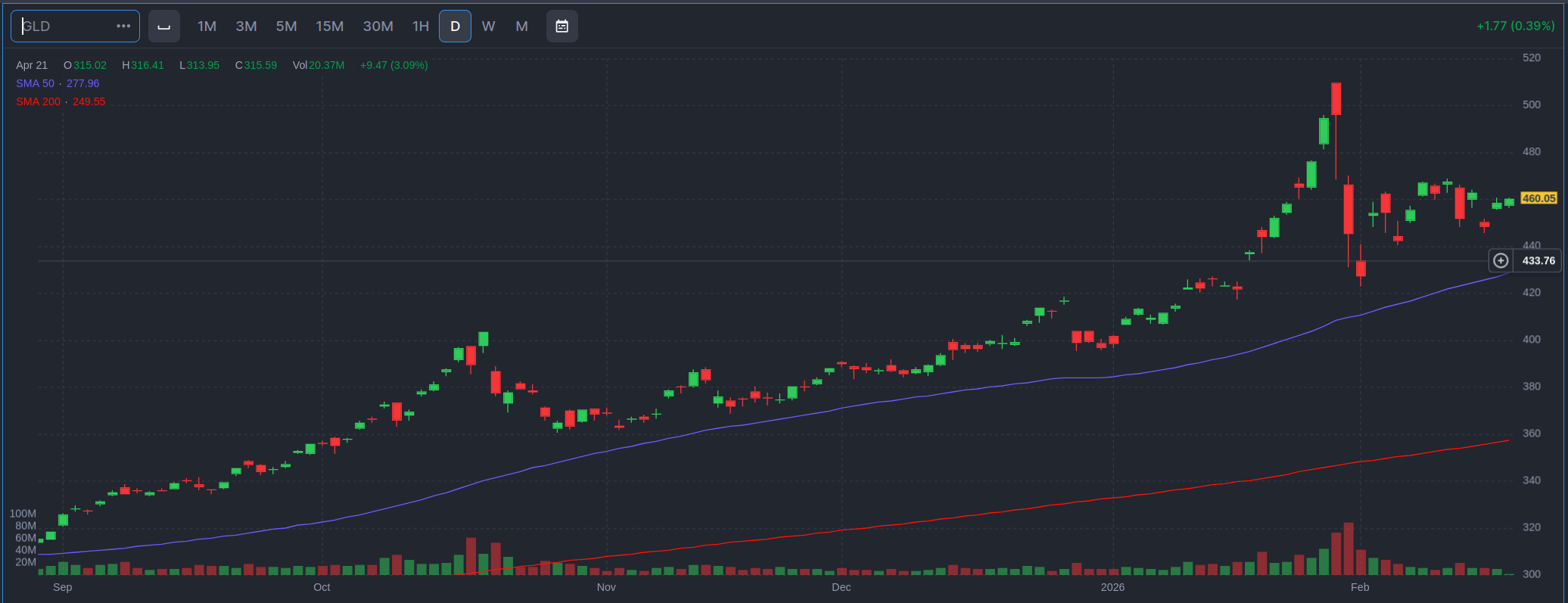
I don’t think the gold market thinks so. Price action is essentially flat. This may change on Friday, but right now it looks like gold is having a consolidation moment after the run-up. I don’t think a lot of countries want to hold gold as a reserve, as its volatility means your reserves are subject to constant swings. The traditional reserve was the dollar, but many countries are looking at an administration willing to subvert its own laws and weaponize its currency. So that makes the Euro more attractive, but it lacks the depth and breadth of market the collar occupies.

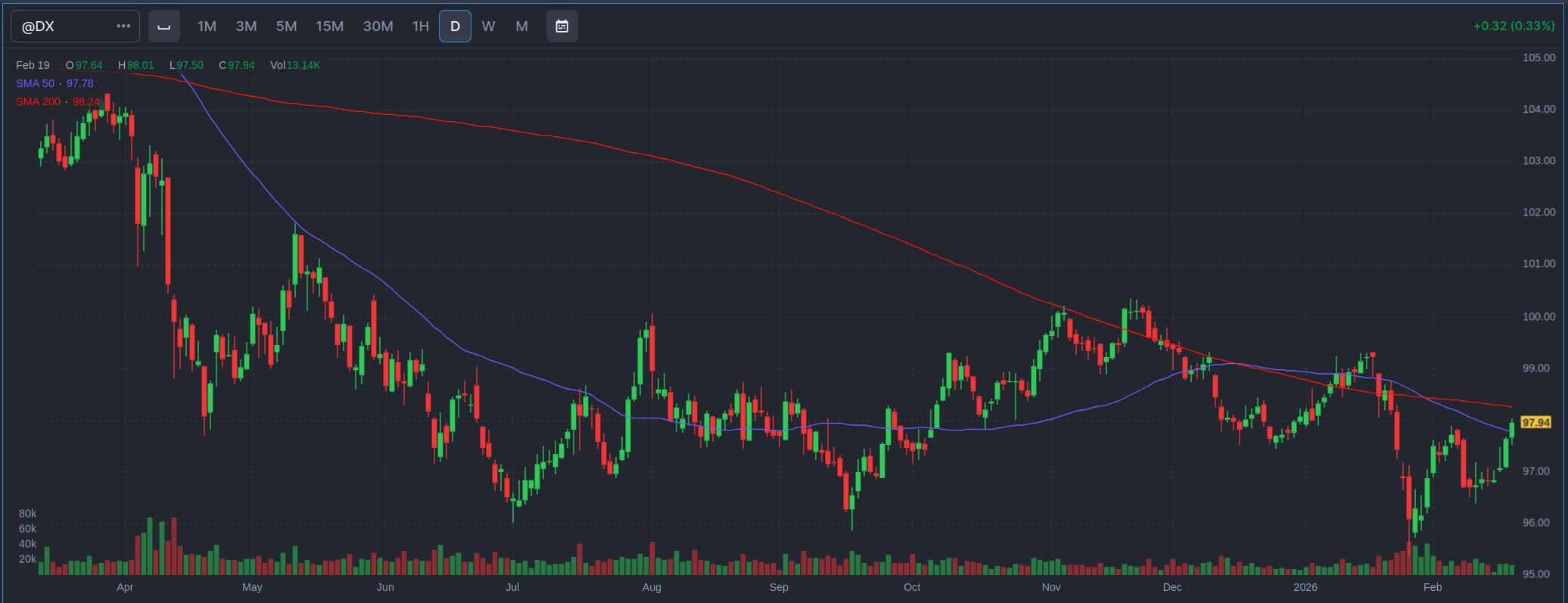
The next proof point would be an appreciation of the dollar combined with falling prices on bonds. I see some, but not much movement. Again, that could change by Friday. But the dollar and interest rate aren’t signalling a belief the US will attack this weekend. The dollar continues to sit in it’s range and the upward movement is as easily explained by the strong economy and the likelihood interest rates don’t change until mid-summer.

What we learned from Venezuela is firstly the operation was a surprise. Second, we have some tactics and weaponry a lot of us didn’t realize we had. Third, the US had no interest in anything but a quick win. Forth, there is no interest in democracy or actual regime change. Fifth the goal, explicitly stated, is control of oil and oil sales.

Thanks to Charle’s brother, the news has a lot on the arrest of Andrew. Iran is below the fold at the NY Times, not on the front page at Bloomberg, and missing from The Guardian. I’ll get to the AP and BBC later, but likely the same. People aren’t looking that way and the administration has tamped down the rhetoric, making it look like talks are underway. No reason to attack if people are talking, right?

The attacks preceding the abduction may have been probes to test the speed, reaction, and air defenses of Venezuela. I suspect we have that dialed in on Iran after the raids with Israel. It’s likely we have good intelligence and wouldn’t need to probe their defenses by striking other targets. After all, we dropped bombs on their most sensitive nuclear facilities with impunity. I suspect we can strike anywhere in the country at any time. And likely one result of the Ukraine war is highly detailed information on Russian air defenses at their most capable.

It’s not likely the US would swoop in and take the Ayatollah back to Rikers in cuffs. But it might be a decapitation strike. There are plenty more religious leaders waiting in the wings to replace any “martyred” leader. So I’m not sure what lasting chaos or policy change it might cause. If there’s anything to strike that would have lasting impact, it’s the revolutionary guard and secret police forces. Maybe target the control and command systems that enable them to suppress internal dissent? After reading about their brutal response to protesters, I doubt anyone would shed tears for secret police and military that shoot at civilians.

The moon this weekend is heading to first quarter. The next new moon is March 3. This doesn’t matter as much as some people think, with the assault for Maduro taking place, as January 3 was a full moon. The moon will set in Tehran shortly after 10 PM, local time. Which means it will be moonless in the early hours of the morning. (The moon isn’t always up at night – remember?)

What will the US want? I don’t think anything but a vague “lay off the dissidents” and demands on the oil. It might have some added benefits of keeping Iranian drones out of Russian hands, to fire on Ukraine. With all the ships and capabilities arriving in the Gulf, a timer has started. There’s a point at which those assets have to be rotated out for maintenance and refurbishment, and to give their crews some time off. A build-up can’t sit there forever. A “permanent” presence, simply means the US rotates ships in and out of the region. It’s not the same ship, years on end.

I don’t expect the US to land troops or in any way take a long-term approach. I suspect it will be much like Venezuela, meaning they realize no one is going to keep paying attention to see it spiral into shit or realize nothing changed. I don’t know what targets they intend to hit. Maybe it will be the re-built nuclear sites. Maybe it will be the revolutionary guard barracks and headquarters. Maybe it will be government buildings. I have no idea. But I don’t think Iran will be able to retaliate in any meaningful way and I don’t expect Iran to be able to stop the attack.

[Note] With this administration, watching the markets may be a good indication they’re about to do/not do something. They tend to be leaky with non-public information.

Calling It What It Is

The practice of calling something what it is seems jarring sometimes. None of us want to come to the horrible conclusion what we’re looking at is as bad as we think it is. That’s why it’s nice to see the NY Times call out voting restrictions for what they are: an attempt to blunt the Democrats taking the house and possibly Senate. Do I think Republicans know better than to believe that illegal immigrants voted in 2020? At this point, I don’t know. I think the person who originates a lie knows it’s a lie, but maybe not the person who repeats it. And human beings have an amazing ability to believe something that suits them.

A lot of journalism, in order to avoid seeming biased, gives both sides a pass. That’s why people who pushed an anti-science agenda that carbon emissions aren’t ruining the climate got an equal hearing with actual scientists. This is especially true if the denier had some scientific credentials, even if they weren’t in anything related to meteorology or climate work. Putting one person “pro” and once person “con” in a discussion group makes it seem like there is a split on opinion. Even though you can see the impacts of a changing climate, you find something else to believe. Or you just don’t believe it, because it’s easier not to. Even with a top tier education, all the information in the world at you fingertips, and being accomplished in your own field, does not prevent you from convincing yourself of something that isn’t true. It allowed you to believe that the scientific field is split, and therefor no one knows. And if it’s all about money, maybe its the 60k a year climate researcher that’s making a mint on this.

Often, this follows familiar contours. We just went through the Epstein file dump and saw the degree to which people tried to excuse, minimize, hide, or ignore what it was about Jeffrey Epstein that was so vile. And what it implied about him and the people that frequented his island. It has become clear that at many turns people could have named Epstein for what he was and what he did, but chose not to. Not because they don’t abhor trafficking and raping children, but it would mean naming themselves as abetters and enablers, and their friends (and possibly family) as rapists. I’m not sure what they allowed themselves to think, or what to believe. I don’t think they can think of themselves in those terms. I don’t think any decent person can, so there has to be another explanation. He’s mentoring them. They’re actually older than they look. Maybe those girls are getting something out of it too, staying on a nice island. And for some of the abusers, probably that if she really didn’t want to, she would have left the room.

Unless we want to fall into that same pattern of behavior, at some point we have to name the Republican party and its attempts to illegitimately secure power. They intend to keep eligible voters out of the polls to hold power in the 2026 mid-terms and the 2028 election. This is an undemocratic attempt to maintain one party rule by tampering with elections in a way that gives a thin veneer of legality. Enough of a veneer to let people continue to believe it’s for securing or protecting the elections. That they’re the good guys, because otherwise, it would make them no better than any other one-party rule dictatorship. They have to believe there is a problem with illegitimate voting, despite the evidence to the contrary. Because if they actually named what they are doing out loud, if they acknowledge it to themselves, they will realize the enormity of what they are doing.

This is why the facts don’t matter. Because the belief is based on what they want to be true. For example, Biden won on the presidential ticket, but Republicans won down-ballot. Does that mean that those results are invalid? It doesn’t matter to them. If you look at pieces of evidence like the Utah audit of illegal voters, that found essentially no problem, it doesn’t matter to them. And it’s no longer just a few fringe lunatics like Sidney Powell, who came off as nuts. In terms of people who’ve convinced themselves illegal immigrants voted, it’s likely a majority of the Republican caucus. If not almost all of the Republican caucus. Some are just dumb and gullible, but others have just convinced themselves this must be true. Otherwise, they will have their asses handed to them in a few months. And more importantly, if they can’t convince themselves, it just means they are anti-democratic and breaking with a fundamental tenant of being American.

Representation, voting, was the chief complaint of Americans that lead to independence. That the English parliament, across an ocean, was making decisions about English citizens that were denied the same representation available to people living in England. While many people look at the tax issues, it was that the taxes were imposed without the colonists feeling like they had a say in it. Denying eligible voters, in America, access to the ballot box makes one a traitor to the very idea of being American. And that’s what these laws intend to do. To take people who could vote, and have grievances about how the government is running, and turn them away by adding additional requirements for identification well beyond what is necessary. Or up-ending the constitution and imposing control over a function explicitly left to the states.

For example, say you were born overseas but became a US citizen. You are allowed to vote. The proposed laws require you to show a passport or birth certificate to vote. Your birth certificate is useless. You have to show a passport. I have always had a valid passport. But only half the country does. I’m assuming among that half are people a fair number are born overseas. It can take weeks to get a passport and there is a non-negligible price. Or if you are a woman, who changed her name after being married, you need to show both the passport and a marriage certificate. I’m sure my marriage certificate is around somewhere, but I’ve never had to show it. Women have been been skewing toward Democrats, as might more immigrants after the horrific ICE crackdowns. What better way to throw up a little roadblock to registering to vote. The icing on the cake will be to place ICE at polling places. The goal being to instill fear into people afraid they might get unlawfully arrested and spend weeks in detention before their citizenship is verified, don’t show. Why on earth would they think that? Because that has been happening to brown people, especially if they have an accent.

But, that’s only a few people, right? Think about how close the elections can be in the United States. We now consider a presidential election decisive if there’s a whole percentage point difference in the popular vote. You don’t have to keep 10% of the likely Democrats from voting. Maybe just have to keep a percent or two from voting. You might still lose the House, but maybe keep the Senate, and pretty much stay in power. Nothing a Democrat House does will pass a Republican Senate. And the slim margin is even more true during the presidential election. And on top of that, the administration will lean on broadcasters and social media to avoid spreading messages that will hurt them in the polls. While no longer under the cover white supremacists funnel money into Republican races. And what coercion by the FCC or FTC can’t handle, and money can’t buy, the patronage system pressure companies to fall in line.

But that may not be enough. You may get a large number of people voting for Democrats, even with all that suppression work. You might think the laws would prevent them from claiming fraud. It won’t. Just like 2020, they will let results that favor Republicans stand, while claiming Democrats cheated with illegal votes. If passage of voter id laws is blocked by either the Senate or impeded by the courts, they will claim the results were full of illegal votes. If the laws are passed, enacted, and allowed for the 2026 mid-terms, they will claim the laws weren’t enough, or that Democrat states failed to enforce them. And it won’t matter if those states are traditionally ‘red’ states. They will do everything they can to deny Democrats seats but will not attack a Republican win, even on the same ticket. They did this in 2020. They will do it in 2026 and 2028.

The voter id laws are a thing to help them structure their fantasies. In one sense they don’t matter. With the laws in-place, after a defeat in the mid-terms, they won’t care about audit trails, voter roles, manual re-counts, or whatever you propose. These are people who legitimately looked for traces of bamboo in paper to show it was from China. They cannot believe anything else than they lost because they cheated. Will there be Republicans that know they lost but still make the argument? Of course there are. Just as there were tobacco executives that realized smoking was killing people, was addictive, and they needed to get kids hooked as teenagers. And that their claims about the science not supporting the cancer claims was just a smoke screen. But plenty of people allowed themselves to be convinced tobacco wasn’t the problem, it wasn’t that addictive, it was their right to smoke, and that if teens smoked, it was the parents’ fault.

It may come to mass protests in November through January to force the Democrats to be seated in Congress. You can be assured that every procedural impediment to swearing in new Democrat congress members will be applied. Every court challenge to their win. Every counter protest (complete with stop the steal activists in battle-rattle and long guns) to declare the results invalid will be pushed. Every attempt to cower the media and social media narratives to de-legitimize the results will be taken. Every time a Republican is interviewed, they will focus on language tuned to resonate with their base and help them continue to believe the election is being stolen. That their country is being stolen. That their voice is being stolen. And their way of life will be stolen, if the Democrats win. But at the same time, accepting every Republican win as legitimate, not really up for discussion, or part of the clever plot.

Just as many Republicans have made it clear they feel voting is a privilege, not a right. Or that maybe their faith says we should allow head of household voting. Or that they can discern who the real Americans are, and only they should vote. Or, if push comes to shove, they can’t trust the ballot box to their satisfaction so there’s no point in having elections. We have over-used the word “fascist” way too often. The county requires separating recycling by type, and people scream it’s fascist. It’s lost its meaning. Authoritarian and autocratic don’t hit has hard as fascist used to hit. But make no mistake, what I’m seeing in America is little different from the slide that Turkey and Hungary took, and Poland was taking, to a single-party, failed democracy. If Orban loses, he may not leave power without blood in the street. Erdogan has shown a willingness to brutally crack down on his opposition and probably won’t leave without a revolt or military coup. And Putin consolidated power that ten years ago so people largely stopped questioning obvious murder.

If the Democrats do well enough in the polls come November, we may not have to listen to history rhyme as Americans fight to be represented. That even if you wipe out a few thousand votes here or there, it doesn’t make any difference and the House and Senate are both taken by Democrats. And that if you don’t acknowledge the election, you can’t seat a new Congress, and the business of the country stops. (I don’t put a full up coup beyond the pale at that point. You just don’t seat Congress and the president runs the country by fiat. Or tries to, in which case we’ll see which way the military heads.) But the fact that a blow-out or landslide is the only way we keep democracy going, kind of shows we’ve already lost. And lost because of the dumbest reason, that people have convinced themselves of something that isn’t true as they can’t just admit they are sheep who would rather give up their rights and live in a dictatorship.

A Little Perspective

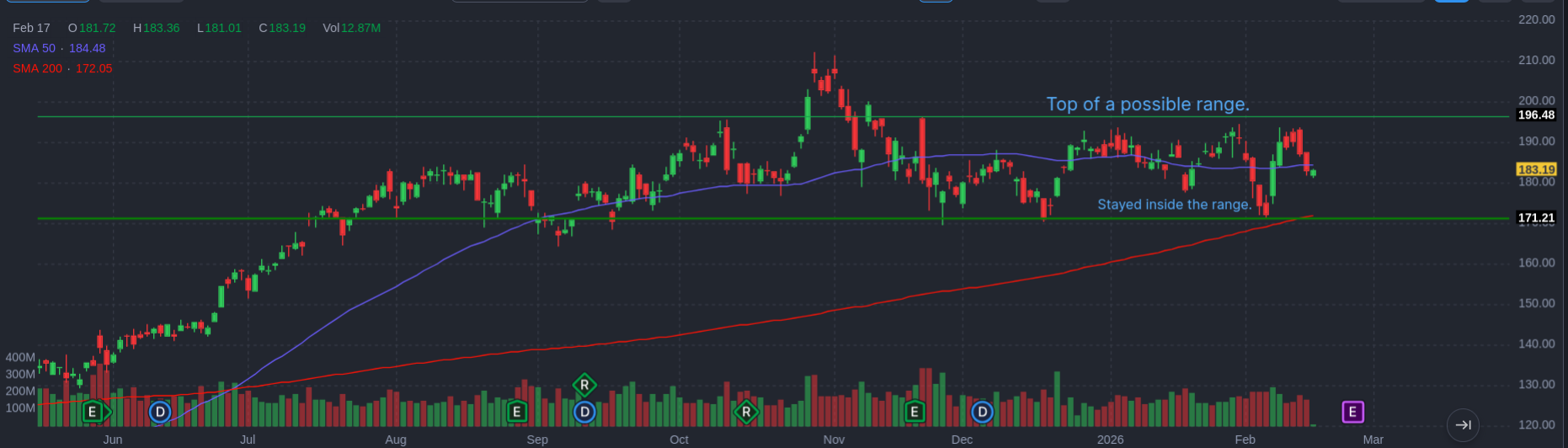
NVDA is going to announce earnings on Feb. 25. Like everyone else, I think I’m more interested in the forward guidance on sales than sales over the last quarter. I think we’re all looking for an indication of any pull-back in AI capex spending. This would not just be an issue for Nvidia, but also for companies ranging from turbine generator suppliers to utility and real estate companies. Looking at current levels for the NASDAQ, the recent high was about 26,000. A historically normal bear market pull back takes us to just under 21,000. That’s at the bottom end of a congestion area from last December. The S&P 500’s recent high was just above 7,000, meaning it’s 20% retracement is in the 5,600 ballpark.

The difference between a regular bear market pullback, that cleans out some of the deadwood, and something bigger is only visible in the rear view mirror. When the stock market started dipping before the GFC, a lot of people thought this is just about clearing some deadwood from the system. Once it’s done, the infinite money glitch will restart. Jim Cramer gets a lot of shit for the “Buy Bear Stearns” call just before it went tits up. But he wasn’t the only one who genuinely believed Bear Stearns was in a bind but would find its way out. In part because they didn’t have all the information necessary to make that call. They did not know what Bear and its counter-parties knew. They have opinions on dozens of individual stocks and are not specialists who follow just one company. As Bear kept dipping, they thought it was time to buy. The bias sell side analysts have toward buying just made them look that much dopier when it happened.

Contrast what happened with the sharp pullback and return during the start of the COVID lockdown. The S&P 500 went from almost 3,400 to 2,200, well over 20% and came back fairly quickly. In six months it was pushing new highs as we sat around swimming pools, masks on, glaring at the neighbor jogging by without their mask. Okay, that was one stock versus a whole market, but after the 1929 crash, the stock market came back in what’s called a bull trap. Price came back, people bought in, and then resumed their slide. In fact, the prices came back to nearly the 1929 top.

I don’t know, Jim Cramer doesn’t know, and no one knows if Nvidia’s earnings announcement will cause investors to double down, pull back, or continue to waffle in the trading range. Or pull back for a couple of months, come down 20%, and then come back. As Yogi Berra said, predictions are hard, especially about the future.

But it’s good to clear out the deadwood. For example, the zero days till expiration options trading may be contributing nothing more than volume, income for brokers, and some volatility. I would say it would be nice to wash those folks out of the market, but I suspect a majority are not professional traders. They think they are, but they’re just gambling on whatever free broker they’re using. It would also be nice to nip the prediction markets betting on the market in the bud. But again, that’s not done by people whose wealth moves by six or seven figures on a daily basis. It’s done by people who can’t replace their fridge, if it breaks.

But then again, other than time horizon and belief, what makes someone betting Tesla will move up at least half a percent today, different from me? I have a longer timeline. And for the last 100 years, we’ve seen the US economy grow and wealth accumulate in assets like stocks. Over a long enough time-line (with an important asterisk there about when you buy in and when you cash out), people have generally done well. But we wouldn’t be the first example of a country killing its golden goose for the dumbest of reasons. London has played second fiddle to New York for some time, but Brexit has accelerated its trajectory into irrelevance. Now, its best financial innovation is possibly loosening laws to become more like Dubai, where it’s anything goes (including fraud). Once, even after the US economy eclipsed the British Empire, London was the financial and insurance center of the world.

At some point, the hyper-scalers will need to stop buying Nvidia hardware unless they figure out profits from AI. The market is already giving Google, Amazon, and Microsoft the side eye for heavy capital spending to support AI. The punishment by the street for not investing in AI might be worse right now. But at some point, if AI isn’t making real money (and not just redeeming credits issued in exchange for ownership in Open AI or Anthropic), money spent on AI chips or data centers would be better used to buy back stock. At that point Pinchai, Nadella, and Jassy might decide to stop advertising their AI capex spend, as it would be driving down the stock, and focus on “core competency.” They will pivot by laying off a bunch of people and fucking over a bunch of contractors who anticipated the completion of additional data centers. Oh well. Somewhere between now and that possibly distant future, I expect to break Nvidia to break down from its trading range. Unless it doesn’t.


This is not investing or investment advice to you, or anyone. It’s is provided for your entertainment purposes only. And if you are investing, contact a professional before making any decisions. Buying and selling stocks, futures, or any investment is a risky activity and can cause you to lose money, including the principal which you invest.

On Tap for This Week

This week is a lighter week.

  • Monday – Markets are closed
  • Wednesday – Housing starts and FOMC minutes
  • Friday – GDP

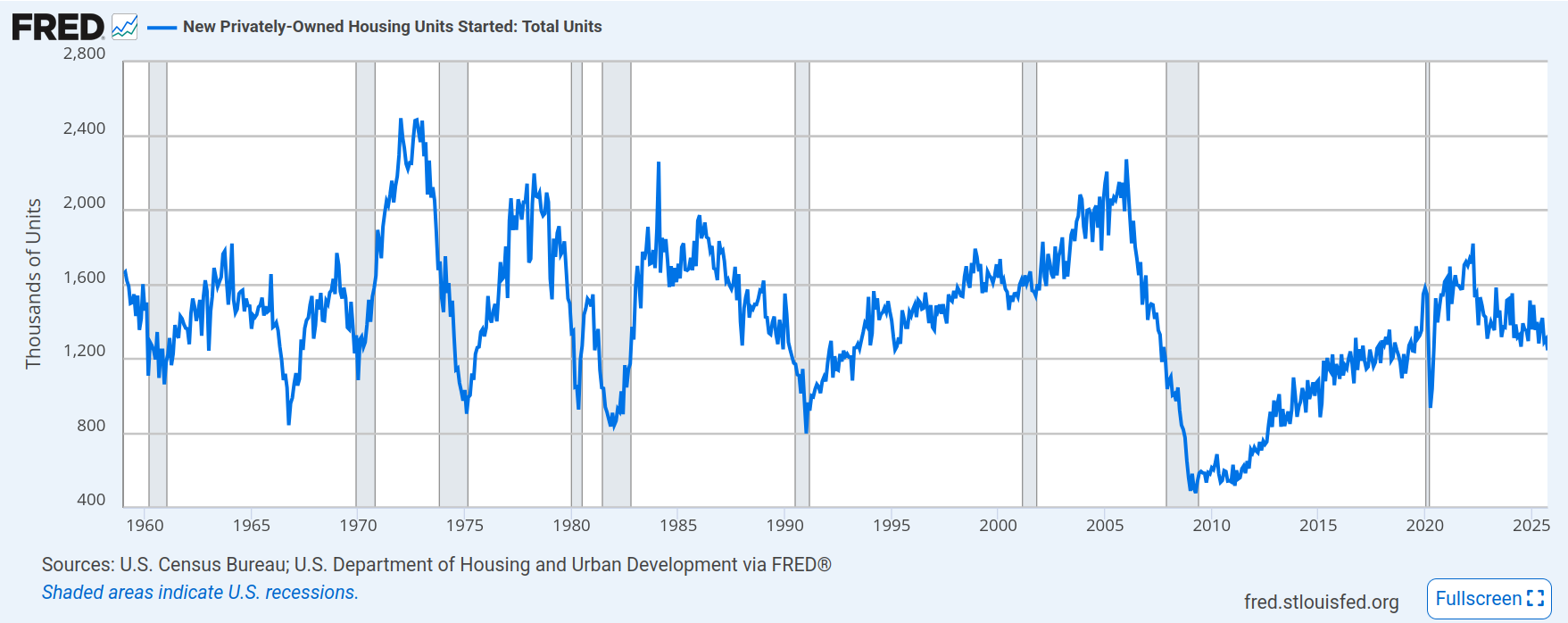
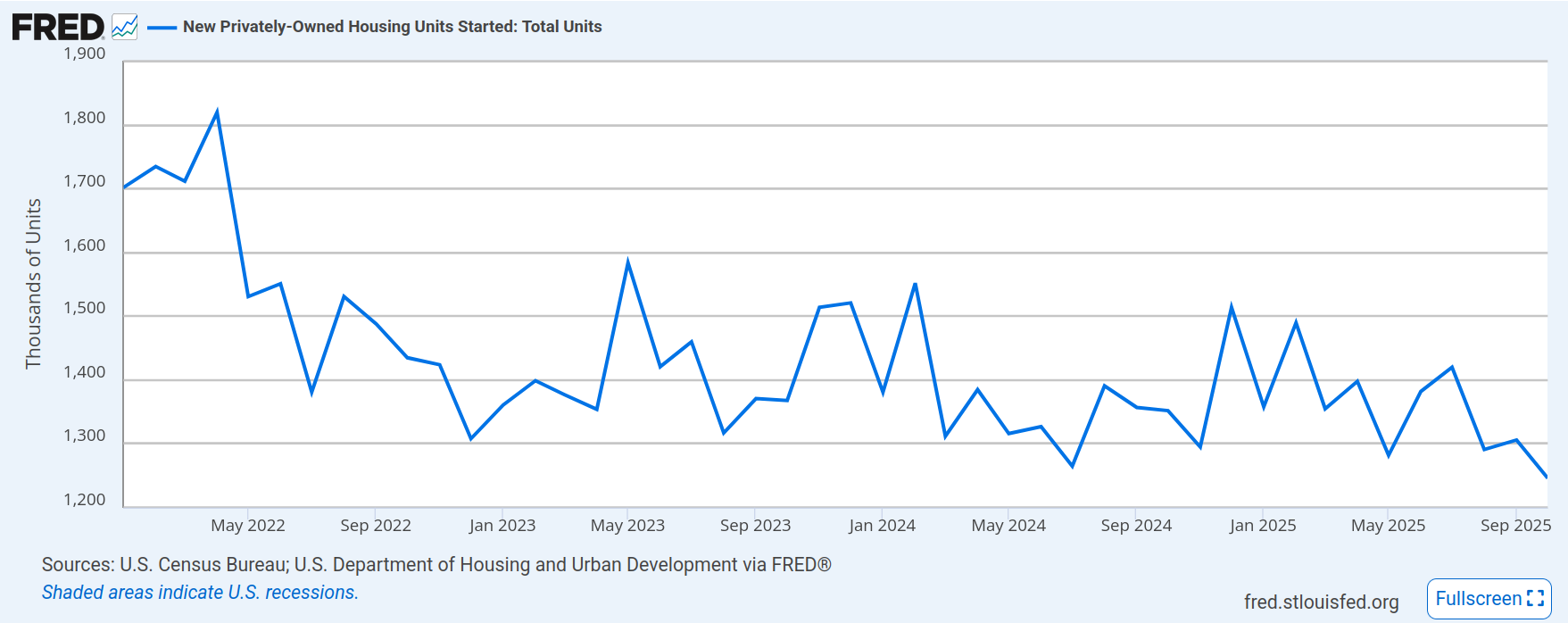
Housing starts I don’t think are as critical as they once were. It used to be that sales of houses were tied to a lot of other economic activity from buying new furniture to updates to existing homes. It used to be more a headline number and market mover.

Here we see the last couple years of starts, compared to the historical numbers for housing starts. Although housing remains unaffordable for many, we don’t see a huge increase in starts over the last three years. From the chart above, we can see a jump shortly after the COVID lockdowns, but nowhere near enough of a bump to deal with the lack of housing created after 2008. And if you have to ultra-stretch your budget for a house, that doesn’t leave a lot for new furniture or trips to Home Depot.

The FOMC minutes, however, will be interesting to see. We’ll get a view of how hawkish or dovish the over-all committee is. And remember, even if Trump installs a rate-cut happy lunatic as Fed chair, that lunatic doesn’t set policy. It’s voted on by the full committee. Which is why Trump is testing his ability to fire other Fed members. In the presence of tax cuts and proposed spending increases, a Fed that cuts rates will be adding stimulus on top of stimulus when the employment rate is in the range of full employment. Which would attack the debt level by devaluing the dollars in which the debt had been issued. But then interest rates (should) climb, or the dollar (should) fall to offset the devaluation of the dollar. When the dollar falls, oil and other commodities climb in price, pushing more inflation. And there is no guarantee that the increase in wages would outpace inflation. We would almost certainly all be worse off.


A quick note for folks that think 0% unemployment is full employment, that’s not how it works. Inflation has a statistical relationship with unemployment known as the Philips curve. Below a certain level, like 7% unemployment, a decrease of 1 percentage point of employment has no impact on inflation. At lower levels of unemployment, a 1 percentage point decrease in unemployment drives higher inflation. Why? Because when the labor market gets tighter (and everyone is immediately swept up into a new job), companies wind up bidding up wages to attract workers.

Those workers have more money for cars, food, vacations, and so on, and that drives inflation from the demand side. Also, as wages get bid up, more workers come off the sidelines into the workforce. These range from moms who no longer see it economical to stay at home, or retired people seeing opportunities, or people who left the job market to write a cook-book, etc. You can get a month to month increase in unemployment as these people come back into the workforce, while having a very tight labor market. As we pushed down toward 3% unemployment post-COVID, that contributed to an increase in inflation. It was great because everyone’s salary was jumping, but few people feel it outpaced the impact from inflation.

It’s a Special Hell

I feel like it’s a special hell to be stuck in a democracy with people who are so fickle and easily manipulated. Frankly, the best thing that could happen is that we walk away from social media and instead start walking toward places where we meet other people, like a bowling league, bar, maker space, library, or whatever. Sure, some places will code right-wing, but people don’t like blowhards and usually just want to bowl, or have a couple of beers, or work on a project, or find a good book. At the end of the day, in spaces with people, blow-hards have their moment and flash out. You find your people. The people who you look forward to seeing the next time you go there.

But we aren’t doing that as much as we should. We just scroll through phones and social media posts. Like, share, re-share, or maybe even re-mix if you’re bored. And before you know it, another hour or two has gone by. That happens for most of the week and you lose days worth of time before you know it. You look and see things aren’t going so well in other areas, so you jump back on social media. Its a combination of an escapism factory and a dopamine dispenser. How should you feel about something? How did you react to that meme? Did you re-share it? Or did it change your gut reaction to a story? Did you switch teams on that one? Did it make you feel smarter? You’re not a sheep. You think for yourself! Except, did you?

It’s a special hell to be stuck making decisions with people whose frontal cortices have shriveled and are driven by their amygdala and limbic system. Feed enough of the right trash into the chum-bucket that is their media diet and a president trying to become a dictator is romanticized as a Tony Soprano, having the guts to go for what he wants. Not pausing to think that it’s against the basic idea of American democracy. Reaching that conclusion requires logical thought. Having an instant reaction to a meme, an image, a video that has to be shortened to seconds to deal with a decaying attention span, requires no thought. Feed enough of those images and you get powerful reactions.

All the while the people that are making money by monetizing your eyeballs are entering into a new and dangerous relationship with a dictatorship-coded regime. One of patronage. Special privileges, tax breaks, or rewards for being a swell pall. The people who decide what to feed your atrophied brain have an interest in feeding the message the dictatorship wants. What Orwell missed about dictatorship was not that government ministries had the ability to sway citizens. It would be the private companies, beholden to the state, that would do the state’s bidding to pursue personal wealth. It wouldn’t be faceless bureaucrats. It would be opaque content policies that might decide which image to feed you, based on careful targeting.

And with all the noise about the Blue Wave, I imagine we have yet to see the content that will be pushed to fire up fear, resentment, and anger to counter that Blue Wave. Whether it’s voter suppression by making people feel their vote is meaningless to stem the authoritarian tide, and they should just protest, or drowning them in emotional counter-narrative, the push back is coming. They don’t have to hire an army of content creators. They just have to push what ever is working and amplify that. That is the same tactic Russia uses to push its narratives in the West. Don’t push all at once. Seed it. See what works. Amplify that.

In addition we have the novelty of AI to prod the narrative. Imagine an Open AI signaling they need government investment to be profitable, and the only condition is they inject some additional prompting. If someone searches about specific topics, inject a small push to the government’s position. Not overt. Not blaring. Just a nudge. Offer content from a set of friendly sites to back up the claim. Not Fox News, just friendly sites. It can’t be obvious they’re being nudged. Maybe let Google and Meta know that a government ready to invest asks that they just treat sensitive subjects in a way the government desires.

Oh, but won’t they fear the Democrat’s backlash? What backlash? Backlash from people who are making their platform “we follow the law?” The Trump platform is “if you can’t help me – I’ll keep you out of jail and make you rich.” That’s why he’s pardoning scammers who now no longer have to provide restitution to their victims. And if he’s willing to bail out a scammer, he’ll definitely cover for a big-tech CEO. And they have no problem lying, even under oath. If anyone ever asks, it never happened. As we get past labor day, expect your feeds to get a little ‘odd.’ Nothing big, but … wow …. you did not know that Islamic terrorists were among the Minnesota protestors. I wonder what else those people with whistles lied about?

This is truly a special hell. I stay off social media not because I’m immune to manipulation (no one is, regardless of their self-image), but because I am just as susceptible as the next person. I had the misfortune to hop on today and was reminded how addictive scrolling the feed can be. Especially when people react to a comment or re-post. But millions of voters hook themselves to it, willingly reshaping their minds to big tech’s content.

[Note] I originally used the phrase “Red Wave”, when I meant “Blue Wave.”

Quick Note on CPI

I need to dive into the details but CPI came in on the slightly low side of “in-line.” This is good but does not necessarily translate to interest rates coming down. As we just saw in the last two weeks, the job market does not appear to be cratering. This could imply the “r*” rate (the neutral risk-free rate associated with short term government debt), could be between 3.5% and 4.0%. Even if inflation is coming down, it does not mean that reducing rates wouldn’t be an unnecessary stimulus, raising inflation. Especially when you consider the tax cuts and anticipated defense spending are stimulative. You can’t add stimulus on top of stimulus without driving inflation. We just did that, right?

The US Is Backing Out Of Europe

That may seem a little extreme to say, but also not extreme enough. Marco Rubio will be visiting Slovakia and Hungary, two European countries that have embraced the far right and are vaguely pro-Putin. Like most authoritarian countries, they have relatively small economies and are performing well below their democratic peers. From the president on down, the message is clear. They want a more divided, more authoritarian, more corrupt Europe. A Europe in their own self image.

This is both a good and a bad thing for Europeans. The fact the Germans were all but disbanding their military less than a decade ago was a stupid idea. A short sighted one based on a false understanding that ties with Russia brings security and cooperation. In 1985, as the US and Europe faced off against the threat of Warsaw Pact forces pushing West across Germany, military readiness was a real concern. The US beefed up its nuclear capabilities using a combination of cruise and intermediate range missiles to blunt what they believed would be an unstoppable roll of red armor. A mere twenty years later, a reunited Germany faced social problems and a Russia more concerned with separatist regions, like Chechnya. The war in Europe was over, as most people believed.

A few years later and people saw a Russia that appeared to have significant, advanced military capabilities. Prior to the invasion of Ukraine, some speculated that Russia’s ability to wage war meant they could drive to the Pyrenees mountains before they could be stopped. With the US presence there as a last resort, the Germans (especially) tried to ensure peace through diplomacy. If Russia sells gas to Europe, it should be invested in a stable and prosperous Europe. It’s much cheaper than trying to counter so mighty a military. But, as was seen in Ukraine, the entire Russian military structure was rotten on the inside. And the Russian army in the 2020s was still driving meat assaults behind artillery, as it had for over a hundred years. Whatever was left after the artillery finished would be murdered or raped by untrained troops that were rioters as much as they were soldiers. They could only get to the Pyrenees if they stole spare parts, gas, phones, televisions, food, equipment, and medicine along the way.

The Europeans have a choice. Do they stay in the American orbit, which is becoming increasingly inhospitable, or do they strike off on their own? If they stay with the US they have to deal with attacks from both Russia and the US on their economic and political union with the express intention to weaken it. Like they did with Russia, they could try to dance diplomatically, trying to spin away the truth. Or they can have a look in the mirror and realize that they are better off in a union, Russia is their immediate threat, and America is on the way to becoming a threat.

Europe doesn’t have to defeat China. They barely have a dog in that fight, except the UK’s sense of solidarity or loyalty with Australia and New Zealand. Nor do they really have to secure the Pacific trade routes, although goods from South Korea and Japan are nice. India and Africa can be low-cost manufacturing hubs for Europe and those are much easier routes to secure. Technology, electrification, and reduced dependence on fossil fuels are in Europe’s interests, along with securing energy arrangements with Africa and the Middle East. Europe doesn’t need eleven nuclear aircraft carriers to deal with Russia. Nor do they need to land forces anywhere in the world within a few hours of getting the word. They need to deal with one threat that has a fraction of their population and a pathetic economy. If Russia did not have nuclear weapons, it wouldn’t be considered a major power.

What most people don’t understand is when you buy a weapon, like a missile or a plane, it needs constant servicing and updates. A missile might need software updates to deal with new counter-measures. The F-35 needs software updates for each mission. It is impossible for any EU country to maintain their F-35s without support from US contractors, manufacturers, and the US government that controls them. What if Russia invades Estonia and the US decides they don’t want to get involved, so they say Europe can’t use the F-35 to fight Russia? It’s not likely, but it’s possible. In part because Russia may not directly attack Estonia, but rather foment insurrection among a portion of the Russian speaking minority and send in “little green men.” Would Trump just say “it’s an internal Estonian matter” and refuse to abide by Article 5? And would certainly not extend the nuclear umbrella to cover an “internal matter.”

If Europeans are hoping other pro-NATO Republicans would step in and stop any serious break in the relationship, they are taking a gamble that hasn’t paid off so far. When confronted about Trump, the first thing the Republicans do is ask to see the proof, as “they haven’t read it.” When you show them the proof of statements made by senior officials and policy documents, they say it’s not serious and look at what the administration does. When you point to actions by the administration, they find some other excuse. That frog has been boiled. It is now Trump soup. And even if the mid-term elections sweep in majorities of Democrats in the House and Senate, there is no guarantee they are going to be worried about Europe. In fact, some of those who get elected will have a “not our problem” approach to foreign policy. Because their electorate doesn’t view it as their problem.

The only real choice is to develop home-grown infrastructure and capabilities they can rely on without participation by the United States. Look at this period as a chance at a transition. The alliance allows countries to specialize, and the US provided a lot of the intelligence, communications, and control infrastructure. And, most importantly, a nuclear umbrella. Europe is going to have to mitigate its loss by developing their own capabilities. This means pushing a European satellite launch program and reusable rocket program (to keep costs manageable). It’s going to mean more nuclear weapons and delivery systems. It’s going to mean replacing US infrastructure, knowing that it could be denied to them, or worse, weaponized against them. It will also mean conducting more aggressive and intelligence and influence operations to help shape US opinion and deal with Russian and US disinformation.

On its best days, Europe is like a super-tanker. It’s slow to turn, but once it has a direction it’s impossible to stop. On it’s worst days, it’s a super-tanker with a stuck rudder. But it has some advantages that the US does not. In Ukraine it has a modern warfare laboratory to develop new weapons and tactics. To take a look at the NATO standard tactics that aren’t working and refine those tactics. It’s a chance to develop weapons for what future combat might look like, and to counter newer Russian weapons. Maybe it’s a dark forest of lurking drones and anti-drones. It also allows space for home-grown replacements to US systems to be vetted and refined. It’s horrible to think of Ukraine as a testing ground, but Ukraine needs more weapons and they need more imaginative to counter the ones Russia is firing at them. And Europe needs to quickly build capabilities.

What I don’t think a lot of Americans appreciate is that US companies they invest in, have in their 401(k), and work for, sell to Europe. Europe won’t just be replacing a few F-35s. It will be replacing Master Card and Visa as payment processors. It will need to replace Meta, X, and YouTube for for social networks. And it will need to replace Amazon, Microsoft, and Google as infrastructure providers. It will need an independent industry to provide semi-conductors and equipment so that a mercurial President can’t suddenly demand those exports are halted. (And a lick-spittle congress does nothing). It will mean moving away from US dollars as a reserve, thereby driving down the US dollar long-term. The US has been the incredible beneficiary of a close alliance with Europe, but they took the benefits for granted.

The Ball of Money Sloshes to the Right

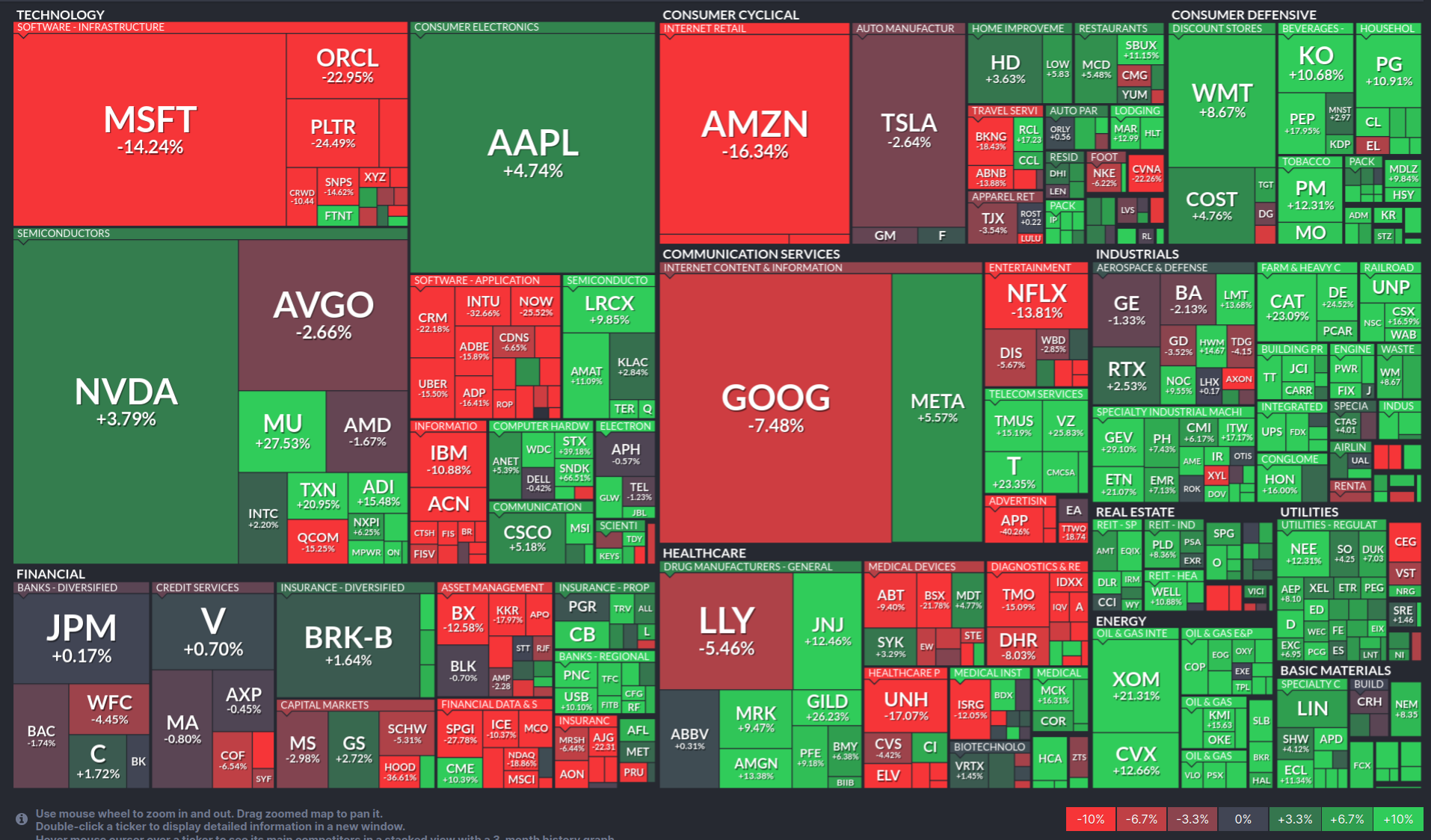
Looking at the 1 month S&P 500 performance, we see money coming out of Software on the left side and heading to the right side into defensives, industrials, real estate, utilities, basic materials, and pharma. It’s coming out of software and hyper-scale cloud operators.

Is Oracle a software company? Meh… sort of? They make more money from infrastructure like clouds and data center builds than they do from software. Remember when they sold databases? They’re racking up debt to build data centers. A pullback in AI would likely be an event that kicks them into re-organization, as they restructure that debt. The cost of insuring their debt has risen as people are getting worried the data center boom is unnecessary and circular.

Proper software is getting hammered because people think you’ll just query the AI for stuff. Except I don’t want a hallucination when I ask a tax question. Or, if the software makers offer AI assistance, it will be a cost they face but not a differentiator. Companies will have to add that support and pay for the service, but it’s because everyone else has it.

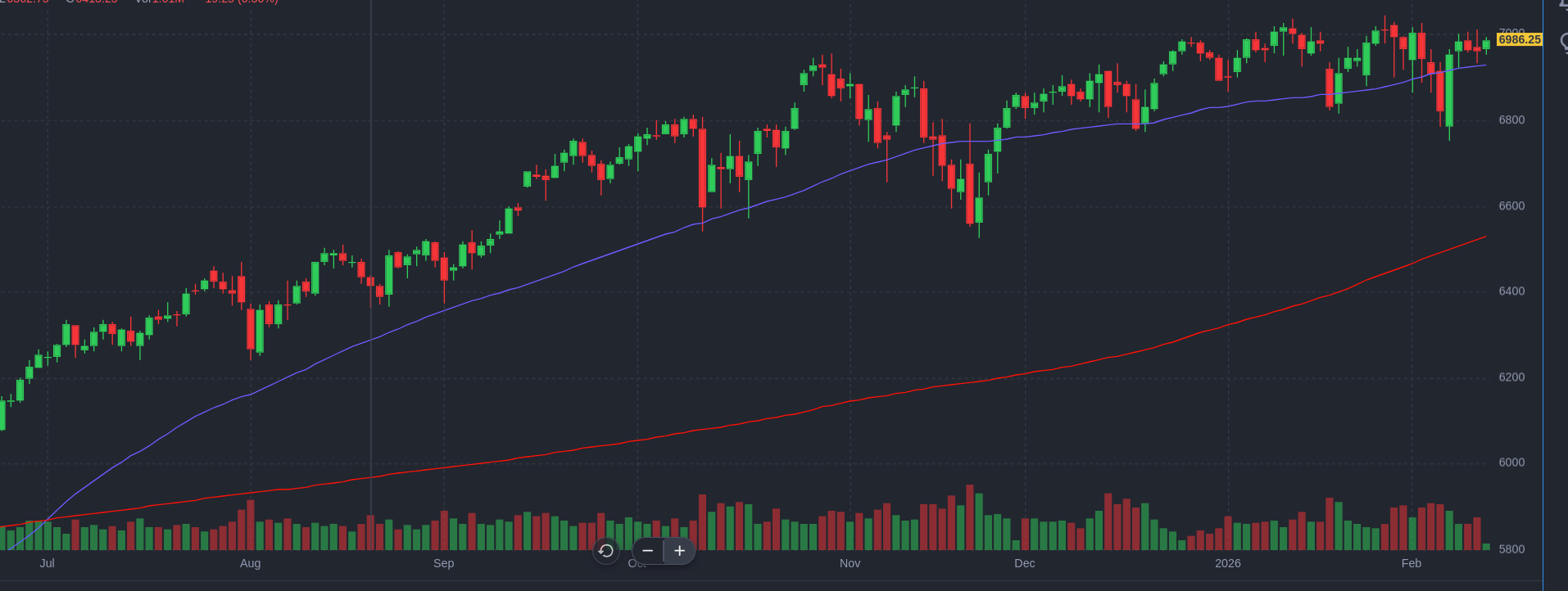
There’s greater concern that the investments made by the hyper-scalers will ever come back in terms of revenue. Rather than paving a road to a bright new future, a good portion of a 200 billion dollar capex spend may just be lighting cash on fire. But if they don’t, they will get left behind. If you look at the chart of the S&P 500, you see for the last month or so, it’s flat. Suggesting new money isn’t moving in, but money is just sloshing around.

But what I’m not seeing is a clear message, other than the ball of money looking for someplace else to wallow. A rotation away from growth (like technology) to defensive sectors (like consumer staples), indicates a belief the economy is due for a pullback. You focus on the things people have to buy, rather than the things businesses buy or are optional.

But, if you take a look at consumer discretionary, and remove Tesla1 and Amazon, you see people are buying both counter and pro-cyclical segments. At the same time they’re buying energy producers (pro-cyclical), they’re also buying utilities (counter-cyclical). People and businesses use less gas and other energy during a pull back, while they still have to keep the lights on. It’s not a thesis about the health of the economy, but rather just a re-jiggering of their portfolios.

And while the “vibes” aren’t great, the numbers don’t indicate an imminent collapse. Yes, the jobs numbers for all of last year were low, but the available workforce did not grow that much. There were about 1.7 million new people in America (0.5% growth all from immigration), and assuming they have the same labor participation rate as the broad population, you only needed to create about a million new jobs at the high side (because we’re also aging). We created about 181,000 jobs (20% of that number), but guys in front of a home depot don’t show up in the jobs number. So the economy is probably doing somewhere between “okay” and “well,” with some sticky inflation.

There will come a point where the large areas in the heat map transfer money to smaller areas, bringing up their “multiples,” or the price of the company. It won’t be based on earnings, but rather because you’re trying to fit a big wad of money in a smaller place. It feels like if we had less money sloshing around, we wouldn’t get ridiculous valuations. And maybe the relief value for all this is money moves overseas, pushing the dollar down and other currencies up. But I’m just guessing. My crystal ball is at the shop.

And this is not investing or investment advice to you, or anyone. It’s is provided for your entertainment purposes only. And if you are investing, contact a professional before making any decisions. Buying and selling stocks, futures, or any investment is a risky activity and can cause you to lose money, including the principal which you invest.

  1. Every time someone makes the case for Tesla, I become ever more convinced it’s either a meme stock or a religious conviction. But it’s not based on their actual revenue. ↩︎

A Not So Quick Note on Jobs Report

The fun thing about the jobs report is re-interpreting it to better suit your political leanings. “Yes, but they’re not good jobs.” Estimates were in the 70k ballpark and the number came in at 130k. There was also slight wage inflation. This makes a rate cut less likely in the next few months, Warsh or no Warsh. The bulk of the jobs came in health care and education, with the government losing jobs. We’ve been assuming that the interest rates have been a drag on the jobs market but the economy may have adjusted to having any number other than zero as an interest rate. In fact, there’s a case for an interest rate increase in the coming year.

  1. The last mile on inflation is sticky, which may mean rates are not high enough.
  2. If the economy is expanding and pushing up wages at 3.5% funds rate, the neutral rate may be higher.
  3. Inflation may accelerate if GDP continues at its current clip and wage pressure continues to rise.
  4. Aggressive spending (like a 45% increase in the DoD budget) may fuel more inflation.

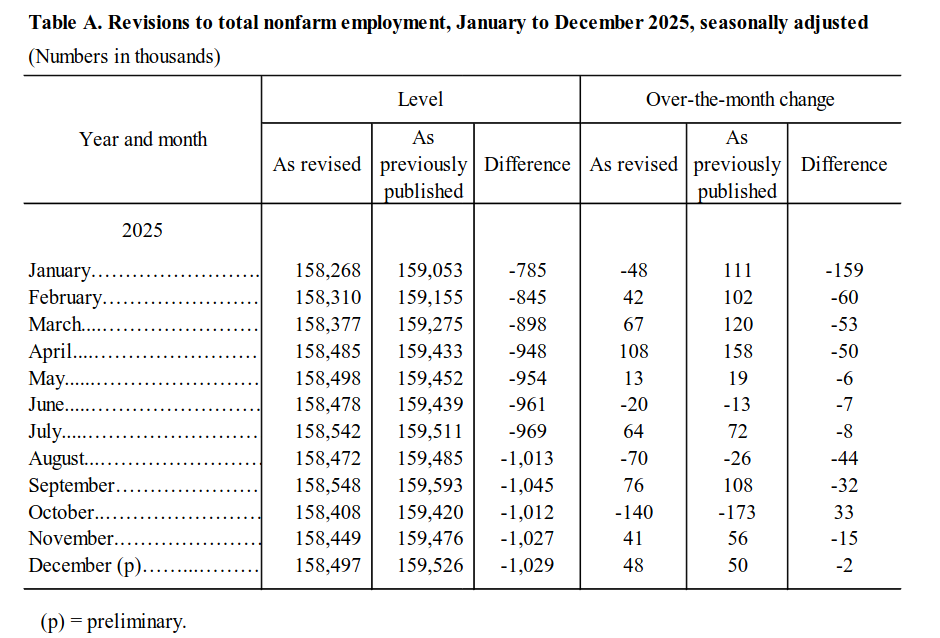
But here’s the thing. Don’t read too much into one report. Next month could surprise down by 50k. Who knows why – there are some long-standing data collection issues. The numbers will bounce around, especially as they get revised. There’s the table of year end revisions to the 2025 reports and it’s illuminating.

We created (revised) 181k jobs net last year. Maybe the yardstick of over 100k per month for a growing economy doesn’t make sense in a country that may start to experience population declines (as we shut off the immigration flows). That’s been the number I’ve used to evaluate jobs reports, but net migration to the US (by policy) is intended to be zero. We’re not fucking enough to make enough new kids. In fact, if the population isn’t growing, and it’s just aging. Wouldn’t slight job losses, but more jobs concentrated in healthcare, be a good jobs report? Maybe the yardstick should be net zero jobs near full employment? And only shrinking and growing during recession or post-recession recovery?

As I think about this, I start to think about the elasticity of wages with respect to growth. Once we push up against full employment, wages need to rise to get more workers into the job market. How much do wages need to rise once we get more workers into the job market? If we go from 4.3% unemployment to 4% unemployment (very low, historically), do we see wages shoot up enough to drive inflation? But if we get not much more slack than 4.5%, do we see wages falling? That would suggest wages are inelastic with respect to employment near full employment. I suspect the same isn’t true in a recession, if unemployment spikes to 7% or 8%, and much smaller (if any) increase in wages are needed to bring down unemployment. We go from having a Philips curve to a Philips hockey-stick.

It also has some implications on growth. A shrinking population suggests that growth that’s slightly too fast results in inflation. With a growing population, part of growth simply goes to absorbing new workers. You need to grow, otherwise you quickly accumulate large masses of unemployed people. And I suspect it favors younger, less experienced workers, as you can hire more of them to replace older workers. They are cheaper and plenty of them. But what if a shrinking population size makes you risk averse, preferring to stay with proven workers rather than bringing in new, lower return, unproven workers from a smaller (and therefore not much cheaper) pool? Maybe that’s why Europe has had a persistent youth unemployment problem?

Hear me out on this brain fart. In a fixed population (or shrinking population), you basically trade one worker for another. When Bob retires, Alice steps in. You knew what to expect with Bob. Bob was very well trained. In Bob’s cohort, unemployment is like 2%. To balance that, in Alice’s cohort, unemployment needs to be higher, say 10%, so on average, we have that magic non-inflationary level of unemployment. But Bob is old and Alice is young. Alice would be much cheaper, if we had a larger pool of Alices than Bobs.

But there aren’t a ton of Alices sitting at home, vaping and playing Call of Duty. Alice is a risk. You could bring in Alice, train Alice, and then lose Alice as she’s offered a better job by your competitor. In addition to the fact you need (say) 1.5 Alices to equal one Bob until Alice gets a few years of experience. Whereas they are not likely to poach Bob, and Bob would probably not get a better deal if he moved. You have an incentive to hold on to Bob and only hire Alice, if Bob leaves. And if one Bob leaves, a slightly younger Bob would be preferable.

Once Alice’s cohort comes into jobs, their unemployment also drops to some low number. But in order for that to work, the unemployment among new workers has to stay fairly high. Maybe I just made a realization labor economists have known for years. In any case, I think we’re going to have to get used to flat jobs reports and more of our workforce moving into healthcare. Otherwise you wind up with inflation pressure and Boomers dying on the side of the road.

Fantasies and Grifts

I can’t be arsed to watch Kid Rock. And it turns out what’s been panned as a half-baked alternate half-time show for religious fundamentalism meets misogynistic hedonism, wasn’t even live. What this has to do with the fact of the last four reads on consumer spending have been weak, will not be explained to your satisfaction. But I would say about a series of weaker than expected reads on consumer spending are notable. I would also say there’s no clear answer or indication from this number. No one at the Fed is wringing their hands over this (I hope). For meany reasons I’m bearish on the average consumer, but I think my belief is grounded in murky reality rather than just a fantasy I have great insight.

Which brings me to a meditation on the word “fantastic,” which today means “wonderful1” or “great.” But traditionally meant beyond belief. “That was the most fantastic story,” wouldn’t have meant it was a great story, but that it was wild and fully of unbelievable things. A fantasist is a person who lives in fantasies or promotes them as fact. Someone can be a fantasist can be a fantasist for several reasons. They may actual believe the ideas or not believe the fantastic ideas, and for a variety of reasons. They could range from a poor education to a calculated grift perpetrated on others who find the fantastic ideas alluring.

Which is why we always need to find a yard-stick of reality against which to measure the thing we believe or would like to believe. For example, that idea that Kid Rock has any mass appeal in 2026 and be compared with whether or not he sells albums and sells out large shows. He does not, and his listeners are mostly white younger Gen-X or older millennials. Whereas Bad Bunny (Malevolent Rabbit when he grows up?) has a clear, broad appeal.

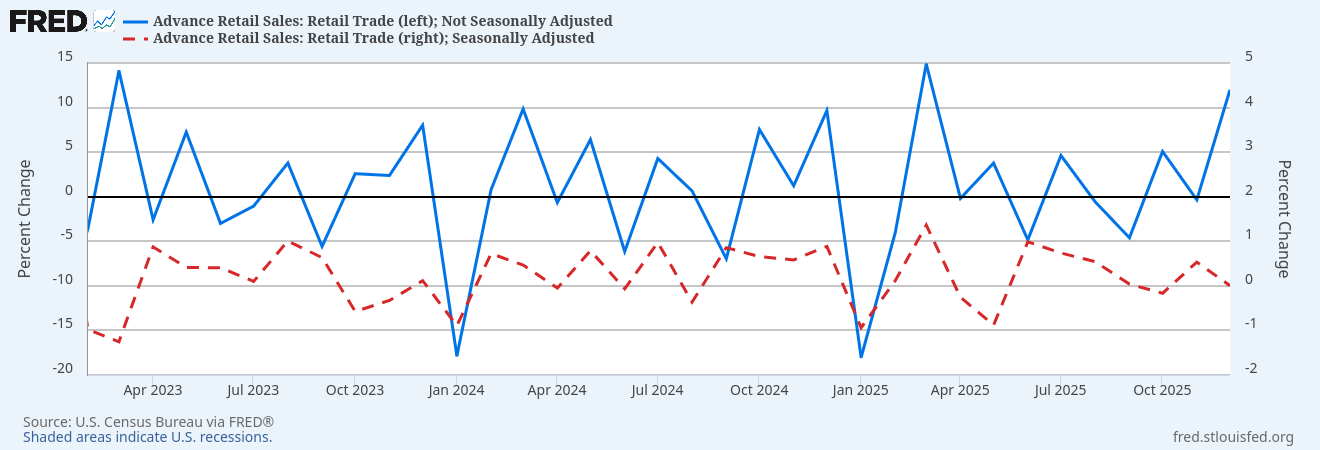
Is the weak consumer fantastical thinking on my part? Looking at month over month consumer spending, for the last few months, I think the consumer is weaker than many expect. Profit warnings from consumer exposed companies like McDonalds and Pepsi reinforce this thinking. If we sum up the actual changes, month over month, for the last quarter, we get 0.6. The sum of the expected is 0.9, or about 2/3 of expected. That’s not a bright, flashing light saying the bottom is dropping out of the consumer market. Rather it’s an indication the bias of professionals is toward the upside.

Note that it’s a really noisy number with a lot of seasonal adjustment. The line in blue is the unadjusted number, which can jump around from -17 or -18 percent to +15 percent. The axis for the adjusted number (in dashed red) is on the right, so it’s not “negative”, but it is visually below the unadjusted numbers. Picking three months out of a noisy number is not a great basis for making predictions (especially about the future). And companies like to lower the expectations bar so they can play the “let’s all surprise to the upside” game. Maybe Pepsi, Starbucks, McDonalds and so on are just trying to set a lower target to beat. I could be wrong about the consumer, but if I am it’s not because my thinking is fantastic. Rather I just see the tea leaves slightly differently.

There is a perma-bear grift economy (or perma-bull). On YouTube you can find plenty of “the consumer is collapsing, buy bitcoin now using my proven three step method” videos. Or a depression is coming, buy emergency food for your bunker pantry. I have to think the Venn diagram of people who think a broad audience would really want to watch the TP USA half time show and the people who would buy into a trading grift have a high degree of overlap. They don’t want to see the world as it is, but as they would like the world to be. I’m not happy the consumer is weakening, and I would rather live with broad prosperity, but I don’t think the numbers are lying. Maybe a little misleading, but something is up.

  1. As “wonderful” also once meant full of wonders or amazing things. A wunderkammer is a room full of amazing curiosities, like rare or beautiful specimens. ↩︎