I Was Not Alone and ADP

I think I was not alone yesterday in looking at the big blob of money wandering around. At one point it looked like the market was going to be broadly down, because the options are depressing. As the blob of money lumbers out of tech and into not tech, valuations wind up rich, especially given rates. Here’s a way to look at it. Take a company that has about a 3% real long term return through a combination of price appreciation and re-invested dividends. I say “real” to mean inflation adjusted. That means every 24 years, or so, you double your money in real terms. The nominal (or not inflation adjusted) rate of return might be 5% (assuming a 2% rate of inflation).

You could also buy bonds, which might be paying 2% in real terms. (The nominal rate is 4% but there’s 2% inflation). If you reinvest the dividend, you double your money in real terms in 36 years. But the bond is considered near zero risk (given the time horizon) while the stock may or may not pan out. Even a very stable business with a simple and straightforward revenue model may not survive all 24 years. Or, like GM, it may stumble repeatedly. 10 years of bad management and shrinking margins may seriously undermine your 24 year plan. The stock has more risk than the bond (which does have interest rate and reinvestment risk – but we’re eliminating interest rate risk by holding to maturity and assume the the reinvestment risk averages to zero over 36 years).

One way to look at the double your money equation is to say you bought the company for cash, today. Every share. How long would it take to make that money back? Well, your money doubles, in real terms, in 24 years. That means it will take 24 years to make your money back. The company earnings are what provide the price appreciation and dividends (although stock buy-backs are seen by stupid investors as more tax efficient). So how much would you pay for one year of that company’s earnings? It’s simple, 24 times. At that rate you should have accumulated enough to buy the company outright in real terms.

That leads to a fairly simple model of how to anticipate the change in value of the company, given the interest rate. If the nominal interest rate goes down to 3% (but holding inflation at 2%), then we would be willing to pay more for that company. Why? Because it would now take 72 years to double our money with the bond versus 24 years for the company. While the company has more risk, it is is more attractive and we would be willing to pay maybe 36 times earnings. We’re taking higher risk, but more reward than the zero risk option. Likewise, if nominal interest rates go up to 5%, and it now takes us only 24 years to double our money with bonds, the company looks less attractive. It’s worth maybe 12 times earnings, for the given level of risk.

That’s the “perfect world,” thought experiment view of valuing a company. The giant ball of money screws with that by suddenly injecting a ton of buying into that company. CNBC and influencers talk about the massive run up in the company. Other idiots then try to follow the trend. That company should be trading 24 times earnings long term, but the ball of money pushes it to 30 and the idiots help drive it to 35. Retail investors get sucked in because “this time it’s different.” Retail investors are left holding the back when the ball of money chases the new shiny thing. The smart money that owns much of the ball gets out at 35. Retail investors ride it down from 35 times earnings to some over-correction down to 18 time earnings, essentially turning over their wealth to the great ball of money.

Which brings us to the ADP report. Is the ADP report an accurate gauge of employment. Not especially. It is a little erratic. But if we look at it over the last few months, we see it’s trending down. And most of the delta between the expected value and the reported value surprised to the down side. The former is consistent with a slowing job market hypothesis and the latter is consistent with most professionals being over-optimistic about conditions. But the picture is cloudy, not clear. We have the Schrodinger’s job market, that’s both good and bad at the same time depending on which number you look at. And that also feeds in to conflicting data, such as manufacturing in the US expanding, but not manufacturing employment.

There is no one number that tells you how the economy is doing. There is no set of numbers that tell you how the economy is doing. In truth, we’ve had a lot of change and I think some numbers, like first time unemployment claims, are no longer indicative of much. While I used to write off ADP as only useful to get journalists on TV hot and bothered when it dropped a wild number, the government jobs number has had a series of issues with major restatements. Companies (for whatever reason – but in this day and age it could be ideological) are failing to report on time, requiring the economists to produce a less accurate estimate. It has never felt so hard to get a bead on the economy.

[Update] Services PMI came in as inflationary to me. Although employment continues to grow in services (which is much larger than manufacturing). New orders are still growing, but slower.

The Great Ball of Money Lurches Away from Tech

This morning, as I shake my head at the lack of JOLTS data from the BLS, I watch the great ball of money lurch from Tech to not-Tech, like staples. Unfortunately, the multiples for many consumer staples companies are already on the high side of normal. For example, PG is at 23, which represents confidence in what is essentially a flat business. Unlike the mythical tech company (and I say mythical with great intention), PG and the other staples are businesses that are both stable, with low but predictable margins, and scale linearly. If they take a little market share this year in one category, it doesn’t mean winner take all. They don’t have 40% ore more margin products. There is no network effect around dish soap.

I have a number I think of when I look at a fair valuation for Nvidia (hint – it’s much lower than it is now). And while I look at AI as having merit, my arguments relate to how much do you want to pay for the productivity. In my own field that productivity is mixed and sometimes requires you to ignore quality. But right now investors are heavily subsidizing AI for consumers and businesses. The question of how much a company would have to charge for a sustainable AI service is open for discussion. We may have a gentle deflation out of Tech but it may mean that PG winds up at a PE of 30? Or maybe 35? That’s a little rich. Because the big ball of money doesn’t know where to go so it just keeps buying and selling.

The impact the draw down on Tech is having is an advance decline ratio of roughly 6:4 (meaning out of 10 random stocks six are up and four are down), but the NASDAQ and SP500 are down. The DOW is treading water, but the Russel 2k is up. People are looking to higher-risk, smaller stocks. As I look at that, the big ball of money is pushing into not-Tech with industrials, consumer cyclicals, and basic materials punching up. That’s in line with the data suggested by yesterday’s ISM – that low inventories are going to drive up production.

It seems like there’s more money sloshing around than value to absorb that money. It’s not floating around in the economy as money to spend (other than through the wealth effect). So it’s not growing anything. It’s sloshing around inside markets, driving growth through multiple-expansion, drafting in more money as people look at the number go up and want to join in. All of which, I’m afraid, makes this gambling more than investing. Jump on the band-wagon, ride it up and then bail before the hammer comes down. But you better get in now, otherwise you’ll only get in at a higher valuation in the catch-up trade and have less runway.

The big ball of money will concentrate into a smaller and smaller chunk of the economy as it sloshes around. With dumber money getting swept up by smarter money. Assuming we just plod along for another couple of years and look for articles that say the top 5% are 50% of spending. Only at those levels they don’t go out to eat more, they just buy $25,000 pizza ovens for their $750,000 kitchen remodel. So the economy will look weird as McDonalds, Walmart, and Target struggle, as household consumer names lurch in and out of bankruptcy and private equity, while Porsche and Rolls Royce are making book. GDP is up. The market is up. But the bottom 80% are just fucked. And you can’t have a democracy when the bottom 80% feel like they’re getting the shaft and locked out of number go up.

Note On PMI

The ISM Manufacturing PMI report shows increased manufacturing activity. In step with the hot PPI we see that prices are increasing. Customers have drained their inventories (which is in line with delaying purchases until there is more clarity or a reprieve on tariffs). That may be pulling up production to fill the backlog. It will be interesting to see what happens if the tariffs are gutted by the Supreme Court and the administration is required to pay back any collected tariffs.

I view this as mixed, but positive. There is definitely price pressure, but customer inventories are so low that this should pull up actual manufacturing at those higher prices. Employment is still contracting, which implies higher productivity (either through automation or overtime). Not sure if an unwillingness to hire indicates people want to see more of a trend. But, if costs are going up, and low inventories are driving forward production, this means that we should see inflationary effects. At some point customers should start passing on costs through higher CPI prices.

Well, maybe higher CPI prices. It depends on whether or not the consumer is able to tolerate those higher prices in the coming months. Two scenarios could play out, given half of all spending is now done by just 10% of the population. A declining equities market reduces spending as the top 10% see their wealth declining. In which case the prices may not show up in the CPI, they will drive down margins for retailers. The second scenario is the wealth effect is not strong/the equity market holds, and people just eat the inflation. That will push off rate cuts even further.

The Downside of Flooding the Zone

Trump has Overwhelmed Himself,” by Ezra Klein, points out one of the problems with flood the zone. That it removes focus from the ones doing the flooding. It makes it feel like the entire White House is in chaos. I don’t know if Trump supporters see it that way, but for those who pay attention, it floods their attention as well. I assumed it would have a built in advantage because of the short attention spans of most people. Something horrible happens in the US, something that feels like we should never forget it happened. A year or two later we see a news story about an anniversary of the event and think “wow – that happened and I should not have forgotten.”

As much as the murder of Alex Pretti at the hands of paramilitary forces is tragic, will we remember a few months from now? What horror shows did you remember from 2025? Do you remember he gutted US AID? Do you remember DOGE rifling through government databases, in locked rooms, with no supervision and the windows blanked out? Do you remember the insanely ridiculous tariff calculations? Signal gate? And we’ve become accustomed to the absolutely corrupt use of the pardon power. The president has been issuing pay for play pardons to convicted scammers. That’s a thing. It barely makes the news. Remember when Clinton got roasted for a couple of questionable pardons at the end of his second term? Trump does that and more on a weekly basis.

I think part of the flood the zone strategy is to keep crisis after crisis going so the real problems don’t surface. Look at the companies footing the bill for the ballroom or the sycophantic Melania movie. Alone, in previous administrations, would have come across as so corrupt as to be career ending. However, when we’re threatening NATO countries, who’s paying attention to the graft from World Liberty Financial, the Trump crypto scam and bribe channel?

I don’t know if Trump wants to run again. But if he doesn’t, he’s going to walk away with as much lucre as he and his family can steal. The party that went purple in the face with rage over Hunter Biden clumsily parlaying his supposed connections to wealth, became the story of the “Biden Crime Family.” And yet turn a completely blind eye to overt corruption. They can because we’re screaming about whether or not the government has to respect the fourth or first amendments. The courts plod along on these cases, with the shadow docket in the tank for Trump. Only going to bat for the constitution and norms when money is involved. Any sense the Supreme Court was non political has been dashed and as far as I’m concerned, sympathy for my causes is more than jurisprudence.

I think it’s too early to declare “Flood the Zone” a dead strategy. Because Trump knows he’ll walk away with billions, hidden behind a screen of outrage. The next president will likely face new limits on their pardon power or power to gut agencies. This is especially true if the next president is a Democrat and the Supreme Court will suddenly rediscover the constitution limits the power of the President.

How to Weaponize Your Own Mess

What links the working class elements of Brexit and anti-globalist American right is a belief the world order has exploited them. The messaging and thinking isn’t precise, because these are not informed opinions. David Ricardo has been right for the last 211 years, from 1815 to today. Trade makes both countries wealthier. What Ricardo didn’t say is how that wealth would be distributed (although I think he assumed it would be a broad lift in living standards). Also implicit in the reasoning around trades is that other aspects like environmental or human rights protections would be respected. In the ideal view, one country doesn’t become the efficient supplier of a good because it’s willing to work enslaved people to death in toxic conditions.

There’s an old economics joke. Stick your head in a 400 degree oven and your feet in liquid hydrogen. On average, you’re fine. A lot of inequality is elided away in mass averages. It comes to light when we break these statistics into quintiles, quartiles, or the top/bottom X percent. There are are so some synthetic measures, like the Gini co-efficient for the US is 41 while 29 for Germany, while the GDP per capital in the US is about 90,000 while Germany 57,000. On a per-capita basis it’s better to be an American. But the likelihood that you share in that wealth is lower. It’s kind of like people wax poetic about medieval times but forget that in all likelihood they were a peasant working as a near slave for the feudal lord.

What has happened in the UK and the US is that the distribution of benefits from trade have not been distributed evenly. There was a belief that the system would work it out in the end. You lose your job in the industrial North of the UK or the rust-belt of the US but something else comes along. Like you leave the assembly line and start designing AI accelerator chips or turn to writing software. In fact, what was needed, was a re-distribution of wealth by the state so the benefits of globalization were more evenly distributed. By the way, the Gini coefficient for the UK is about 35.

The benefits of trade were delivered unequally, benefiting capital more than labor. That capital also became militant about not raising taxes or wealth redistribution. After all, are you advocating for class warfare by asking billionaires to pay a reasonable tax rate? Why do you want to tear society apart this way? Go back to your squalid little pens and rejoice in the social order, you troglodytes. Oh, and breed more little troglodytes because we’re running out of consumers.

It cost Bezos a mere 75 million to produce the Melania movie as a not-so-under-the-covers bribe to the Trumps. That money was found when Jeff turned his couch over and collected what fell out. That’s how much money he has. He has been a principal beneficiary of freeing trade and intends to keep every red cent he’s ever earned from it. For Microsoft or Apple to put up money for vanity projects like the destruction of the East Wing of the White House to make way for a gaudy ballroom, it is not a sacrifice. These are companies that don’t worry about millions of dollars. That is a rounding error in their day to day change in capitalization, and the personal wealth of their founders and leaders.

But… But… But… Look at the tariffs! Those are anti-trade. True, but you also need to look how they’ve been turned into a patronage system (by offering individual companies a way out in exchange for obsequiousness or out-and-out bribes), and the loopholes and exemptions lower the effective tariff rate. But for the Trump backers, it means they will pay a lot less money in taxes. If a Harris presidency might mean an extra 50 million in taxes, spending 5 million on PACs is a reasonable investment. Which is how the rich view politicians. As investments. In fact, they got a boon with Trump.

Those same people who benefited from trade. Who were the main beneficiaries of the 2008 bailout, and seemed to wind up with the lion’s share of the COVID stimulus, have weaponized far right parties to prevent any attempt at redistribution. Making people so angry they put the party of the oligarchs and plutocrats in power is a master-stroke of genius. And all the while absolutely castrating the opposition, who is just as needful of their patronage. They are like the clever player that starts the NPCs combating with one another while they watch and plunder the resulting treasure. Exploiting the lack of social cohesion, and the politicians desperate for money, keeps them in effective power and keeps their money safe.

Before you start reaching for the revolutionary pitch-forks, keep in mind that a bulk of these folks seem to survive each revolution. They are the cockroaches during upheavals. Whether it was the Russian revolution, or the French revolution, or the American revolution, a lot of these folks wind up on top. Our best bet is not revolution. It’s putting aside our emotions, our clever memes and slogans, and our sense of “team” to actually look around. Using our clear-eyed view of the world around us to vote for change. I don’t expect a lot from Mamdani, but he is the result of the ‘establishment’ left foisting an unpopular candidate that preserves the status quo. People gave the establishment left the great, big, stanky middle finger rather than support a sex pest.

Take in the world with a fresh eye. Look at the fact Amazon and many other companies benefit handsomely from trade, that trade will bring in wealth, but maybe that wealth shouldn’t be concentrated into so few hands. Look at the private equity players who purchase companies with debt, load those companies with more debt, sell them, bank their proceeds as capital gains or income, to do it all over as those companies declare bankruptcy. Minting their income through debt, massively reducing their tax burden, but in the process devastating the lives of millions of individuals. And realize they’re the ones priming the coffers of groups like the Heritage foundation.

At the end of the day, nothing changes until we change. We continue to be the NPCs screaming at each other about this or that issue, while the players sit on the sideline and laugh. Red team versus Blue team, while the green players reap the rewards. If you want any better evidence, in the first Obama administration, the democrats had both congress and the White House could have easily fixed the loophole that allows private equity partners to earn their money at a top rate of 15%. They did not. Because the private equity partners are the people the phone banks staffed by your congress person call to raise money. Now those same groups have decided their future money interests are better served in an autocracy, and they’re using the misery of millions of Americans to do that. A misery they created in the first place.

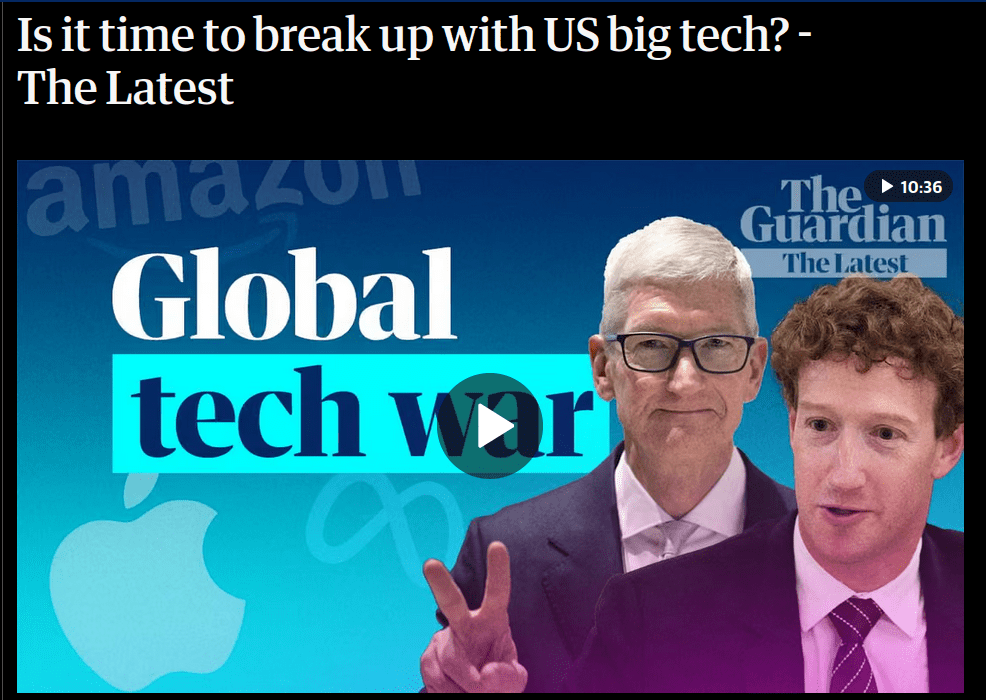
Tech Bros Are Going to Lose Europe

The Guardian asks. First off, it’s not that the European version of these services do not exist or need to be built from scratch. But that’s not the reason to switch. Until now, US elections, even 2016, produced reasonable outcomes for Europe. Now they have an agent of chaos more than an ally. A country that foments division among its alliances and has stated that a weaker Europe is in American interests. And so much of their communication is funneled through American companies. Companies that have shown a willingness to cooperate with an administration that shows a willingness to use the levers of government in a retaliatory manner. This retaliation could be illegal, but there has been little interest in the Republicans to stop it and there seems little ability (either talent or power) for the Democrats to put an end to it.

Even if the cost is a little higher (with the US being the low cost producer), it is the insurance you pay for having a functioning society. For the same reason you might choose the Grippen over the F-35. Maybe have some F-35s, along side a mix of other fighters. Should the relationship with the US result in a suspension of the contract for maintaining the F-35, or the US out-and-out prohibits their use in the defense of Europe, there is a plane Europe can fly. The resulting insurance against being effectively disarmed by America may be worth additional cost. As would be securing broader sources of many products and services.

But let’s say the 2028 election produces a left-of-center Democrat who is able to assume power. What is the guarantee they don’t pursue some of these policies because of political expediency? There are many instances where a policy unpopular with the winning voter coalition are continued. There is no guarantee that the new administration drops those policies on its first day in power. And what if it loses power to the ideological continuation of the Trump administration? What happens if, in four years, Marco Rubio decides it’s better to rule in hell as a populist autocrat than to serve in heaven? At this point, from an outside observer, I would imagine even Donald Trump Jr. would not be an impossible outcome in 2032.

But there is something coming with AI generated search results I think Europe underestimates. They can be primed to deliver answers that promote division and fringe movements. This could include AI summaries of documents or the generation of material from AI. These could be over-the-top, cringe inducing, obvious trolls to very subtle wording or choosing what information to present. And should Europe complain, threats of tariffs or outright cut-off of these services follows. Or EU leaders are sanctioned and cannot access their digital (or financial) assets.

So yes, Europe needs to figure out what would help. Making it cheaper to start businesses in Europe? Sure. Ensure these companies have guaranteed revenue through government contracts? Maybe. Changing the laws to withdraw from the anti-circumvention features foisted on the EU by previous trade negotiators? That’s a good idea. If Apple threatens to cut off iPhone access to the UK, for example, return the favor by making it legal to jail-break your iPhone and install alternate services. Tax the profits of tech companies to help pay for it? Even if you wind up taxing your own tech companies, the money might come back to them in other grants or contracts.

Right now the US companies have market dominance. Let’s say they have 95% of the office software market. The EU shouldn’t try to retake the 95% at once. It should just focus on reducing dependence on the US to 85%. From 85%, 75% feels possible. Because a lot of tech is based on network effects, as other companies plug in to the services of other companies, each tranche becomes an easier target. Just start with critical pieces, like your ability to share documents securely and e-mail. And start with the easiest part to control, your own bureaucracies. At some point you’ll need to worry about other cloud services, or even the content on social media, but it will be from a stronger place.

On Tap for Next Week

Next week is going to be a pretty news-heavy week.

  • Monday – Institute of Supply-chain Managers (ISM) manufacturing PMI
  • Tuesday – JOLTS
  • Wednesday – ISM services PMI
  • Friday – Payrolls, Unemployment Rate, Consumer Sentiment.

Outside the weekly unemployment claims (which may be a useless metric right now), I’m looking at the JOLTS number to see the level of openings. I think it’s exaggerated, as companies have openings for jobs that are unrelated to an actual job for which they would hire someone, the trend is important. And Friday, of course, we get the higher quality read on jobs. However, it has been plagued with data collection problems for the last few years (blame the respondents not turning in paperwork or delayed paperwork rather than “cooking the books”).

What I’m looking for in the ISM numbers is data related to prices. Do they indicate inflation pressures? If there are price pressures, I’m expecting to see price pressure on the CPI number week after next. That would mean short term rates should stay steady for now. That’s going to put upward pressure on long rates (over 10 years). The 10 year rate is the rate that has a clearer impact on economic activity. The Fed only has influence over short term rates. As we get to 5, 10, 20, and 30 years, their influence fades and other economic concerns (such as inflation or economic growth) come in play.

PPI Came in Hot

What we have now is the PPI coming in a little hot. What I’m looking at specifically is core PPI came in hot. (Stripped of the more volatile components. This is what I would expect from tariffs. We tend to think of tariffs as impacting just end user commodities, like wine or automobiles. But it also impacts goods used to make goods, such as the input steel or the machine needed to punch that steel.

Is it really from tariffs, which would definitely be a competing factor. There are multiple mechanics at play. One is how sticky producers expect tariffs to be. If you see a TACO moment coming, or a Supreme Court about to throw out the tariffs, you don’t want to annoy your customers with a sudden price hike. Especially if the court allows you to recoup your tariffs from the treasury. You could eat the costs and burn down the inventory built up prior to the tariff being applied, hoping to replenish it in a low or no tariff environment. This strategy has a limited life span. We’ll know February 20, whether it’s a realistic strategy.

Next is the swiss-cheese nature of the tariffs. There are significant exemptions or carve outs that lower the effective tariff rate well below the statutory rate. Just ask Apple. You say it’s a 25% tariff but then exempt several sub-products or specific companies, meaning the macro effect of the tariff might be 10%.

Then we have supply chains re-adjusting. Some companies may have imported part of something from China, like the motor, castings from Mexico, shipped it up to Canada for paint and assembly, and then back to the US for the electronics, partly imported from China and assembled in Mexico. They might look at that machine and decide it’s better to just make it in Canada and pay one import tariff.

Next, some companies just paused imports for a while, meaning you couldn’t buy the imported thing, as they were figuring out how to file the paperwork for the product. Now they’ve figured it out or adjusted their supply chains and can now start importing those goods.

There are a set of reasons as to why the tariffs may have had delayed impact. And those impacts sit on top of the month to month noise in the PPI. That noise is a product of both problems in data collection (with respondents more likely to be late in their replies) and just variability in behavior. It could very well be that the tariffs would have had a more noticeable impact over the last few months, except for noise. Or this month is the aberration and the actual tariff impacts have been swiss-cheesed into a nothing burger. And as we get 12 or 18 months of data, it will become more clear.

I Feel Like Tesla Analysts Are Insane

Listening to this idiot, it almost feels like he doesn’t even really care. Elon has lost his fucking marbles, scrambling his brain withe ketamine. The one Tesla product he had a strong hand in, the Cybertruck, is a worthless piece of crap. Sell side analysts will gladly tell you its raining while pissing on your leg, but even this is just cringe.

Back Door Default

The price of gold used to be fixed as a matter of law. The price for gold was set by the US at $20 an ounce. A one ounce gold coin was worth $20. During the depression, Roosevelt raised it to $35. That was not the same as a default on US debt. But it was a default on US debt. The day before the change you could trade $20 for an ounce of gold and an ounce of gold into French Francs. The day after, it would take $35 to buy the same amount of gold. Since the Franc had not been depreciated, it meant you could buy fewer French Francs. But international trade and finance was much smaller in 1933. If you were an American sitting on a pot gold, you were suddenly 75% richer, but you were forced to sell your gold to the US government at the stated price.

Within the United States it meant the Federal Reserve could print more money, as the same amount of specie backed 1.75x the amount of dollars. (At a time when the supply of dollars was fixed to the amount of gold held by the government). In addition, it made US exports cheaper, as the same amount of French Francs netted your more dollars to buy American made goods. The United States continued to pay the coupon on their debt. But, could do so with cheaper dollars. If I recall, this was eventually ruled by a court as a default, but it wasn’t a default in the sense you stop paying your bills. You just made it easier to pay your dollar denominated bills.

The US is a reserve currency. Meaning that instead of gold, countries are willing to hold dollar denominated assets (along with dollar deposits) as something freely convertible to Euros, Rials, Drachmas, Lira, or however the local Sheckel is denominated. There are few people or few countries that would not take the US dollar as they can sit on it or turn it over immediately for something else in a highly liquid market. And US issues government bonds are both dollar denominated and pay interest, accumulating more dollars. Holding gold as a reserve does not cause the gold molecules to generate more gold. In fact, the dollar gets more valuable when the Federal Reserve raises interest rates and more people demand more dollars to buy more US bonds. As long as the value of the dollar holds, the reserves are safe.

The problem is the United States is indebted to the tune of 125% of GDP (compared to Europe’s average 85% and Japan’s over 200%). There is no magic number that says X% of GDP is a threshold above which a reserve currency falters. And the rules of the United States (with the primary reserve currency) may be different than the reality for Japan’s Yen (when is in the ‘other reserves’ category). Since the US makes the dollars in which its debt is denominated, you don’t have a repayment risk like you have with, say, Argentina. Argentina can’t (legally) make more dollars to pay its dollar denominated debts. It has to trade real good for those dollars. Meaning a default and devaluation of the peso by Argentina largely makes the population poorer (as a whole) although some individuals (with big dollar holdings) richer.

This is why the analogy to a household budget or comparisons to Argentina don’t work with America. A household that could print its own currency, if widely accepted as a reserve currency, could borrow as much as it wants. Dad could buy a Mercedes Benz S class, promising to repay in “family bucks.” They family prints “family bucks” so repayment risk isn’t a problem. The problem is they flood the market with “family bucks” and the currency gets devalued. This also breaks down because the size of the market for US dollars is incredibly huge. It’s well beyond the needs of the United States, as China and Australia may use dollars in their trade (for example). It would be more akin to everyone everywhere using Family Bucks, so printing a few extra Family Bucks is not a problem. The market absorbs it like pissing in the ocean.

So the holders of US dollars and debt are perfectly safe, right? No, they are not. There are risks for investors. In order of my belief in their likelihood are devaluation through inflation, and a partial default. These are “cut off your nose to spite your face” solutions to America’s fiscal and social problems, but we have an administration that wakes up every day with a nose cutting cleaver in hand. Right now the world is searching around for alternate reserves. Gold has almost doubled in price in the last year. And as much as gold can skyrocket in value, it has also crashed. It is much more volatile than holding Euros or Swiss Francs. No sane person wants much gold exposure as a stable reserve, but the Euro and Yen aren’t ready to take over the dollar. So why are people moving away.

Let’s start with inflation, which I think is the more likely avenue. It’s not quite the same as the dollar being devalued against gold in 1933, but similar. Easy money and an inflation causes the value of the dollar to fall. For example, if you have 6% inflation, it will take about 12 years for goods and services to lose half their value. If you paid $30,000 for a car, in 12 years the same car would cost $60,000. (Your mileage may literally vary as different goods and services will respond differently). But it also means if you buy a 12 year bond for $1,000, it will only be worth $475 in current dollars at the time of redemption (when you get the face value of the bond back). By comparison, it would be worth $785 (in current dollars) if we stayed with 2% inflation.

When inflation risk is seen as a temporary aberration, interest rates do not move much. If bond buyers suspect sustained inflation they will need a combination of coupon payments an final redemption that is worth the risk. The US has no repayment risk. If bond buyers suddenly believe that inflation will be sustained and around 6%, they will pay a lot less than $1,000 for the bond. Or, if it’s a new bond, they will want a much higher interest rate on the bond. In the long run it is not a great strategy for dealing with debt. In the short run it is a way of reducing the value of the existing debt. But it would reduce the debt to GDP ratio as nominal GDP would expand much faster than real GDP. Inflation is up, interest rates are up, our exports are cheaper, and foreign imports more expensive.

As I’ve indicated, it’s assumed the US would always pay its bond interest and principal. (What actually happens to the principal is a new bond is issued to pay the principal). But the fact a default hasn’t happened in living memory does not mean it won’t happen tomorrow. The vast majority of US debt holders are US organizations or individuals. I hold some number of US bonds. But a portion are held by foreign governments, organizations, or persons. Sometimes it’s hard to determine if something is truly a “foreign holding,” but the government of France holding treasury bonds as a reserve is a pretty clear example. In this case, the nose severing instincts take over and interest payments to foreign holders are capped or stopped.

This doesn’t help with the over-all level of the debt, but the interest payments on that debt. It could cut those interest payments by as much as a 25%, if completely stopped. This would present a weird market situation, as a US buyer does not immediately see the value of their US bonds deteriorate. They bought the bond thinking a 4.5% rate was good enough for the next five years and that’s what they’ll get. A foreign buyer, however, sees an immediate impairment to the value of the bond. If they sold it to another foreign holder, that buyer would require a heavy discount on the bond. They would have to sell it to a US holder for the best price.

The destruction of value as a US bond holder would happen as foreign sellers cause the price of bonds to plummet and I need to hold to maturity to avoid a capital loss. Second, the foreign sellers would want to convert back to their local sheckel, meaning they sell dollars. They want to sell the US bond, for example, and buy Euro bonds or Korean bonds. (Japan is an interesting question right now). As they convert dollars to Euros, that drives down the value of the dollar and drives up the value of the Euro. This is another form of devaluation. Suddenly, our exports are cheaper, foreign imports are more expensive, interest rates are higher, but internally not much has changed.

Of course there’s nothing stopping them from pursuing both policies by destroying the independence of the Fed to lower rates and raise inflation, while capping foreign bond payments at 2%. Not to mention some bond holders may be afraid that if sanctions are applied for political reasons, as has happened to the ICC, they may not be able to access their reserves. In addition to the possibility the US economy may be impaired in the long term from civil unrest or a breakdown in the rule of law. In short, the once sober and boring US financial system is approaching shit-hole country chaos. That boring, law respecting, dullness helped make the US *the* reserve currency to hold in a world that has largely moved away from gold (other than a kind of last resort medium of exchange).

While the impact of import prices and export demand is not critical to the United States the same way it is for Germany (about 25% of US GDP is trade related versus 80% for Germany), it higher import prices are inflationary. US exporters would benefit, but would also face higher interest rates and higher prices for their input materials. Of course, all the US would feel the higher interest rates, driving up mortgage rates and car loan rates. I think it would be similar to the oil shock of the 1970s, which contributed to stagflation. In a strange way oil is like another currency (although you can’t hold it forever like gold). As the dollar devalued against oil, it helped stimulate inflation. (It was not the sole or primary cause – but it was a notable contributing factor). We might get stagflation or a recession we can’t spend our way out of (because of high debt levels) and nor can we stimulate using monetary policy (without risking hyper-inflation).

But at the end of the day, it only deals with existing debt. Newly issued debt would adjust to the new reality, with foreign holders seeking higher rates or avoiding the US. If we pursue either of these bad ideas (or some other policy that is effectively a devaluation that I’m missing right now), without reducing the persistent budget deficit, we will just wind up accelerating the slide to economic ruin. Not that it isn’t a long slide. There may be investors that still buy US assets, just ones that are inflation resistant and not bonds.

I don’t think people just switch to gold. For one thing there is the volatility of gold, which can have big swings relative to currency markets. Second, the supply of gold is fixed in the short term, meaning it’s possible to be unable to enter into a gold denominated transaction not because you lack the goods, but because no one can come up with the gold. This currency crunches would happen in the US prior to the adoption of modern banking and the Federal Reserve. People wound up trading scrip (IOUs) until enough currency returned to that region so they could settle the debts. It created unnecessary boom-bust cycles. But it can be recession inducing when these runs happen. What about 21st century gold? Crypto-currency is likewise fixed and even more volatile than gold, making it an even worse choice.

The current off-ramp may be the Euro, the Yen, and a basket of other currencies of other trading partners. It will likely need to be a diverse basked, since not everyone wants to hold some of these currencies. It will make transactions more expensive and balancing reserves trickier than it is today. And the dollar will continue to participate in that basket. It took decades for the British pound to stop being a widely held reserve currency from the time it was evident the UK was becoming a middle power. But it will mean the US will lose its cheap finance, its leverage, and its low interest rates.