Dollar is Slumping

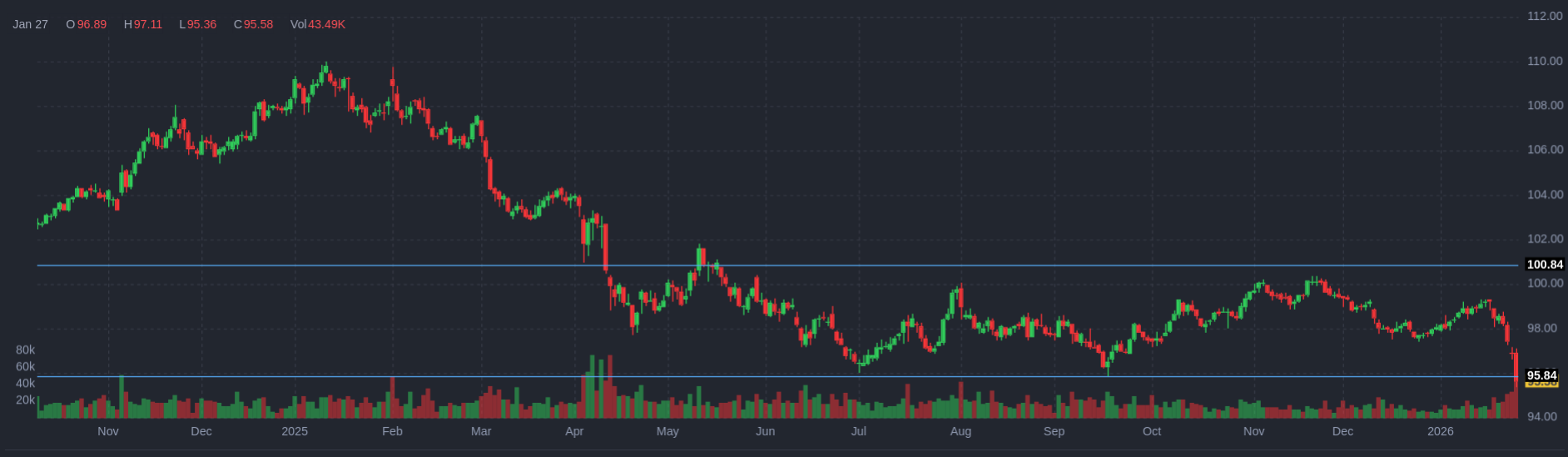
There are a lot of things going on, including a change in investors’s estimates of the risk of holding long Japanese bonds. But there is a “sell America” trade based on the erratic US policy. The way I read it, starting in April the dollar enters a trading range. That coincides with the bat-shit crazy tariff announcements. But it’s not an abandonment of the dollar in any way. However, with the President saying he’s fine in the dollar falling, that’s giving folks the green light to sell dollars.

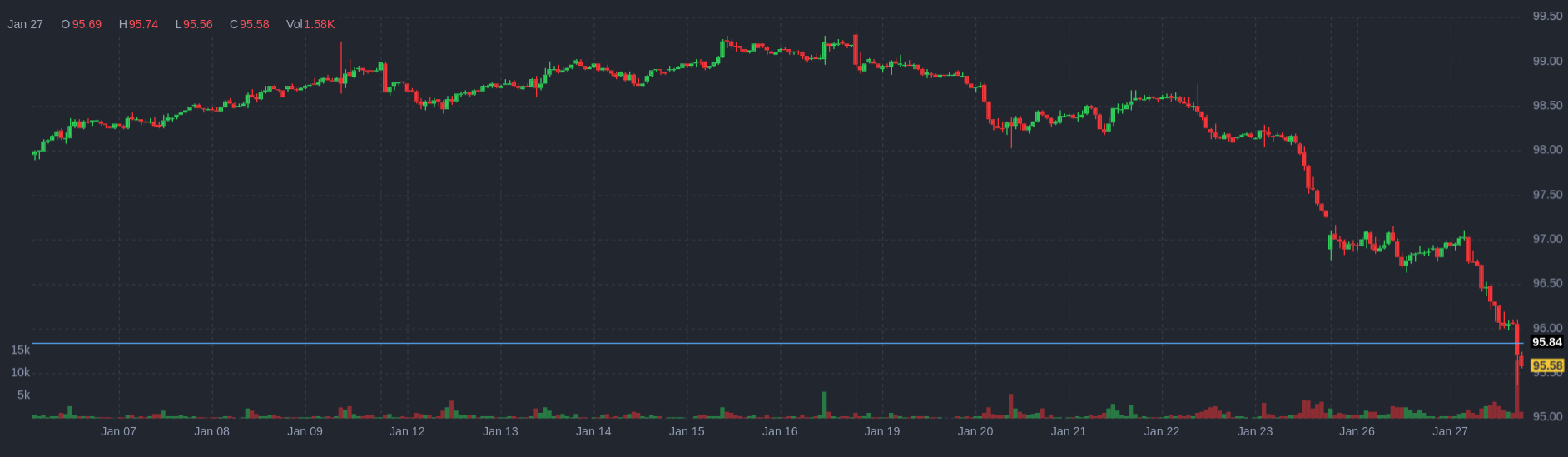
This hourly chart shows how quick this has happened. As of the time I write this, it may not result in a ‘real’ breakout from the range. It could just be a reaction down and a reaction back up. But it does show there is real energy to pull the dollar down.

What happens when the dollar falls? Metals and oil tend to go up with a falling dollar. In a sense oil, gold, silver, and to a lesser degree copper, operate as a currency. As the dollar sinks against other currencies, those commodities become more expensive. As do imports, which are already tariffed. Which is pro-inflationary. However, it does help make US exports more attractive. Of course the real drop occurred because of the statement below by the orange moron.

It’s a Bleak Battle

I expect the administration was taken a little aback by Republican voices expressing discontent. I think the 40% that is the bottom of Trump’s approval probably excused the extra-judicial killing by paramilitary forces in Minneapolis. Many in the Republican party barely said a word about the rest of the brutality. I think the push-back was unanticipated and they weren’t ready for it. The canker-lipped spokesperson of the administration had a muted statement. They are regrouping, not defeated. They have flooded the zone with a sea of shit and this is like saving exactly one house from partial inundation. One mole whacked down as other pop up.

We’re back to the two party system of the Autocrats and Ineffectuals. The Autocrats want to rough-up blue areas of the country before the next election. Their goal is establish control, purge voter roles, and stifle turnout where possible. And while they had a setback in Minnesota, their continued success in building a system of patronage was on display at the Melania premier. With corporate executives finding clever ways to pump money directly into the hands of the Autocrat kingpin and his family. And as they take ownership of Tik-Tok, popular voices from the actual opposition are being banned. The platform was essentially handed to one of the regime backers.

Meanwhile the Ineffectuals will continue to send very strongly worded letters. But will seek to work with the administration where they can. Because it’s important they aren’t perceived poorly by Chuck Schumer’s imaginary friends. They must show they dutifully adhere to the old norms. However, these are difficult times so they may insist on some modifications to the funding bills to keep the government open. [Note that they may withhold votes to fund DHS unless “metro surge” is ended except ICE is enforcement is already mostly funded through the next few years.] Because it’s important to get concessions from a party that does not feel they need to honor any deals.

Gavin Newsom? Great haircut, but he is begging for money from the same people Trump is tithing. He talks a good talk, but no corporate dollars are really in danger at the end of the day. Does he have a “social media game?” Sure, maybe. But he’s the smart money bet by the Ineffectual establishment. Chances are he’ll flop like many of their other darling candidates. You know, the same political establishment that tried to foist Andrew Cuomo on the city of New York. A discredited sex pest. Of course they got Madmani … Mandady … Mamdani. Who seems like a nice enough guy but may be in over his head. And if it weren’t for the fact the establishment ran the worst candidate shy of Anthony Wiener, would still be enjoying his seat on the assembly.

It’s fucking dismal. It’s beginning to feel like the remaining Republicans don’t give a fuck, want to keep their heads down, and get through the next election. Although quite a few won’t. Or shouldn’t, given a reasonable election. I would say the possibility of Trump trying to cancel that next election is small. But I think they issue is we haven’t figured out how he challenges it. Trying to stop vote counting on January 6, 2021 to stay in power was a truly shit idea, but it wasn’t predicted. I think we just haven’t figure out what he’s going to do. And how the Ineffectuals will bumble and fumble the ball. Using a football analogy, we’ll see how far they get into the red zone before inevitably turning it over.

I would say, had we a real opposition, an attempt to subvert in election in 2026 should lead to a nationwide shutdown. Or at least a blue state/blue enclave shutdown. But more likely two or three hours of, middle aged people standing by the road, not blocking traffic, and waving signs, as honking cars drive by. Of course, that depends on how cold it is. But the Autocrats will dutifully line up behind imaginary election fraud, sacrificing our future as a democratic republic to try to maybe hold the Senate? Or maybe try to seat only some of the newly elected Ineffectuals? They don’t care about the future because the rapture is apparently right around the corner. And the Ineffectuals might send yet another strongly worded letter. Maybe Chuck Shumer’s imaginary friends have some insight on how to handle that crisis, should it come to pass?

Comply or Die [Kind of a Rant]

Tim Miller at the Bulwark said it best on a pod cast. The “Don’t Tread on Me,” Gadsden flag waving, concealed carry crowd has become the Comply or Die crowd. Right now people are hot and the longer the occupation of Minneapolis continues, the hotter they’ll get. And in a country that has more guns than people, where all 50 states have laws that allow people to carry concealed firearms, it’s almost guaranteed that ICE and CBP agents will come across armed people. It’s also possible someone just throws on some fatigues and and a mask and pretends to be ICE to do god knows what. (CBP appear to have more regular uniforms but some ICE members look like they showed up in their personal gear).

It’s a little over nine months until the next election. Although it seems impossible now, as a country we have the ability to forget the scenes of yet another extra-judicial killing by armed paramilitaries. After January 6, 2021, it seemed that Donald Trump was un-electable in the United States. And yet, here we are. I don’t think the pressure for mass deportations is going away and I don’t think the administration will let of the pedal for very long. I strongly suspect Steven Miller, that fucking ghoul, will be back demanding more arrests. That angry little fascist cosplayer, Bovino, is likely going to pop up some place else with some other gig. And I’m sure it will be just as cruel. He’s too “central casting” for this administration.

Friedman suggested we play a game “ICE or Hamas.” Try to figure out if the masked paramilitary is a terrorist or a US Federal employee. The truth is, they’re both terrorists. They’re both trying to terrorize populations into submission. This is clearly evident as the Federal Government makes demands in exchange for “letting up.” They both try to use brutality to try to instill that fear. Maybe they’ll go smaller and in more cities. Maybe they’ll just go to blue enclaves in red states. Maybe they’ll start raiding farms. Who knows? But to further the fascist state, you need to have thugs do intimidate the masses.

This is exactly the second amendment crowd’s wet dream. Masked federal gunmen coming in to take peoples’ rights. But the second amendment crowd has never been about all citizens’ rights to have firearms. Or about all citizens’ need to defend their rights. They wanted to show up at a protest, armed to the teeth, to try to intimidate the other side. This is yet one more example of the lying through their teeth we’ve seen from many of these rights absolutists. Just like the thinnest skins on freedom of speech are with people who demand you don’t censor their racist comments. They are liars.

Since Carney’s Speech

I’ve seen a lot of folks on the left glom onto an idea that wasn’t in Carney’s speech, that the entire post war system was a sham. It was far from perfect, but certainly not a sham. At its best, it saw respect for the rule of law to a degree that dictators could move their assets to the “West”, where they could defend them from seizure by the courts in those countries. Not because people in those countries especially like dictators, but because as gratifying as it would be to return their ill-gotten loot to the countries they looted, but because the rule of law was more important.

Of course there are many interpretation of the same series of events. We are biased against seeing what is counter to our narratives. Like the shooting of Alex Pretti demonstrates in real time, some people will always refuse to believe their lying eyes. They will discount 100% of the information they do not like and see the information they like as the totality of the truth. Just like I see many take the view Carney was saying the old international order was a sham. Was the post World War II based order flawed and subject to abuse? Yes, of course it was, just as people have abused every institution. And it’s hard to ignore the benefits of trade the post WWII order has brought to countries as large as the United States and as small as Singapore.

For decades, countries like Canada prospered under what we called the rules-based international order. We joined its institutions, we praised its principles, we benefited from its predictability. And because of that we could pursue values-based foreign policies under its protection.

We knew the story of the international rules-based order was partially false. That the strongest would exempt themselves when convenient. That trade rules were enforced asymmetrically. And we knew that international law applied with varying rigour depending on the identity of the accused or the victim.

When I listened to, and read, Mark Carney’s speech, I did not take away the admission by an insider that the system was a sham, but rather the imperfect but beneficial system was coming to an end. I would agree with Nesrine Malik, for example, that there were evident cracks in the system going for quite a while, and that a sitting US President justifying the use of forms of torture considered to have been war crimes in 1945, was one of those cracks. In Carney’s remarks there’s an acknowledgement of a system that functioned imperfectly, but not a wholesale condemndation. While the rules sometimes did not appear to apply to some countries, they did generally apply. And that facilitated trade, relations, and a growth in global wealth. The fact that imperfect system is dead is not a good thing, which I think is also implied by Carney. But maybe we need to think about how we got to this moment.

In 1945, most people in their 40’s, 50’s, and 60’s that were in power, had seen or fought in two horrible wars. In the first war, a generation of young men in Europe had been gutted. They were left dead in the mud in France and on the Italian border. There was a hope, in 1918, that such a horrible war would never happen again. If you were in your late 40’s or early 50’s, you might have served in the Great War or known someone who died, or a family who lost someone in those wars. It was hard to imagine anything worse. But in 1945 you find yourself left standing in an even more ruined, horrified, and murdered world. Something had to change.

That was why we initially put the signs in the window. Did it work? Most times it did, even if we had to stumble and find the way while not every country was a willing participant. It did not work well for every country in the world, but we developed an international system of commerce that has lifted billions of people out of poverty. India and China alone have seen the most brutal, horrible poverty fall off to a large degree. While much of Africa has not fared as well, many countries have see significant and sustained improvements for their populations. All made possible by secure sea lanes, mechanisms for settling international disputes in courts, and the ability to enforce their rights even in their offender’s courts. The French, English, Portuguese, and Spanish were forced to divest from their colonies, in part because of the United States1 as well as the Soviet Union.

What has broken down? The worst of the rot has been in China and America. I think if it is not clear at this point that China has no interest in the rule of law or international rule of law, you are horribly deluded. While their wealth was enabled by that system, now that they have wealth, they do not feel bound to that system. The experiment that a developed China would liberalize and join other nations in that order has been a devastating failure. Their trade policies and grossly self-serving foreign policy have made the US and all of Europe more than a little wary.

America’s break down is different, and the result of internal rot. And it is not without a counter-part in Europe. Much like the UK, America is very different depending where you reside. The “blue” parts enjoy longer life expectancy, better services, and more income. And to the degree these benefits are present in the wealthy parts of America, they are absent in much of he rest. The “reds” (rightfully or wrongly) see it as the by product of a system run by international elites and at the expense of their America. Not only has this caused many Americans to abandon their belief in trade and an international, rules-based order, they now question basic American rights and law. A vocal plurality of Americans want half the country arrested and shot or imprisoned by military courts This should be much more frightening and deserving of more attention. And I can’t see why more do not see a bright, clear line connecting it to both a new American Imperialism and a loss of confidence in the domestic system.

The last 25 years have seen once-in-a-lifetime economic crisis after crisis highlighting that few appear to benefit from the current order, while many pay. The 2008 financial crisis was especially damaging with no one facing any accountability2. Which Americans believe that rule of law, international alliances, and trans-national legal frameworks are the way forward? Mostly it’s older Americans, particularly in blue states and cities. They are the remaining beneficiaries of that world order, with many red state Americans and people under 40 seeing themselves as the losers3. That is not a winning coalition if you want to see American continue to be an enthusiastic supporter of a wider world order, even if it actually benefits America. Until that changes, America will not participate in that world order. Or at least not in a constructive manner. Much like climate change, US dependence becomes something middle powers need to mitigate.

Will this be a more just world? I have no idea. I’m certain economic development, if not retreating, will become slower and harder to come by. For Canada and Mexico, trade with America should be incredibly cheap. Nothing has to be shipped across a great ocean. Forging alliances with more distant countries requires more energy and work to exchange goods and secure trade routes. Middle powers are forced to choose the less efficient option because it provides a level of insurance when the hegemonic interests of China or America ask for too high a price. This diversity is not prosperity regardless of what the United States or China does, but it prevents complete collapse should the demands become too large. The same will be true for Europe, South America, and parts of Asia. Rather than trading with the lowest cost, most efficient partner, they will need to spend more on defense and infrastructure to fund that insurance.

But there is no alternative. China has little use for the old order, now that it is wealthy, and America is abandoning that order because of necrosis in its social tissues. While I doubt the remnants of NATO will have to fight America any time soon, I see no path to a better tomorrow. The people who knew the horror that begged them to build something better are gone. In fact, those who want to destroy the system adopt the symbols of the worst of the evil to chip away at the last deference to that old order. Whether it’s Stalinist or Nazi memes, the goal is to signify they no longer buy into the dying or dead international order. They are figuratively pissing on the graves of all those who tried to build a better world out of the horror of an older world. The great irony is the way forward may be more international order. That stronger institutions and more alliances are the way forward for middle powers. Until the United States and China suffer some calamity or deterioration that forces them to take a more equitable and less coercive position, I see no other way.
  1. The United States has a complicated relationship with colonialism. It doesn’t view Puerto Rico or (at one time) the Philippines as colonies, or US adventures in South America as colonialism, many Americans did not care for European style colonialism. â†Šī¸Ž
  2. In fact, the opposite of equity. The C-suite people sued to get their bonuses, payable because money was injected into their banks. Main street was billed for the losses, while Wall Street got to keep the gains. â†Šī¸Ž
  3. As do a number of Europeans who are not able to find a well paying job or afford a home. It might express itself slightly differently, but it’s the same “we’ve been had and exploited” mentality. â†Šī¸Ž

Europe is Catching On

In a world where you can’t run a company with US payment systems and US infrastructure, and the US has shown they’re willing to weaponize the dollar and its technology stack1, the EU can’t just write off their dependence on US infrastructure. This is a complete own-goal by the Trump Administration. It will make it hard for US companies to sell their infrastructure in Europe. Both EU based companies and EU governments, in light of the Greenland fiasco, recognize they are vulnerable.

The risk isn’t that the US flips a “kill switch”, as the interviewee suggests. The risk is something targeted, such as putting ICC judges on the sanctions list. Except the target may be larger. This could mean generals, politicians, or bureaucrats can no longer access their e-mail, their cloud documents, or any special sovereign clouds or arrangements to support those governments. For example, if the German government has a reason to investigate its far-right parties. Maybe that prosecutor and their office is sanctioned. Maybe the regulator initiating an action against a US interest (such as monopoly abuses by those same technology companies). Or, if the EU company is a competitor to one of the companies where the US government has started buying shares.

They would lose access to data, applications, be locked out of payment systems, and communications. If you are unable to send an e-mail because your account is a Google enterprise account. Or your office cannot pay for salaries, goods, or services.

This is 100% an own goal by the Trump administration. Because they wanted to show how they were willing to disregard norms, the laws, and alliances, they made US technology a vulnerability as much as it is an asset. The writing is on the wall and the mid-term elections won’t hamper some of these actions. Especially since the courts have been giving the administration a pass or a benefit of the doubt. You may get your Office subscription turned back on, but after several months in court. But even if you have precedent on your side, the Supreme Court has shown that it doesn’t really matter.

  1. https://www.state.gov/releases/office-of-the-spokesperson/2025/12/sanctioning-icc-judges-directly-engaged-in-the-illegitimate-targeting-of-israel â†Šī¸Ž

Did Microsoft Strongly Encourage EU and Canada Linux Adoption?

Microsoft has indicated they will hand over BitLocker encryption keys if asked by the US government. Could this mean an EU or Canadian company essentially has no device level encryption on a Windows PC with respect to the US government, or a future DOGE like contractor? Maybe, but first let’s scope the risk. For this to be useful, the US agency or contractor would need to posses the device. That would mean either covert access, theft, or grabbing the device at the border. Mostly, it would apply to devices brought to the US. It doesn’t help with remotely accessing or hacking a computer. As long as the device does not come into the US, it is largely safe from having its contents read by decrypting the disk.

But this is one more event highlighting that US infrastructure is a weakness for the EU. If you encrypt your device using BitLocker, to prevent leaking data in the event of a theft or loss, it could be accessed in the hands of a US company or contractor. As Microsoft is disabling the ability to use PCs with only local accounts, this means every newly activated Windows computer’s disk could be decrypted Combine this with the ability Microsoft or Google has to access e-mail and office documents, and suddenly EU companies are naked. Much like Germany is looking at repatriating its gold from Fort Knox, EU and Canadian companies may need to look for non-US controlled solutions. For desktops and laptops this might mean moving from Microsoft to Linux. And from Office 365 and Google Drive to an EU based alternative.

For US citizens, this means that journalists cannot rely on Microsoft’s BitLocker encryption and recovery. Under the fifth amendment, individuals do not have to provide potentially incriminating information. This includes passwords. But this means that Windows PCs are not safe, should the DoD want to decrypt a journalist’s device. As as the recent search of a Washington Post’s reporter recently highlighted, this administration is not overly encumbered by the constitution.

I’ve had to use BitLocker recovery before because I had upgraded hardware or plugged in an external GPU. It is much easier to go to the Microsoft site and look up the recovery key. I don’t have anything that Microsoft doesn’t already have access to, through services like OneDrive. The fact Microsoft had my key did not materially change my security, although how easily it hands over the keys may raise a concern. But I’m not ATML negotiating to sell lithography machines to a potential Intel competitor. Would the government’s stake in Intel be enough to encourage Intel executives to ask the administration to grab the ATML executives business data? Let’s face the fact Pam Bondi and Kash Patel have destroyed the independence of the DoJ and FBI. While the ATML executive is out to dinner, a quick clone of their drive to be unlocked and handed to Intel isn’t out of the realm of possibility.

The Damage Is Done

As Rick Wilson points out, the damage to the standing of the US is done. This is going to translate into a reduced role for the US and a discounting of US actions or statements in the future. Even when Trump is gone, and a friendly, likely Democrat, president supportive of NATO in in power, they will only look at the short term benefits. Because they know that the next election could put in someone like Trump. What they get for the next few months, or at most a couple of years, will be the expected benefit to balance against the cost, which can be for decades.

Is Europe Better Positioned than we Think?

The problem of coalition maintenance is on full display when Europe has to make tough decisions. There is no such thing as a European. There are German, French, Dutch, Italians, Spaniards, and so on. There are no Europeans. Each leader of, sometimes fragile, domestic electoral coalitions has to walk a tight-rope between international, European-wide, domestic, and even regional issues. I don’t say this with any derision at all. These are people who practice state craft at a level American politicians can’t seem to muster. And Chinese and Russian politicians, such as they exist, will practice only in the most vague and muted sense. For example, Russia primarily using non-Russian minorities as fodder in Ukraine, to prevent unrest in the Russian population.

In a crisis, like columns of Soviet and their allied armor crossing through Poland and headed to Germany, the US would effectively short-cut the decision making and command the response. The US could also impose standards on systems to avoid the problem of ten different versions or calibers of the same piece of gear. It was a practical standardization supported by America’s ability to design and produce products at a scale larger than even a collection of countries. Especially in the 1950’s through the 1980s. But, at least during the cold war, there weren’t member countries actively working with the Soviet Union (although France was more than a thorn in the side). Hungary is almost Russian aligned. Turkey is more than soft on Russia – but they seem to ultimately prefer the prosperity Europe has to offer. But good state craft has either muted or side-lined Turkey, Hungary, or Slovakia’s ability to be a problem for NATO.

At this point I can’t imagine a NATO member who isn’t thinking about what they need to do to mitigate the absence of US leadership. I’m sure many are also trying to understand how they deal with a US threat. Without America, NATO will lose the third party that effectively deflects and absorbs domestic fallout from unpopular decisions, such as the 1980s IRBM deployments. In the next twenty-four hours, there is no substitute for the US forces stationed in Europe. But their reliability is now questionable to a degree it was not six months ago. By 2030 or 2035, an increasing portion of those US troops, aviators, and seamen need to be replaced by Europeans. Whether you see the fiscal situation of the US as unsustainable, the state failing as paramilitaries start ethnic cleansing in US cities, or an electorate tired of overseas commitments, US participation is no longer guaranteed. What is guaranteed is a Russia that wants to re-absorb portions of Europe, destabilize the rest, and is a client state of the trading partner that could offset the negative impact of US tariffs (China).

There is some good news. Currently, the EU plus the UK is a larger economy than Russia plus China. China not only has a worse form of the same demographic problem plaguing Europe, but dictatorships are inherently unstable. The inability to flow information in China is not a strength. It is a weakness. Russia doesn’t require large, blue water navies to manage. Europe has a safe lake separating it from Africa and the near east. Europe has a highly educated population. The US is currently destroying its appeal to foreign researchers and graduate students, opening a door for Europe to reverse the brain drain. Much of Europe has a more sustainable fiscal policy than the United States and the Euro is also on track to be the next major reserve currency. Not because of great European decision making, but because the relief valve from American deficit spending is likely to devalue the currency and inflate away the problem.1 There is not enough Swiss Franc and Gold to support international trade. China has an opaque and highly interventionist approach to the Yuan. And crypto currencies are useless because their volatility means the value of your goods can change 5% or more in one trading day.

I know Peter Zeihan has dim opinions on Europe, with other regions as more attractive, such as the Texas-Mexico border region. But even good demographics, an ample supply of energy, and plenty of other resources are useless if you cannot create a stable country or educate your population. If Europe can mange the collective decision process, or figure out how to turn it into a strength, Europe may be more than okay. For example, the Texas-Mexico manufacturing story may be mute if North American political upheaval combined with Mexican drug warlords results in chaos. With three to four times the population and more than 10 times the GDP as Russia, Europe can afford the capabilities needed to counter Russia. Trade can be managed across the Mediterranean and down the African coast with only coastal navies, or through the Suez. If trade with China were to fall off due to contested sea lanes, there is still India and parts of Europe to fill the gap. This does not mean Europe will be a major power projecting force to every corner of the globe. But it will be far from dire straits.

  1. The US debt is 125% of GDP while the EU is around 85%. But more importantly, the US is showing little restraint in going higher. â†Šī¸Ž

It Doesn’t Matter If It’s TACO This Time

Or it might not be TACO. We might be back here in a month or two after negotiations around this same ridiculous idea to annex Greenland. Or it could be TACO and we will have a completely different unnecessary, invented, highly destabilizing, and unhinged crisis. As Republican congress people line up behind Trump, and the Supreme Court has given him at least one more month of tariffs by delaying the release of their opinion, we have to conclude the Republicans are the autocrat party. And their supporters welcome autocracy. The legislature and courts will help him cement his power. Tying logic into knots of socioeconomic reasons as to why enough people in a given swing state switched to Trump is a useless exercise. It’s because the are garbage people, with garbage educations, and a garbage sense of the world. They operate on a gut level, moving from meme to meme on their phones, thoughtlessly retweeting Russian or Chinese made propaganda. A strong man tickled the part of their brain little changed from our days as lower primates. They mumbled something about the price of eggs, and chose the strong and confrontational white man over the sensible brown woman.1

The paramilitaries deployed to harass and intimidate cities run by the opposition, using corruption accusations to go after perceived enemies, threatening the media with retribution over factual stories, and removing civil servants when they refuse to break the law, are all hallmarks of an autocrat. The fact the few remaining people in his party who don’t want to go down the path of needless chaos, mostly because they are retiring, push back but then cave shows how little power they think they have. And where does his power come from? Like any autocrat, whether it was Assad in Syria or Qadaffi in Libya, Pinochet2, or any number of other autocrats, they rely on a highly motivated base. That’s why they showed up at Charlottesville, and many other protests, with guns. That’s why they cos-play militia on weekends. They want to show they are armed and almost begging for a fight. And, like any autocrat, they do not need broad, popular support as long as they keep the support of their dedicated bases. Trump has a core of support that is armed, intense, willing to use violence, and believes they are attacked when Donald Trump is attacked.

The market popped this morning because they believe it was just TACO all along. We’re not going to blow up the transatlantic relationship. We’re not going to use force against an ally. We’re not going to piss off the Europeans to the degree they would eject our troops (but likely keep all the free shit we’ve staged over there). But like enough shots on goal, eventually one gets through. Maybe the next shot on goal will be something in Korea, Japan, or Brazil? Some time in the future it won’t be TACO. As we se the stakes escalating, like some unhinged reality television show trending to the mid-season cliff-hanger, the cost of TACO not coming to the rescue become serious. At this stage, we should be thinking about preemptive mitigation.

Carney cutting a deal with China and the EU with South America is a start. Pressure might be applied by replacing Tesla with BYD in their EV market. But middle powers have to do two things. The first is stop or reduce buying US debt, especially long-dated US debt. In the bizarre echo chamber of the American autocrat party, people are already starting to float the idea of not paying the coupon on foreign held debt. A strange and seemingly fantastical idea? Like invading Greenland? That would also likely be a TACO moment, but maybe the next President feels like Trump’s mistake was not going through with the idea. The autocrat party has shown they’ll fall in line. The non-political people are being gutted from law-enforcement, the military, and the bureaucracy. Some think someone like Scott Bessent can assuage those truly stupid ideas. He’s shown a willingness to put stooges in key positions (another hallmark of an autocrat), so what’s to stop him from putting a moron up as Treasury secretary. The members of his autocrat party won’t stop him.

Next, every piece of technology from either the US or China that can be remotely switched off because of an internet based service hosted or controlled by the US or China should be removed, reverse engineered, or the operator should have a contingency plan. This includes everything from civilian infrastructure, like John Deere tractors, to weapon systems like cruise missiles. As the US has shot its tariff load, the threat of tariffs for backing out of agreements over IP law is a mute point. The tariffs are coming at the drop of a hat, with no push back from either the autocratic party or the ineffectual party. (In fact, I suspect the court has a weasel position that allows the tariffs to effectively stay in place. My, thankfully often wrong, tinfoil hat instinct is the court is delaying the release because it will effectively entrench the power of the executive). Ideally, the UK, Canada, Australia, and New Zealand should start the process, arguing their exposure to Chinese products makes this necessary. This can also be pushed through laws requiring a domestic partner or other forced technology transfers.

Middle countries should have a multi-provider strategy for digital infrastructure and they should limit or tax the penetration of US and Chinese social networks and digital services. X is the social media arm of the autocrat party. Middle powers should change their laws to promote something like Mastodon services but hosted within that country, with forced data portability from US and Chinese based services. This includes AI, where I suspect smaller models engineered around specific tasks will outperform (in terms of cost), massive general models. The EU and Japan have the technical capability and economic capacity to have a domestic AI industry. And while the AI “problem” may resolve itself if the bubble implodes, the social media problem is one of influence and intelligence gathering.

For a long time, the rest of the world could rely on the US as having a bi-partisan and fairly level-headed foreign policy posture. But the internal mechanics of US politics have changed. The Republicans could now be called the Autocrats and the Democrats could be called the Ineffectuals. And what has been laid bare is that even the educated, intelligent members of both parties will fail to push back but for different reasons. The idea Merz could have a meeting with Trump and get it all sorted by discovering a ‘real reason’ or appealing in some way to the cesspool that passes for Trump’s conscience, is ridiculous. He’s negotiating with an autocrat in the process of cementing his power. German, Italian, UK, Australian, Korean, Japanese, etc voters need to vote like they believe the in the idea the US is no longer a reliable partner. That largely level-headed, bi-partisan, foreign policy lead by seasoned professionals is gone. Now it’s just crazy until TACO, or someday not TACO. Even if the Ineffectuals take power in the next election, they will not remove the hacks and shills currently being embedded into the system and rebuild its expertise. If anything of the professional, capable US foreign service is left in three years, the next victory by the Authoritarians will wipe it out.

  1. I used to believe it was because Ms. Harris made one or two errors, or she didn’t have enough time, or not enough distance from Biden’s policies. I don’t think that any more. â†Šī¸Ž
  2. Assad has his Alawite militia, Quadaffi and Pinochet’s support came from the military. They realized that if they don’t back their leaders to the hilt, their bodies get burned along side their dictator’s body. â†Šī¸Ž

The Problem with a Coalition

Different European states want different things out of the US relationship. The Baltic states need to avoid a losing game of attrition with Russia, likely starting with an invasion of little green men. (I can’t imagine a direct invasion like Russia tried in Ukraine). Italy likely wants to sell stuff to America. The UK needs both defense help and is probably still fantasizing about some trade deal. Germany needs the export market. It may be easy to agree on the idea Europe should respond as a general principle. But the large coalition makes choosing a specific action hard, as the retaliation could come in a way that hurts one member much more than the other. A collapse of NATO, which I suspect may be inevitable, would hurt the Baltic states more directly than, say, Spain. While a tariff war would hurt Italy and Germany at a time when their economies are struggling.

More trade with China might make some countries happier, but would be a threat to the German industrial base. And, frankly, if Europe wants to have security, they need an industrial base. In fact, they need both a low tech base for shells and artillery tubes, and a high-tech base for drone and counter-drone operations. They are sensitive to energy demand, but pushing South to Africa may mean getting involved in stabilizing their trading partners. That would require them to build the military capability to project strength down to Africa. This might be culturally difficult for some countries, although some compromises are easy when shivering in the cold is your other option. I could imagine Italy, France, and Spain working to secure energy supplies from Africa, but I can’t imagine the average UK or Finnish voter wanting to do the same. And they would have to compete with China and Russia. Maybe as part of a broader trade deal, a push to establish a military presence to the South might have some appeal.

Europe’s numbers are not great from a demographic standpoint. From a GDP and population standpoint, they compare favorably with the US. They have about 120,000,000 more people than the US. They have good technical skills and educated populations. They could offset the demographic issue with automation. However, the US holds a lot of the technology cards. But upending trade deals around IP law, such as weakening patent protections or allowing companies to reverse engineer products, could backfire for some countries, particularly the Nordics. But there might be an area of broad compromise, if they tax digital services that are largely provided by the US, such as on-line advertising. Depending on the company they make between a quarter and a third of their revenue from Europe. This could be billions of tax dollars in short order. But despite the valiant efforts of Schleswig-Holstein, it’s unlikely they could do away with Microsoft, Google, and AWS, entirely.

One thing that is certain, it is unlikely they can defeat the US in an armed conflict. For one thing, they spend just over half of what the US does on defense. For another, they depend on US weapon systems that can be deactivated by the US. This has been a great deal for US defense contractors. And future business for those contractors could be a point of leverage. The US also provides and manages a lot of the space based assets for NATO, along with intelligence. The EU does not have the infrastructure to fill that capability gap. In fact, the US is key to command and control. The EU has a much better arctic capability, but the US can just overwhelm with numbers and technology. In addition the size of the US surface and submarine fleet would deny Europe access to Greenland.

The one thing Sweden, Germany, and Poland could do is to develop a nuclear capability. But a nuclear capability is more than just making bombs. The actual bomb itself is well within the capability of Swedish, German, and Polish engineers. And they have economies or a specific need to quickly develop a bomb. Maybe it takes longer with Poland due to their limited budget, but the would be motivated. Next they need a delivery vehicle, which would likely be a cruise missile or IRBM. Submarine launched missiles would take a while longer. The UK, although it does have nuclear warheads, they travel on US missiles. That would need to change to have a complete solution. And for a second-strike capability, submarines are a better fit. Of course, like many projects, it depends on the focus and execution by the member country. If they start by hiring a company to write the request to set up an office to manage the project to design the 50 year plan for a nuclear deterrent, in order to set the parameters for a European nuclear policy, they’ll fail. They need to skunk-work it through, quickly, quietly, and in a way that denies Russia the ability to use nuclear extortion to stop the project.

Depending on the escalation, it’s not that the US is invulnerable. Although the majority of American debt is held by Americans, the Europeans hold much more of the debt than China. They don’t have to set much of it alight to cause problems for the US. It’s likely they have a carrot here, as well as a stick. Without willing buyers at the long end of the yield curve, US interest rates will struggle to drop. Long term rates are actually rising even though rate cuts are likely (something of which I am painfully aware). Europe can offer to purchase an additional tranche of US debt with maturities in the 20-30 year time-frame. And if the US attempts to backslide, they can quickly stop their purchases. It would push down long term rates, as the supply of long bonds is a little constrained. The paper issued by the treasury for the last few years has been in the short end of the market. The US is not a default risk (although there are some people in the US who think that’s a possible policy). It is an interest rate and inflation risk, with inflation and currency devaluation being the fastest way out of its high debt levels.

It’s not that there aren’t a lot of solutions. Some better than others. And the Europeans have been good negotiators. Access to the US market has been the major carrot the US trade negotiator has used with Europe. But the existing tariffs, and constant threats of additional tariffs, have soured the taste of that carrot. The difficulty is finding something the member countries (including some that lean toward Trump) can agree upon. I’m sure some Europeans imagine that once the mid-term elections happen, Trump will be checked. That he has, at most, another year of being able to act before the next Congress takes their oaths. But let’s say the Democrats who win also have a populist streak, or the Republicans are able to rally and hold the Senate. The ability of Democrats to “stop Trump” would be muted. And a future election could bring another edition of an anti-European, populist leader. I would look at Trump as evidence of the sentiment lurking in parts of the US toward the rest of the world. And that in the face of a “might makes right” bully, having the moral high-ground is not as good as being able to lay out the bully. That needn’t be militarily. But the reliance on the US, especially for technology, can’t be a continued modus operendi for Europe. But the status quo is a lot easier than a new direction, when so many different voices have the power to say ‘no.’