Why Advocate Against My Country?

Surely, once Trump is gone, the US can return to normal? Right? And then America’s diminished capacity will hurt my quality of life.

In order to understand why, you have to get past the polling that shows Trump has 40% approval. If an election were held today, and he were on the ballot, he would not lose 40% to some Democrat’s 60%. It would be surprisingly close. Trump would likely lose, because many people are not happy with the economy, but at most by by 2 or 3 percentage points. A large number of Americans that identify as independent, or who are “disapproving” of what Trump is doing, are actually neither. The threat that someone comes into office and treats all people with dignity or provides them health-care is unconscionable. Despite all the contrary evidence on spending and deficits, they would say the spendthrift Democrat would raise the debt. They worry more about fantasies of shared bathrooms (something common in many other parts of the world). And some people are just hateful bigots that do not like people based on their race and creed.

If Trump were to go tomorrow, those people persist. The 40% that approve of threatening allies, of imposing tariffs, and rounding up people that look foreign, because they’re brown, aren’t going away. Nor are the 10% or so on top of of the 40% going away who claim to be independent, claim to not like the policies, but are in the bag for Trump. If there’s a little bit of an economic boom, or the Democrat says something a little too weird, we might even get an illegal Trump 3rd term. The opposition has been ineffective, his own party will do nothing to moderate him, and the Supreme Court has given him more than one inexplicable pass. But advocating for a move away from the dollar as a reserve currency doesn’t address that issue. It will raise US interest rates and make it harder for the US pursue policies like sanctioning Russian oligarchs.

I would say a world where three great powers divide up the globe under their patronage systems, will be a poorer, less free, and more miserable world. Russia is one example, but China also engages in state sponsored kleptocracy to maintain its power base. America doesn’t want a transition to “multi-polarity” where different regional powers take responsibility for the security and prosperity of their regions. The American President, along with the Chinese and Russian leaders, want a tri-polar world where they get to dictate the policy they see fit in their assigned area of influence. With an endless series of proxy wars to try to expand or counter the expansion of those spheres. But that’s making the Chinese rich, right? Yes and no. It’s making some Chinese rich, but mostly the politically connected people. Outside the glamorous coasts, most of China is a backwater or epic proportions. And being rich does not guarantee you are not disappeared. The same is true of Russia, with a resplendent metro in Moscow, and outhouses in other parts of the country. The most autocratic countries in Europe, like Hungary and Belarus are also the poorest. If you want to be rich, live in a strong liberal democracy.1

If you care about being a moral, good person, with values you want to pass on to your children to also lead good lives, you do not want a might-makes-right world. Nor do you want to live in a world where you are not secure in your rights as a first principle, but only secure in your rights based on race or political favor. We’ve had that world in the past and it was not good. As we evolve we came to reject absolute monarchy or Jim-Crow style laws. There are plenty of people who would rather be poor and in charge than rich and powerless. Although the already rich would love to have more power, imposing their stamp on policies and places to feed their ego. That’s the path down which we are heading. And that should not be allowed. And as that world won’t be safer and the vast majority of people will be poorer, anyway, why not sabotage the movement toward that end?

Until this last Spring, I thought it would be good to have more boots in each of the services. The US armed forces have shrunk to such an extent that I began to wonder if we could hold our own if China tried a quick dash-and-grab for Taiwan, leading to a protracted, regional fight.2 In both Europe and Asia, we had too few people dependent on too few high-tech weapons, that once fired are not easily replaced. Ukraine was bringing back good-old-fashioned 155mm artillery in a war of attrition. The way the US and allied forces were structured, we would have to go home once the supply of pricey missiles are exhausted. They take weeks or months to manufacture and the planes that deliver them sometimes equally long to repair. Now, I want to see the size of the armed forces cut. To a small degree because of the horrific deficit, but mainly because I see the threat of those forces being turned against cities in the US. That’s why I would argue to cut military spending. The administration has threatened to turn it into an occupying force. Why give them more guns and boots?

Arguing for certain policies that would slow the de-evolution of the us US to keep the world more prosperous, safer, and free is not in conflict with being an American. Even a patriotic American. Because when everything is said and done, America is about the constitution and those liberal, enlightenment values. Without that we are no more exceptional than Argentina. And with an electorate that produces Trump, based on the whims of a few counties in four states, that’s not a bad thing. When about half the electorate is fine with racism and autocracy, I have to ask if such a country should lead the world in any sense. The Republican party likes to make a big deal about their pocket constitutions. But if you don’t live the words, you have is a tribal talisman, not a blueprint for liberty and justice. What is shown to be possible by their support of an unhinged autocrat, leads me to think they do not care about what made American a beacon to others. That means a safer world is one where, should this continue or the racist and autocratic forces come back to power, America is least able to act.

  1. A lot of Americans don’t understand what the world ‘liberal’ means in this case. They think it means “lefty,” rather than the idea we have inalienable rights and the state should guarantee that we are secure in our persons and our possessions. ↩︎
  2. Many people are fixated on the boats China has but it would likely use air assets to quickly move troops across the straight. ↩︎
Dollar Denomination of Contracts

Quite a bit of commerce is done in dollar denominated contracts. If you’re a European company, that means you have a built in interest rate risk every time you buy or sell. European companies may hold dollar deposits to smooth the risk, as they need dollars for future transactions, so there isn’t an immediate need to convert all at once. However, at this point, they should be pushing for Euro denomination on some contracts for commodities. Certainly, the Yuan isn’t acceptable.

As the US begins flirting with erratic, dangerous, and radical policy ideas, the value of the dollar itself will diminish. Part of the issue with accepting the Yuan, is the goals of the Chinese government will result in unwanted currency manipulation. The easy, lazy, and stupid retort is ‘America also manipulates.’ For the most part, America has kept the dollar relatively strong, meaning that imported goods had an advantage, along with American consumers. The Chinese would take the opposite tack, making their currency cheap and promoting its own exports. As they engage in their cycle of capturing the technical aspects of producing a product, withering the foreign expertise in producing the product, and retaining their dominance once the lock up the technology.

Also, this would encourage other countries to adopt the Euro as a reserve currency. I don’t think there’s any economist worth their salt, looking at gold returning as a reserve, that is happy about the current state of reserve currencies. Washington is making the dollar more toxic every day and I think there are countries dying to find an alternative. Right now the Euro has a small plurality of reserves (20%-ish). That could bloom by just moving more contracts for commodities to the Euro, where the dollar is currently used.

Why Can’t We Just State the Obvious

“Who are you going to believe? Me or your lying eyes?”

I see Scott Bessent interviewed on the news or at Davos and I hear the words coming out of his mouth. The are disconnected from reality. Trump is a deranged liar and an agent of chaos. Bessent was supposed to bring order and some level of credibility to the administration. At least on fiscal policy. He has either burned his credibility to the ground by showing he believes in the same stupidity as his boss or willing to say anything to keep his position. (Which should make us ask how handsomely he must be profiting from it). And no one is really calling him on his complete lack of credibility. Even Noem got to a point where she had to walk back a statement saying ICE and CBP weren’t using tear gas. Bessent just digs in and bumbles forward, expecting everyone else to be too polite to call him out. At some point someone is going to have to say something and not just nod with a concerned look on their face.

Europe Needs to Implement a Digital Services Tax

If the EU wanted to do something more than the absolute minimum proportional response (if that), they should do the following three things.

  1. Resurrect the digital services tax.
  2. Get off US infrastructure.
  3. Promote interoperability.

I don’t say this lightly as I work on that US infrastructure. But the road has not gotten better. It has gotten worse and there is no indication it will get better. If Greenland, than why not Iceland? Why not the Faroe Islands? Heck, why not Air Strip 1? Let me be clear about what could happen in the future. Not what could happen next week, but maybe in a few months, if things continue to escalate.

First, the US puts EU leaders on the sanctions list as they did to a judge at the ICC. This would make it impossible to access any of the services provided by Office or Google Cloud. Their 365 e-mail account gets locked, along with all their files, and they are unable to perform almost any financial transaction that involves a bank or on-line retailer. In other words, they are locked out of their work accounts, personal accounts, and are limited to almost a cash existence. Imagine Kier Starmer, Merz, or Meloni having to find an individual in their office that can use MS office on their behalf. This might lead to countries backing out of the various agreements and treaties that allow sanctions to be comprehensive. Which could inadvertently result in Russians getting sanctions relief. Some EU banks, with US ties, may find themselves in the impossible position of satisfying the US and the EU at the same time. They would like pressure the EU to back down.

The US government taps AWS, Microsoft, Oracle, and Google and suggests that hyper-scalers slow-roll or stop updates to Sovereign cloud offerings in these countries. Within a period of weeks, as certificates expire, these clouds will begin to fail. In addition to the US DoJ, legally or illegally, demanding access to the data stored for European governments and European companies. Essentially, the US would likely have a carte blanche to access Google or Microsoft hosted mail and messaging for those governments. These offerings were meant to give the European governments, militaries, police, and intelligence agencies high-quality, secure cloud services. They might have local operators, but they are completely dependent on US companies providing updates. Even though the data centers reside in the EU, the US parent company has a degree of control over the systems that could result in the data being exfiltrated and their services being disabled.1

This is horrifying and what the end of NATO could look like. To get ahead of it, Europe needs to prime the discussion now, because it takes way too long to agree on anything. The first part is straight-forward. It is mostly US companies selling digital services to Europe. Or start fining them to implement desired EU policies such as more open App stores and anti-monopoly rules. Just restarting these discussions may add pressure on US companies that control much of social media and digital infrastructure. They will pressure their own advocates in Congress. If anything, fining X should be a priority across the board. Social media and internet services companies could threaten to pull out of one country, like Denmark, but the would not want to pull out of France, the UK, Germany, Italy and the Nordics. But the “big” countries have to all agree or the “small” countries don’t stand a chance.

Next, they should start discussing (again because of the length of the talk runway) plans to move to EU providers for key infrastructure. The ability to run a railroad or run a water treatment system should not depend on the whims of an aspiring autocrat 5,000 kilometers away. This, by the way, applies to some power systems supplied by China, which could be cut off to help their client state, Russia. Europe needs to put “sole source” laws into place indicating to only buy the product, device, or service, only if no European supplier exists. Or local partner laws, like China has had, to force technology transfers. But the process of moving off that infrastructure is not quick. It will also be expensive, as cloud providers try to create one way valves. Cheap to get data in but expensive to get data out. That cost could be offset with a digital services tax.

Next, the EU should promote adversarial interoperability. The EU should actually (not just make face noises about it) withdraw from provisions of the trade agreements that prevent EU companies and citizens from jail-breaking their devices. This is necessary to prevent a foreign power from bricking your infrastructure. If it is completely legal to replace the tractor firmware with your own firmware, you don’t have to worry about John Deere turning it off, remotely. (Like they did to the ones Russia stole from Ukraine). If EU citizens are allowed to jailbreak their devices, or reverse engineer apps on those devices, they could decide to have X – but without the Nazis. Or they could elect to install an App Store that only charges the listed Apps 5% instead of 30%, where even US companies would want to be listed. Interoperability should include, taking all the data you like from Facebook or Instgram as a scrape, get rid of the adds and unwanted content, and have that as your version of social media. (Although social media is largely a tool used by adversarial nation state actors to conduct influence campaigns and not a great loss if it did go away).

This is getting ugly, stupid, and weird. America has enough legacy income and wealth to get by for a long time, as the institutions that have underpinned its success get wiped out. There is anger on both the left and the right against the institutions, as they have been used too often as spring-boards for their leaders, who profit from them. For example, the possible insider trading both at the Fed and in Congress. And when those people leave, they get plumb jobs in industry or finance, shaping the rules and laws in their employers’ favor. Court rulings that make government bribery charges against officials almost impossible to prove. Parties that have allowed themselves to be captured by monied interests to the point they align only in places where the welfare of dollars are at stake. Europe does not have to get dragged down by the US as it implodes. In the process, tearing apart countries and the conscience of the EU member states.

It’s not that Europe doesn’t have its own challenges. In some ways life without America will force some countries to come to grips with the level of commitment necessary to provide their citizens with security against Russia, Iran, and China. And their aging populations may require them to re-think their approach to their own welfare states or economics, given new security needs. They may take a more active role in the middle east in order to prevent waves of refugees from each successive crisis that god-forsaken part of the world continually spawns. They might have to project power into Africa, both to deal with refugees and secure energy for their countries. And finally, with no expectation of the US nuclear umbrella, German, Poland, and the Nordics need to plan for developing nuclear weapons and a strong second-strike capability. They have relied on the US too much, who was both willing and able to pay for these missions. I can’t imagine the 79 million Americans who voted for Trump being willing to stick their necks out of Polish, Romanian, or Estonian sovereignty.

But they should do this as a United Europe. All these problems are bigger than just one country and require cooperation between multiple countries. That spirit of cooperation and strong institutions is the model that will bring every region a better quality of life. Once upon a time, your impact on the world extended no further than your neighbors, then your city, and then a nation, and now problems are so large they are trans-national. The US is attacking the basic idea there is value in these alliances. They are an agent for a rolling back of progress, along with Russia, and a China that views trade as wealth extraction from the rest of the world. If the world of cooperation, alliances, economic and social progress is going to defeat the world of angry isolation, it needs to rise to the moment. One way to do this, is to be explicit that the US intimidation could come at the cost of the part of the economic order helps enable US digital hegemony.

  1. Note that the UK has to ask the US for permission to fire its nuclear missiles. France does not. And if the US exits NATO, the UK should prioritize fixing this problem. ↩︎

Semantics Are Useful

It’s 1990 and I’m in a Poli-Sci class and we’re talking about El Salvador. The cops, or maybe cops – sometimes you can’t tell, running around with assault rifles and armored vehicles were called paramilitaries. Some of them were police, some of them were national guard, and others were just regime supporters wearing a mask. “Paramilitary” is not a particularly positive term. It either connotes over-armed enforcers or poorly trained military. But that’s what I see on the streets of Minneapolis. The same over-armed, hyped-up, highly partisan paramilitaries wire-brushing a “blue” city under the guise of rounding up “criminals.”

It’s hard to sometimes look at yourself and see what it is. It’s easier to say “shooting” or “officer involved shooting” instead of murder at the hands of regime paramilitaries, it makes it easier to take. The paramilitaries in El Salvador were engaged in targeted, extra-judicial murder. These were the death squads. Do I think we’re in death squad territory? No. But is there anything left that I think would prevent that? Yes, but the system isn’t as robust as it once was. Largely, I think, it would be how it polls. Could I see the ICE/CBP paramilitaries deciding to start down that route if they have blanket immunity from prosecution? An FBI that will bury the investigation? Maybe. The only thing that stops that is broad and intense public disapproval. It used to be the case if you tried that you would be charged with murder. Now, there’s no risk of these paramilitaries being charged with murder unless the right wing media machine loses control of the narrative.

The Weirdness in Unemployment Claims

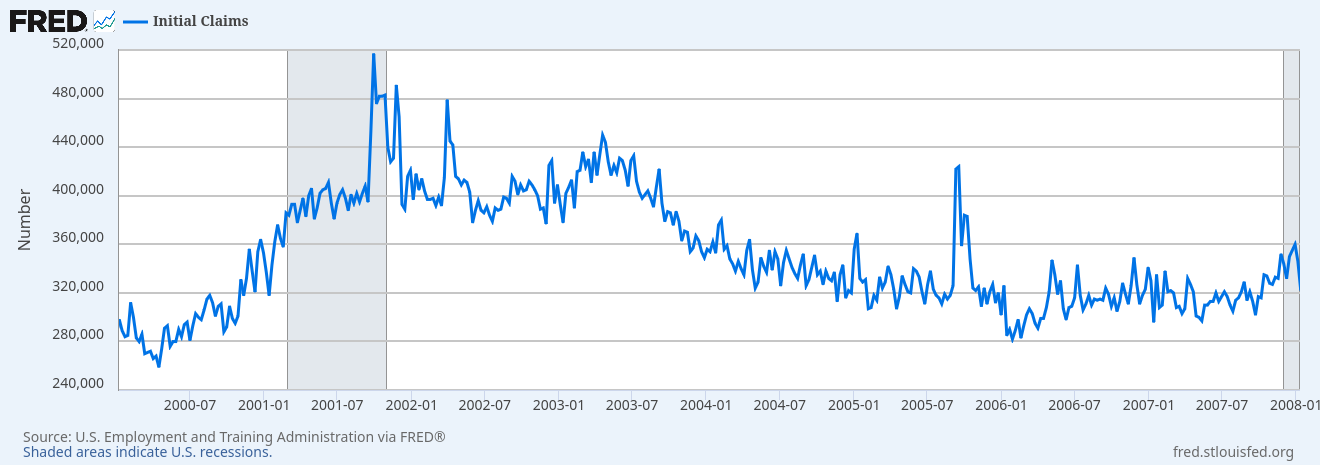
Here are the first time unemployment claims from 2000 to 2008. Although the first time claims rate accelerates before the 2001 recession, that doesn’t happen in every recession, with the first time claims generally being a trailing indicator. The lowest point on the chart, touched briefly at the peak of dotcom boomery, is about 260k.

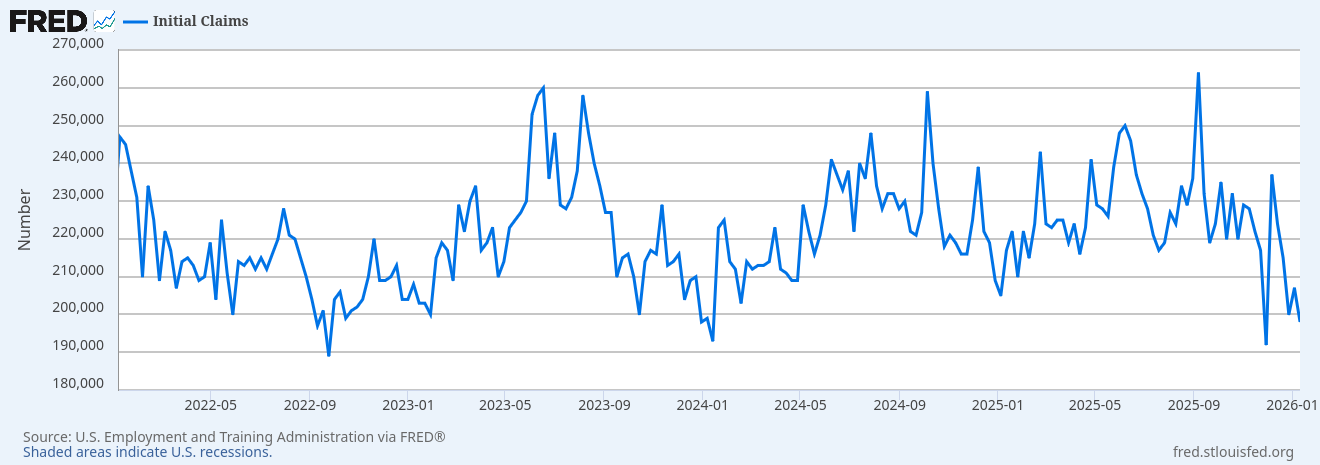
Here is the last couple of years of first time claims. Its highest point is about 260, which it touches during spikes. Although it looks more variable than the chart above, it’s not. It might be even slightly less variable. It’s low points are at 190,000. If I were to look at this, I would assume the jobs number would be substantially higher. We’ve created about 150,000 jobs over the last six months. To absorb new entrants into the labor market, that should have been 600,000. To grow, that should have been closer to 800,000.

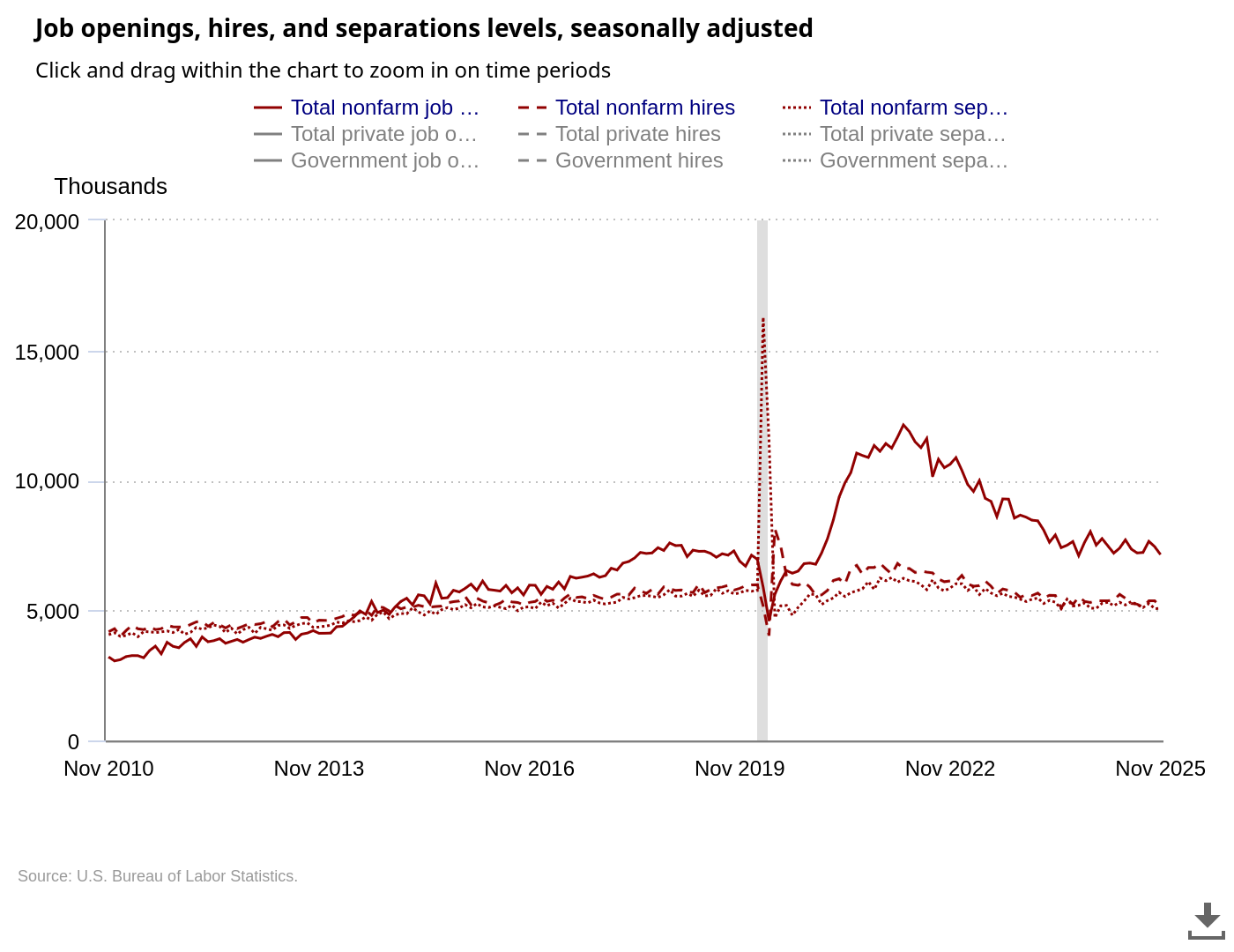
There is a degree to which we could be job hugging. No one is convinced they can hire a decent replacement. No one is convinced they can find a better job. People aren’t getting fired and they aren’t quitting. And there aren’t enough new jobs to absorb new entrants. What we should see in the JOLTS data are low separations, low hires, and low openings. But that’s not what we’re seeing. Which actually further confuses the situation.

Separations and hires are still historical norms. Openings are still high. This leads me to be even more convinced, every passing week, that we’re measuring the wrong thing. That’s dangerous because we can be optimizing the wrong numbers. Maybe the Fed is too worried about the job market. Maybe it’s doing better than anticipated. I’m more convinced the job market is structurally different than it was even 10 years ago. That means comparing even 2006 numbers with 2026 numbers could be misleading. Is the gig economy, ranging from Uber to Only Fans the new “go to” when you get fired? Should we be measuring the number of gig workers? The BLS understands the need. But the current statistics are too spotty and hard to compare (also because of the lack of history).

If this seems like splitting a hair, let’s take a look at some policy choices. The first is to leave short term rates where they are. This is likely having a depressing impact on the labor market. If we depress the labor market too much, we go into recession. (Although our latest Keynesian experiment may offset that). If we cut rates slowly, we relieve pressure on the labor market, but does that cause more competition for labor to the point where we get inflation? Or does it ease the pressure to relieve the risk of recession? Finally, there is aggressively cutting rates, which what the economics illiterate Cheeto wants. That could drive a freight train of inflation through the economy and tank the dollar. But from the labor market data, it’s hard to say which is right.

All the options seem logical. If you look at the monthly jobs number, it looks like recession is right around the corner. If you look at people losing their jobs and filing unemployment, we have a perfectly fine labor market. If you look at the JOLTS data, the labor market is dangerously tight, with many more openings than workers. Or is the JOLTS data signalling weakness as we drop below the 5,000 level? I’m more partial to the jobs number and its erratic cousin, the ADP report.

Our Upcoming Keynesian Experiment

We have aggressive deficit spending in place. The administration is discussing an additional 45% in defense spending. Let’s say the AI bubble pops. (Which I don’t think will be because AI is useless, but because there’s no path to profitability). Even if the magnificent seven collapse in value (Nvidia loses well over half their value, and Meta, Microsoft, and so on have large drops). I think that would start a change in spending as people see their wealth evaporate. I think it would also put a lot of pressure on banks that have loans, or loans to private equity, to fund data centers that will not be needed. Or OpenAI or Anthropic declare bankruptcy. This should be enough to push toward recession.

However, we have cut taxes (albeit largely on a group of people who just accumulate wealth rather than spend more to stimulate the economy). We are engaged in aggressive deficit spending, although slightly smaller as a share of GDP. Spending on defense largely mandates spending on US suppliers. Also, especially if Trump is able erode away Fed independence, we will get substantially lower rates. Even if the AI bubble bursts, we may be pre-staging the kind of counter-cyclical spending needed to keep the economy afloat. We would almost need the AI bubble to unwind in order to counter the inflationary impulse coming into the economy. In a way, this will prove if Keynes was right, that in the face of economic slow-downs, you can just dump money into the economy to get out of it.

The Estimate of the Floor on Trump’s Support Is Wrong

An AP-NORC poll found that Trump’s support doesn’t seem to fall below 40%. Individual issues or slight re-framing of specific issues may be higher or lower, but the approval rating doesn’t drop below 40%. I don’t know what it would take to break the lower floor at this point. It’s not the poor job people believe he’s done for the economy. Certainly, it’s not tyranny and overreach by a corrupt president. I also suspect that invoking the insurrection act in Minneapolis won’t do be that bridge too far. And there may be additional stops along the way, such as just above 35% where his die hard supporters truly wouldn’t abandon him for shooting someone on 5th avenue.

It’s pointless to talk about what the Republican party was even twenty years ago. Right now it is a vehicle for Trump through which Trump exercises his power, some wealthy people see a chance to line their pockets or reshape the world according to their egos, and for many Americans to vent their anger at a changing world. I think the break down of the polling data by race and gender illuminates some of what motivates that support. Of course it’s not a perfect alignment, and sometimes it just pushes against that 40% floor, but there is a difference between the way white Americans view this president and all other races view the president. Even among Hispanics, about a third still approve of the president. And a difference between the way women and men view the president.

I have long maintained that 40% support is more than sufficient for keeping an autocrat in power. When Gaddafi fell, it was because his support fell to near zero. When Nikolai Ceausescu fell, his support had cratered near zero. There just weren’t enough people willing to go into the street for them and plenty of people out to get them. Same with Mussolini, or Czar Nickolas, or Assad, Ferdinand Marcos, Louis XVI, or any one of a number of autocrats. Maybe some supporters saw the writing on the wall and realized it would only make it worse, but not change the outcome, if they died rallying around the dictator. Maybe some didn’t want to be torn apart in the bloody aftermath, and hoped their spurt of “good will” would cover up a lifetime of sins. Some of the autocrats even tried to stem the tide by giving in on some demands to gain some support, but at best that only delayed the inevitable. Maybe some genuinely lost faith. But at the end of the day, almost no one was willing to run to their aid.

Right now, Trump stands around 40%. A lot of things have to go bad before that drops to near zero. Maybe the economy is too good and their bellies are too full. The fallout from destroying the American system hasn’t hit them. And in some cases a lot will have to go wrong before it does. Regardless, there are plenty of people who would still rally and defend the president. We saw it recently as the war power resolution died in the Senate. A move congress would normally support to maintain their own influence on foreign policy. This defeat means we are even less likely to see restraint in moving against (and I can’t believe I’m writing this) Greenland. (Something the perfume guy thinks he turn into a few more dollars in his personal wealth).

I also think that, at least in the present moment, that 40% number is artificially low. I think it’s more like a 45% or even 50% approval when it comes time to vote. For many reasons, ranging from the fact our monkey brains love a big, angry, chest-thumping primate to lead the herd, to our need for security in a world made less secure by Trump. But mostly because I think a large number of people are not comfortable with their racist and chauvinistic attitudes. When they think “welfare,” they don’t think of the white family down their own road, but the people of color in ungrateful “Democrat” cities leaching off their hard work. Or people who ascribe their economic insecurity to the deterioration of cultural norms that centered men. Despite the statistics, despite the fact the deepest red states are the biggest beneficiaries of federal spending, despite the fact men are just not showing up, they see white America and male America as providing while much of non-white America and women as selfishly taking advantage. They may say they “disapprove,” but when are forced to choose, they choose Trump.

Trump also has a working patronage system. That helps bring the monied interests in line. He has a friendly Supreme Court, and is able to pressure any Republicans (either through threats to their continued re-election or threats to their families) to toe the line. The goal is to keep pushing so any particular act is only outrageous for a short time. Most people fail to understand that if you shoot one woman at a protest, that’s a lead story. If you shoot people on a regular cadence, eventually we just track the totals. Much like mass shooting are now almost part of the background static of our lives. He realizes his best defense is not to cross the line until he needs to back off. It’s to cross the line by just the right amount and keep on crossing it. It will take months for a court to stop him, if ever. Among the uneducated it appears he did have the right. And among the educated, he’s secured the right in practice. His opponents are pushed back, defending the new line.

I don’t know how we got here. I’m not even sure where “here” is. I do believe the single most important thing we can do is to vote in the upcoming midterm elections. Not because it will usher in a group of leaders who will turn a tied against the president, but because it will reduce the avenues he has for action. He wants to boost military spending by 45% and the ICE budget has exploded to insane levels. Cutting either of those will make the democrats look weak to some voters, something they would rather not risk for the 2028 general election. But it would at least restrain those impulses. And like all authoritarians, the current crop knows growing the military and law enforcement is a means of being able to exercise internal control. Adding more boots to the Army will be just as much about holding a large territory in martial law, as it will be to counter China. (Which I think will largely be allowed to do what it wants in a little while). The best thing we could do is deny him to tools to occupy more than a handful of mid-sized cities.

I say the estimate of his support is wrong because it allows us to come to the wrong conclusions. Like if support drops below that magic number, it’s a sign it’s slipping and the end of Trump is coming. That’s a completely incorrect assumption. It could be that it needs to drop below 20% or 10%. Maybe with 5% die-hard supporters, concentrated in law-enforcement and the military, an autocrat survives. But also, at the end of the day, it’s not 40%. If people were forced to choose between Trump and a Kamala Harris they choose Trump because he’s the right race and the right gender. They don’t consciously scream “white power” as they vote. It is their unconscious bias, a lack of education, and disinterest in the norms and laws that are violated. He is backed by the recipients of a patronage system that provides resources to promote him, his policies, and his candidates. Patrons who have no obvious interests beyond their egos and their money. And that’s why he’s not weak at all at this point. I wouldn’t even say he’s cornered. I think his supporters and backers realize any discussion of Trump being on the ropes is a full dose of hopeium. And that’s why I don’t see too many of them doing anything to hedge their bets.

Depreciation Should Be 3 Years

The goal of Nvidia, as stated, is to produce graphics card that provide the best performance, such that is is not even economical to run a competitor’s cards. Let’s delve into this. First we need to understand marginal cost. If you build a machine to make widgets, and let’s say you buy the machine up front, the cost of the machine is a sunk cost. If you make one widget or a million, it doesn’t matter. Your sunk costs are your sunk costs.

If it takes $10 with of labor and inputs to make 1 widget, my marginal cost per widget is $10. Anything I earn over $10 per widget covers at least my marginal costs. I may not be profitable, but I’m making money on every widget and cash is coming in. If I make less than $10 on a widget, I’m losing money every widget and bleeding cash. Based on the market, I expect to sell 100,000 in a typical year. A price of $15 would cover both my marginal costs and the amortization of my sunk costs. That’s the best of all possible worlds.

What did I mean by amortization? I expect my widget machine to last, say, 10 years. I don’t just assign the cost of the machine to the first year, as it will produce revenue for the next 10 years. It distorts my performance by making my first year look like a legendary disaster, but the next 9 years like I’m a genius. I take 1/10 of the machine cost every year in amortization. If the machine was 5,000,000, that’s 500,000 a year. If I sell 100,000 widgets, I can assign $5 to each widget as its portion of the sunk cost. If I sell 100,000 widgets for $16, I cover both my sunk and marginal costs and $1 of profit per widget. If I sell 100,000 widgets for $14, I need to sell more than 100,000 to cover amortization.

But let’s say the widget business is not so good. Someone offers me $12 for 50,000 widgets. If I have no other orders for widgets, I’m going to lose money, given the amortization of my machine. Specifically, I won’t be able to cover 400,000 of the amortized cost. However, because my marginal cost is only $10, I get $100,000 of contribution to my sunk costs that I would not have received, had I not taken the deal. I could even make money if I got enough contracts at $12. If the offer is for 200,000 widgets at $9, I should not take the deal. Even if it is more money, I’m losing $1 per widget in marginal costs. I am losing more money on that deal than if I just shut down the machine. There is no sales volume that would result in anything but losing more money.

If my competitor buys a newer widget machine, that’s more efficient, and can make widgets at $8 a widget, they can undercut me at a $9 price point. They’re still making a contribution to their fixed costs (since the marginal cost is $1 less than the selling price). But I can’t match their price without bleeding money. I have no choice, at that point, but to re-tool and try to get my cost down below $8 to be competitive. Otherwise, they take market share and drive me out of business.

The cost of building the data center and filling it with GPUs is the sunk cost. Next, you have marginal cost which is largely electricity. It’s used to both power the devices and cool the devices. Then you have people to manage the data center. Then you have software costs related to that tuning or managing the model. The goal of Nvidia is to make it so that the marginal costs of operating a competitor’s chips is higher than the Nvidia chip. They want to produce new chips at a 1 year cadence, and within 2 years make the marginal cost of operating the newer chips decisively more attractive that the old chips. They want the economics to drive customers to replace on a 2-3 year cycle, to minimize their marginal costs.

One myth is you only need the latest and greatest chips for training, but when they’re two years old, they can move to inference. Training is when the model is sent data to get it to make a good response. Inference is when you and I ask the model for stuff. It’s estimated that 90% of the costs are for inference. That means the least efficient chips would be used for 90% of the cost. Moreover, as the models come on line, they are larger and push the limits of the older chips, meaning those chips have to work even harder for one unit of output. There may be some models that require too much memory or more bandwidth than the older chips provide. Using a 5 year old chip that’s struggling on a newer model is the highest possible marginal cost you can have. Granted, no one can have all new chips all the time, so you have a blend of generations with some chips being new and some chips older. You can track a blended marginal cost, and let’s say that’s $10 per 1,000 queries. [Don’t worry about the exact numbers – I’m making the math easy.]

What Nvidia is trying to do is to make chips so the AMD customer might by a cheaper chip, but their marginal costs are higher than Nvidia’s offering. For example, the AMD chip is a $12 per 1,000 queries, while Nvidia wants to be $10. But next year AMD will come out with a better chip, maybe meeting Nvidia’s $10 per 1,000 queries. So Nvidia has to come out with a chip that produces 1,000 queries for $8. And the same again next year. The two year old Nvidia chip still costs you $10 per 1,000 queries, but the new one costs you $6 per 1,000 queries. To stay ahead of your competition, you need to retire the 2 year old chips as fast as possible and buy as many of the new chips to keep your blended cost lower than your competitor’s blended cost.

But even the models themselves have a short life. Every few months a newer or improved model comes out. Most users want to use the latest model, even if it’s larger. The old model, which might run well on the old hardware, begins to see its market shrink. It may still have applications that are tied to it, but not new applications and not new users. The realistic lifecycle of a model might only be a couple of years. The chips are constantly being pushed to larger and larger models. To get better performance more and more “think time” is built into how the model is executed. This makes new models on old chips not just a little worse, but even harder because the model has to be run with more iterations to provide better output. It’s like having a truck that burns more gas than the new model, but you also have to make more trips with it.

Right now we don’t have a price war. We have a war of financing. Investors want to see growth. More than undercutting each other on cost, the goal is to be able to grow your user base with free services. If that’s the case, using your highest marginal cost chip, to offer free services, seems like putting a noose around your corporate neck. All your competitor has to do is pay more in sunk costs that have to be figured out some point in the future (buy more new GPUs) and kill you on marginal costs today. This won’t work forever, but it works in the short run.

The goal is to be the last one standing in a winner take all market. If your competitor is only bleeding $8 per 1,000 queries on free customers to your $10 per 1,000 queries, they can either offer better models or higher limits. They don’t have to be profitable. No one is profitable right now. No one is meeting their marginal costs. But if you can operate more efficiently, you have more time until the corporate grim reaper comes for you. Your runway lasts longer. What about the GPUs your investors financed? Don’t they want a return on their investment? Yes, that comes from you making it to the finish line while your competitors do not, rather than getting to positive cash flow.

So let’s think about this, again, for a 4-6 year lifetime for a GPU. I would buy 4 years, as that’s probably where the chip is clearly on its last legs, but at 3 years it may still be effective to run in a blended cost environment. That 4th year is likely when it really starts becoming an economic millstone around your neck. I think 6 years is absolute fiction, unless you have government and large corporate customers who have a fixed (and profitable) contract and don’t want you to change the model used by their applications. For the part of the market, like developer subscriptions, or chat agents, or new development, which live on the latest models, a 6 year old chip is likely killing you. It raises your blended costs and you burn through your investment even faster. So no, I don’t think a 6 year life span makes any sense whatsoever, except for a narrow type of government or large corporate customer. I think a 2 year lifespan makes a lot of sense for a very aggressive AI provider, who wants to keep their marginal costs as low as possible.

Rebuilding the Agencies

When the next administration is sworn in, January 2029, they are going to have some major challenges. Every time you read about another career prosecutor leaving the DoJ over some prosecution they refuse to file, it’s another person that put their agency and their profession above politics. Everyone that stays, and is willing to file those charges, is someone who caves. It’s likely that a number of senior people being promoted, who will promote other people underneath them, at best put their career above their ethics. At worst, they put their politics above their ethics. Perhaps so much so that they will undermine a Democrat administration.

Some of these folks will see the writing on the wall and will leave to start a podcast, “telling all” about the failed Democrat justice department. And with no sense of irony, will talk about how they were pushed toward political prosecutions. They will join a long line of other former federal law enforcement that quit to specially crap on Democrats. That’s nothing new. I would be surprised if the bulk of federal law enforcement didn’t lean Republican. And they’re not above the tribal fighting that the current administration is promoting. What’s happening is the ones who may vote Republican, but put their professional ethics and their agency above politics, are being pushed out. The saving grace, if there is one, is craven people are usually less competent.

But what does the next administration do? Does it start to go through the agencies, with a wire brush, making it clear they want the nakedly partisan people gone? Pam Bondi and Cash Patel will be gone the moment a Democrat president’s hand comes off the bible, January 2029. There will be, and should be, no discussion of keeping those unqualified political hacks in place one minute longer than necessary. Along with many of their deputies and assistants, who would normally be held over into a new administration, at least for a time. I don’t think it will take long for them to see that some people are the result of four years of intentionally injecting politics into prosecutions. And those people have to go.

In a sentence, the next administration will be accused of exactly what this administration is doing. Even if their goal is to simply get rid of the lackeys and hacks.

In the same way the Supreme Court is giving the administration a free hand on even long stand precedent regarding independent agencies, they will try to curtail the new administration. If the Democrat fires commissioners at the FCC, for example, I’m sure they’ll suddenly rediscover the error of their previous decisions. And I’m sure when it comes to suits by civil servants being pushed out because they are brazenly political, they will be horrified that a Democrat would politicize the justice department.

I have no illusions about the Federal Courts any more. I think they mostly follow the law, and some cases depend on how you see the world in interpreting the law, but the result of the Trump appointments (and the failure of Obama and then Biden to fill those appointments) is a more political judiciary. One that will impede the return back to a professional, ethical Federal law enforcement bureaucracy.