The Tribe is Speaking

I spent 9 paragraphs ranting about the authoritarian tactic of accusing your enemies of financial crimes, prosecuted by a highly political machine, to discredit and remove them. I only touched on, in passing, the state sanctioned, extra-judicial murder of Renee Good the next day. My thoughts go out to her family. I find her murder especially troubling, and more indicative of a dark and ugly truth.

The first thing they did to the woman, when her body wasn’t even cold, was to paint her has a member of the other tribe. Don’t investigate the murderer, investigate who else is in her tribe. Those mentally stunted weirdos even asked (out loud) who paid her to be there. Find out who’s part of her tribe and let them know they’re next. The shooter wore the tribal uniform of the paramilitary, with at least one gun, as we’ve seen from Charlottesville through the January 6 insurrection, to today’s ICE enforcers. The tribe circled round him, likely not even seeing the murder as a bad thing, which is how video from the murderer’s perspective may have leaked. But they don’t see it as murder. Murder is only in your own tribe.

Will this be a one off? No. When I see how amped up and angry the ICE and CBP agents are, and how scared they look when people start to gather around them, I don’t think the shootings so far will be an aberration. I suspect they will become more confrontational, more aggressive, and even less restrained by the law and the constitution. And fear will encourage them to pull the trigger. And the tribal dynamics will interject them more and more into “blue” cities for exactly this type of confrontation.

The agents will realize their tribe provides two lines of protection. First is the FBI and DoJ which will excuse the shooting and prevent a local investigation. Second will be a pardon from the tribal chief. Take the shot, the tribe will protect you. And if people resist, the tribe will make sure the whole neighborhood or city is miserable from crackdowns and collective punishment. The tribe will hurt the other tribe. And when the Homeland Security director shows up with a “One of Ours, All of Yours” sign, I think they lack the historical or cultural understanding of what they’re doing, except that they are intentionally reinforcing tribal membership.

Or, maybe they do understand the historical implications of that sign. In which case so much of our country is infested with the worst kind of racists and authoritarians. That could very well be. Farmers were willing to vote for an immigration crack down that cost them their laborers, even risking their export markets. They may not recognize it in themselves, but that kind of behavior suggests they care more about racial identity than about their business. They just wanted to hurt the other tribe, not true Americans like themselves. Punish the blue state tribe and keep out the new tribes. And their boy knows the tribe, he’ll be good for a government handout like his last administration, should tariffs cause an issue.

It’s the same impulse behind my sense of schadenfreude when I hear yet another FAFO story. But in my defense, they voted for the racism, bigotry, and disregard of the law that’s biting them in the ass right now. I only wish to give them the dignity of their choice. I don’t really follow sports. I don’t see 11 strangers failing to convert on 4th and 1 as having failed my tribe. But a lot of people do. Maybe 4 out of 5 people have that kind of deep tribal instinct. The best part of mankind tries to get past this tribalism to form bonds between peoples. The kind of tribalism that the New Testament specifically tries to overcome. That’s the whole point of stories like the good Samaritan.

What reinforces tribal membership? Race is part of it. It’s almost impossible to hide your race. That’s why they feel so free to arrest anyone based on race. If “those people” don’t like getting arrested, they can go somewhere else. Next is accent and speech. You might be an American, but you don’t sound like their tribe. You’re part of the other tribe. Religion is part of it, especially outward demonstrations of faith. And the dozens of little cues like Mar-a-Lago face. Or hyper masculine characteristics, like the kind of physique that requires a possible course of HGH or anabolic steroids. A particular type of license plate or car. The music you to which you listen. Or the drink you order at a bar. All those things signal your tribe.
If you’re a good person, you temper your tribalism. You don’t relish in the misfortune and pain of others. Tactics like collective punishment should be abhorrent, if have a sense of justice or empathy. America works if the process is more important than tribal victory. Once tribal victory becomes the only thing that matters, the whole thing falls apart. Because those tribal feelings are not necessarily conscious thoughts, they can invade into the actions of people who are especially admonished to be non-tribal. Why do you think police officers target certain people, even if they’re the same race? Because they are not a member of their tribe.

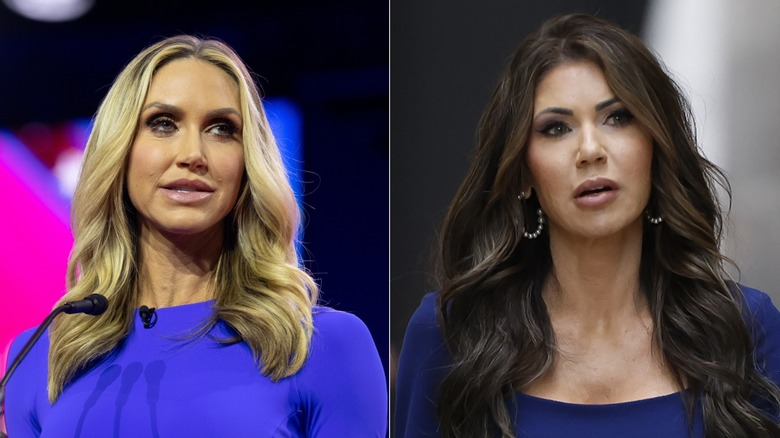
The sign in front of Kristi Noem is a tribal sign. In fact, it’s particularly despicable. The dog-whistle comments help reinforce that sense of tribe. It sends a message of twisted unity. They need to promote the in group and create an “other” out group. Murder is only within the tribe. If you kill members of the other tribe, it’s justified to protect the tribe. That’s why they repeat the same accusations, over and over again, no matter how patently ridiculous they sound. To reinforce their enemy’s membership in the out group, the other tribe. The goal is to make the other tribe so distinct that you aren’t even killing another human being when you kill them. You are just eliminating a threat. If you kill one or two by mistake? Good, maybe their tribe will get the message.

We need to oppose this is because the same territory cannot be occupied by two tribes. I don’t know how the American right comes back from deep tribal thinking. There is tribalism on the left, but so far it mostly eats its own, and has not presented as an existential threat to others beyond social media Ethnic cleansing (the effective policy of ICE) and mass murder and genocide, are the means by which one tribe takes ownership of a territory. Like two battling groups of chimpanzees, with one group forcing the other out. When people operate at this basic level of social development, the end has been on full display for the last 10,000 years of human history. The goal of punishing “blue” cities is to convert them (great) or get rid of them. If they cause enough pain and enough disruption it will maybe make them dissolve? Or go away? We’re not operating at the intellectual level once we descend to tribalism, so it doesn’t have to make complete sense. But then the tribalism speaks, listen, and recognize it for what it is.
Tit for Tat When It’s The Chicken Game

Game Theory was part of my economics education and later my computer science education. Game theory analyzes interactions between competitors to understand the strategies, given the incentives and the rules of the game. The overused example is the prisoner’s dilemma. Two prisoners locked in separate interrogation rooms have two options: to stay quiet or rat out the other prisoner. They are unable to communicate. If both stay quiet, they will get convicted of a crime with a short sentence. The prisoner who rats out the other prisoner, while the other prisoner stays quiet, gets off. The prisoner who stays silent, while the other rats him out, gets the worse sentence. The player that is silent while the other player rats is called the patsy. If they both rat each other out, they get a medium sentence.

Without getting too deep into the weeds, if you play the game repeatedly, players do best if they adopt a tit-for-tat strategy. One player stays silent, and on the next iteration the other player also goes silent. If they both stay silent, they do much better. If one player decides to “get one over” on the other player by ratting them out, the other player goes back to ratting. And the player who ratted has to accept the cost of staying silent and being the patsy to get back to a better outcome. Therefore, no one has an advantage when cheating, except it will cost them more than if they hadn’t cheated. I’ve heard the argument made the Democrats need to start playing tit for tat instead of being a permanent patsy.

The Republicans keep ratting (abandoning norms and breaking the law) and the Democrats keep silent (playing by norms and rules). In game theory speak, the Republicans are defecting (not cooperating) and the Democrats are cooperating. But I’m not sure that’s we are playing the prisoner’s dilemma. There’s another game called the chicken game. (Named for the “sport” of two drivers hurtling toward each other in their cars, with the one who swerves becomes the loser). In this game there are different payouts. If player 1 does not swerve, but player 2 swerves, player 1 gets their best outcome. Player 2 loses some face. The worst outcome (they both die) happens when the both do not swerve. Unlike the prisoner’s dilemma, where if they both rat on each other, the outcome is not their worst. For the chicken game, this is not just the worst outcome, it is a catastrophically bad outcome. If they both swerve, it’s a draw and neither wins or loses face. In this game swerving is cooperating strategy and not swerving is considered the defecting (not cooperating) strategy.

A slightly modified chicken game is the game I think Republicans are playing. They can reign in the administration, by cooperating with Democrats, but that costs them their job during primary season. Unlike the normal chicken game, where if both parties cooperate it’s a tie, any cooperation with Democrats is loses face. But the the country is in tact. Or, they can defect and not reign in the administration, expecting the Democrats will cooperate by obeying norms and laws, and the Republicans expand their power. That’s their best outcome. But what happens if we apply tit-for-tat to the chicken game and Democrats stop cooperating until Republicans cooperate? We get a catastrophic outcome. In the cold war days, this was the strategy of mutually assured destruction (MAD). The US can back down and lose face, the Soviet Union can back down and lose face, but if neither backs down, there aren’t enough bulldozers to scrape up all the dead bodies.

Look at what happened when Joe Biden came to power. Initially, the goal was to prosecute just the protestors breaking into the Capital. The norm was to never prosecute the opposite party, lest that open up a Pandora’s box of criminal accusations at every transfer of power. The restrained effort to hold the ex-President accountable moved through bi-partisan commissions and through Congress, not the White House. They retained Republican appointees at Justice for their full terms. Republicans didn’t cooperate, while the Democrats reliably cooperated. As the Democrats had cooperated by preserving order in the Senate during the made up “norms” Mitch McConnell discovered about Supreme Court nominees. The Republicans are fully expecting the Democrats to swerve again, should they lose the presidency in 2028 or the house, and maybe the Senate, in 2026. Republicans are not expecting something like a two year delay on the a Supreme Court appointment, if Clarence Thomas leaves the bench.

The idea the Democrats will fall back to norms partially preserves the system. If there’s a transfer of power we can all take a breather. We might get lucky and everyone goes back to norms from here on. At least half of the political machine is still invested in the system. If Democrats play tit for tat and stop cooperating until the Republicans cooperate? If no one is invested in the system, it completely breaks down. At that point it’s no longer a democracy. It’s mob rule and he who has the biggest mob rules. Instead of an orderly transfer of power it’s a shoving match at the end to see who comes out on top and woe to him that does not. There are countries like this all over the world, where once power changes, people flee the country to avoid being arrested. And we could very well become that kind of country. (Although some people think we’re already there because they’ve never traveled to any one of these places and are deluded).

The more brazen the Republicans get, the less tied they are to norms and rules, the bigger the stakes if the Democrats apply tit for tat. With the conduct of ICE, and the the highly politicized FBI covering for ICE, we may already see the people they’ve killed as extra-judicial murders. What if Democrats come into power and decide to arrest hundreds of ICE agents and arraign them on Federal murder chargers and others with felony murder? (Felony murder is charging someone with murder if they aid or abet a murder. Even lending a car, without knowing there was a murder, has been grounds to charge someone with felony murder). And what if the DoJ and Treasury (no longer independent and summarily replaced with partisans) go after the right wing pod casters and big Republican donors. (I suspect there’s something Elon can be charged with without even stretching the truth). Maybe start charging anything crypto related with money laundering, unless they buy into the new Democrat run “clean” crypto. Maybe force the companies Trump has bought into to higher key Democrats into the C-suite?

And let’s be clear about something. In countries where norms don’t form or where norms are abandoned, corruption follows. As long as you have power you need to extract wealth and create a system of patronage, just as the Republicans are doing now. To hold power, you need people who are vested in you maintaining power. That flows by bestowing money or status. Tim Cook and Apple would be just as happy to give a Democrat a gold iPhone, if it meant some kind of special treatment. They might grumble, but even oil executives will happily line blue as well as red pockets. And if enough executives are getting snatched up for tax evasion, they could be incentivized to behave themselves. And if those that behave are rewarded, even better. Especially if they were were afraid the arrest would involve a degree of physical violence.

So what’s the out, if we don’t want to become as ineffective a government as your stereotypical banana republic? Are Democrats turned into eternal patsies, while Republicans take increasing liberties with the constitution? Unlike the prisoner’s dilemma, chicken game participants can and do communicate. The Democrats can signal they will stop cooperating next round and that they will be just as bad, if not worse. To make this threat credible, they really need to gin up the base. This isn’t easy, but some of the administration’s actions are making it easier. This is not something Chuck Schumer, or his imaginary friends the Baileys, can do. Or the Obamas, frankly. As Amanda has said, this “we go high” strategy doesn’t always work. Sometimes, if they spit in your face, you need to make them spit out their teeth. Nor is the far left useful. They are more willing to tear apart the slightly less politically correct left, than do anything particularly useful.

Of course, the Republicans may not believe it. This was the real danger of MAD (mutually assured destruction). If the other side mistook your actions as guaranteed cooperation, and lost confidence in your willingness to respond, you could very well wind up in nuclear war. To avoid nuclear war, you had to convince the other side you would respond quickly and robustly. But we don’t have to completely convince every Republican, beyond a shadow of a doubt, that it would be the end of the American system. We would only need to make them think it is sufficiently likely. Unless they moderate and return to norms, and look at cooperating as not so bad compared to other outcomes, they have no incentive to change. Right now, I don’t think Republicans believe Democrats have the balls. If things get bad enough, the danger is the Democrats get pushed into a tit for tat strategy when the base demands they don’t chicken out this time. And we wind up not with the third worst outcome (from prisoner’s dilemma), but with the destruction part of mutually assured destruction.

Finally, Someone Engaged with Reality

In the effort of appearing statesmen or scrupulous guardians of norms and decorum, too many politicians and members of the press have used language mask the illegal, brazen, and power hungry nature of the administration’s actions. They couch the actions in terms of difference of opinion or something on which they can “work with the administration.” I never expected the Chairman of the Federal Reserve to be the one that calls out, in plain language, exactly what is happening.

Politicians on the left and the right have been intentionally or unintentionally legitimizing an illegal authoritarian drive toward power by not wanting to directly confront the problem. Too many in the press have treated insane statements by the administration not as the crazy they are, but as something on which “legal experts disagree,” as if there is a legitimate debate. Their inability to face reality is leading us down a road to the end of the American experiment. A country that is a constitutional republic in name only. The irony is America’s experiment may be coming to an end as we approach its 250th birthday.

If it were just this action, I would assume it was petty, vindictive, and likely a dead end. But this is just one more data point in a long line of data points where complicit republicans and compliant democrats largely rolled over. And a supreme court that uses the shadow docket to “let it slide for now.” (Don’t worry, they’ll re-discover limits to executive power when a Democrat is president).

The drive to establish a fraud prosecutor tied directly to the White House instead of the DoJ smacks of the kind of political prosecuting that happens in dictatorships. Putin didn’t start by throwing his enemies in jail for what they said, they were often prosecuted for “tax fraud.” Xi didn’t purge his opposition by charging them with personal disloyalty, he arrested them for corruption. In America the indictment may not result in an automatic conviction, but even if it doesn’t, the defendant has to hire lawyers capable of defending them in Federal criminal court. That may be multiple attorneys, each billing in the neighborhood of $500 an hour on up.

I have a friend who believes that Trump didn’t do anything wrong on January 6. That the rioters were not criminals, or were let in, or were driven to it by FBI provocateurs. I can’t bring him back to reality. That people were prosecuted as part of the January 6 riot as part of a concerted effort to undo the 2020 election. To replace legitimate electors with frauds. To effectively overturn the election to keep the previous Trump administration in power. I could sit him in a room with Jack Smith and have Jack Smith walk him through all the evidence and I don’t think it would make a difference. It’s because my friend isn’t engaged with reality. And he’s representative of many of the people who voted for Trump. People who sometimes felt Trump had been treated unfairly, even if they didn’t understand all the facts about what was being alleged.

Republicans who bemoan this state of affairs in private, or sometimes in public, have often failed to step up when asked, picking their party over the country with devastating consistency. To those Republicans who stick their heads in the sand, or wish things were different in private, I say “fuck you” and grow a pair of balls. To those democrats looking for a middle ground that isn’t confronting this for what it is, I say “fuck you” and wake the hell up or get out of the way. To the media that tries to sound balance at the expense of excusing this illegality, I say “fuck you,” and grow a spine. At the end of the day, the lot of you seem like you’ve disconnected from reality. That you inhabit another country where the president is normal and maybe just a little ‘colorful.’

This is the very real hellscape we’re in. Most Americans are more focused on the memes they can get out of it, rather than the fact a sitting president is trying to indict the Chairman of an independent body, in order to force him to change policy. If you think “well, he is the president, he gets to set policy” I say you are a fucking moron ignorant of basic American civics. You don’t understand our system of government. These independent agencies and the Federal Reserve were created by acts of congress and signed into law by previous presidents to keep their operations specifically out of the political spoils system. That made us not like some banana republic or tin-horn dictatorship. Now the courts are largely political and they have eroded the separation between the executive and the independent agencies to the point that we can’t really call them independent. The Federal Reserve is one of the last bastions.

To the “don’t worry, it’ll be fine in the end,” crowd, I say fuck you. I’m not sure why you think everything just turns out fine. To the “courts will deal with it” crowd, I say fuck you. There’s no guarantee you won’t get an Eileen Cannon who wouldn’t be in the tank for Trump.

For all those who wonder what the Germans, or the Italians, or the Russians were doing when their countries slid into dictatorship, it was exactly what we’re doing now. Trying to find the reasonable middle path, or trying to appear even handed, or moderating your tone to keep your press access, or sticking your head in the sand because at least your party was staying in power. There wasn’t any one day when someone could say “well, it’s official, we’re a dictatorship now.” Bit by bit they got there as everything soured. Each day a little more spoiled and rotten. This is starting to smell like the end.

The Lack of Progress in Computing and Productivity

As “A Much Faster Mac On A Microcontroller” points out, even the cheapest processors today are capable of meeting most peoples’ needs with a couple of major asterisks (the underlying compute hardware in the article is about $10 to $30). I’m not going to claim that Word in 1995 is as good as MS Word in 2026. I get a lot of features on 2026 MS word on my Surface laptop that I didn’t get with my Mac 6100 from 1996. But a 1990s PC did that work while consuming less than 100 watts. A modern gaming PC can push 750 or even 1,000 watts while gaming, and 200 watts or more doing nothing. I would argue the biggest difference in desktop computers is in gaming and media consumption. Productivity has largely been static. And this has some implications for productivity we might want to consider before burning up the planet with AI and filling it with toxic e-waste.

What I will say is that for many use cases, the computer from 1996 is as useful as the computer sold in 2026. I have watched many people use nothing more than Outlook, Word, Excel, and their browser, day in and day out. These are tasks I was happily doing in 1995 on my DOS/Windows 3.1 laptop at work, or my Mac 6100 at home. With fewer features, but the largely the same work. The biggest change is moving from desktop applications to web based applications, real time collaboration, and apps like Teams and Slack.

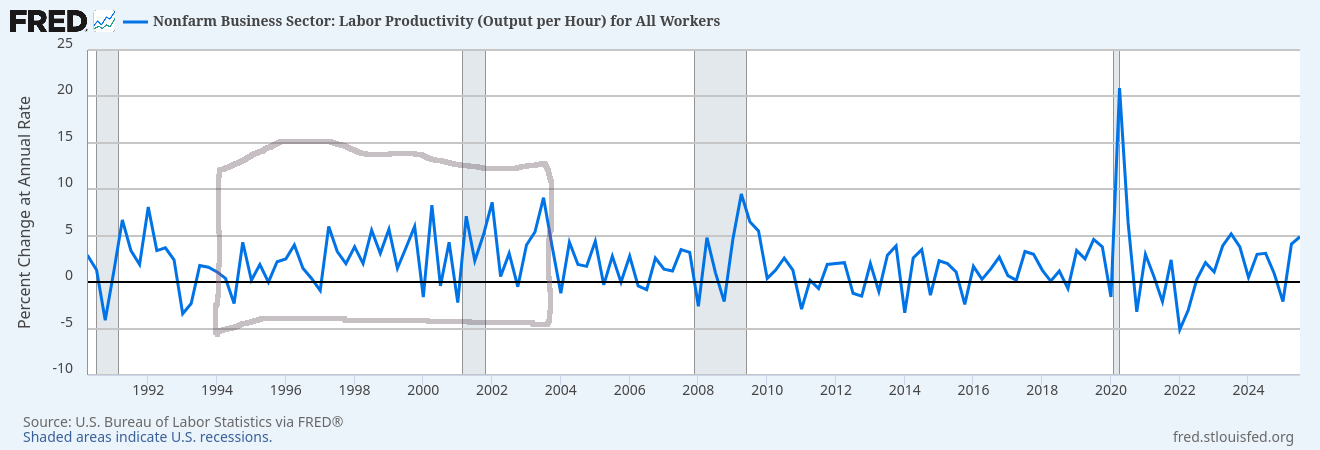
From the productivity numbers, most peoples’ work computer shouldn’t be a $2,000 computer, or even a $1,000 computer burning 200 watts on average. It should be a $100 computer that consumes under 50 watts when running full tilt, but 5 watts at idle. With reasonably well written software, that cheap machine can do everything you need for the bulk of office workers, including Slack and Web-based applications in Chrome. But even more damming is it suggests that investing in computers has had little impact on productivity. I’m going to show you the best possible argument, with a slightly higher productivity when computers were being deployed at scale between 1994 and 2004.

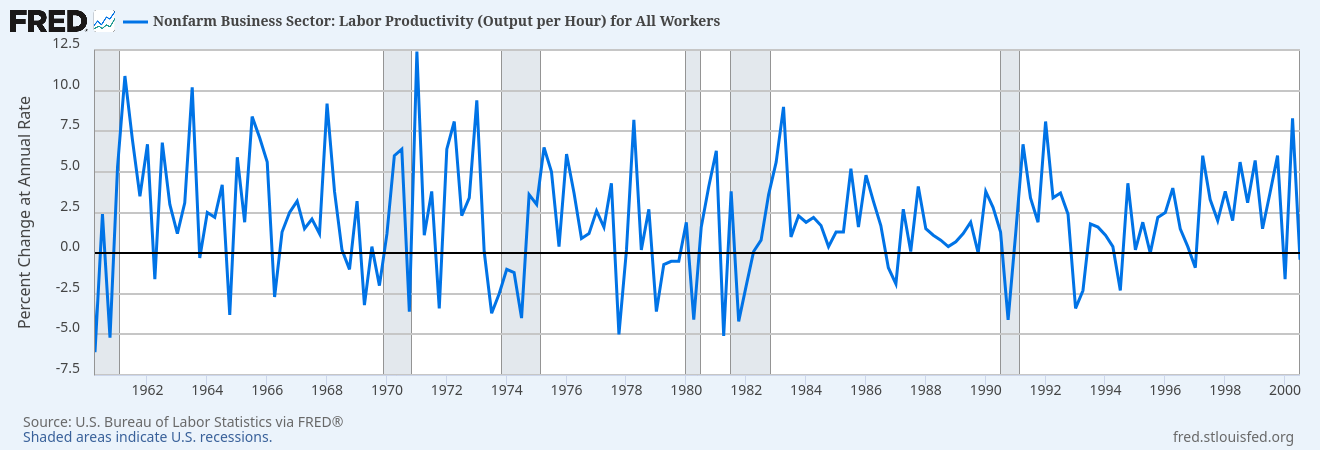
How to read this chart. Productivity measures output per labor inputs. This looks at the percentage change, quarter to quarter. Why do we get negative productivity growth at points? Because the amount of output drops per labor our due to changes in demand. If you produce a little less but don’t lay off, productivity falls. Annual productivity has grown 1-1.5% in the last 20 years. This, combined with the growth in population of about 1% implied a 2-2.5% real annual growth for the highly developed US economy. (Setting aside the population growth was coming through immigration and the implications current policies have on that for this discussion).

But growth was not likely coming through the computer revolution. In fact, we see productivity grew more before 2000, when offices still had shared computers, than it did between 2008 and 2020, when almost everyone had at least one computer (if not two or three) at their disposal. The software and operating systems were much better in 2010 than in 1995. More computers and computer automation did not imply more productivity. This is known as the Productivity Paradox.

The 1990’s computer revolution had productivity gains about the same as the previous 40 years. So the desktop “computer revolution” didn’t meaningfully impact this measurement of productivity. In fact, the period from 2008-2020, with its ubiquitous computing and zero interest rates should have spurred investment leading to productivity growth. That period had unusually low productivity growth. More computer did not translate into more productivity. Take that in for a minute. The era when we introduced iPhones, iPads, and Android devices, and had capable, cheap laptops and desktops coming out of our ears, along with zero interest rates, had sub-par productivity growth. Maybe that’s a hang-over from the great recession? Before then, between 2000 and 2008 had at best historically normal productivity growth.

Why I focus on the desktop versus the enterprise is because I think there’s a real difference in individual versus institutional computing. I still think there is a lot of needless spending on bells and whistles that drives up the cost, but it’s hard to argue that book keeping and accounting aren’t more productive today. But if one group is getting a lot more productive, we still have to ask if this means another group is less productive to balance the average? Or the impact is so narrowly focused it doesn’t move the broader needle? It’s also possible to argue that technological change means computers are a necessary input to enable or unlock the next productivity gains through robotics and machine automation. Maybe productivity would be even lower absent computers. But I still maintain that most office workers would be only marginally less productive if you put a thirty year old computer in front of them. (Although they might complain a lot. And maybe quit).

Which brings us to artificial intelligence. I use it and find it’s maybe a 5% productivity boost. I can’t just yell at the computer to do things. I have to create a context and prompts to enable the AI to produce something that’s usable. And then I still need to refactor it to bring the quality up above a naive or basic implementation. And sometimes, it’s just faster for me to code it at a production ready level rather than doing all that other work. I could see how some developers actually find it a negative productivity tool. It doesn’t always generate the correct code and I’ve only had reliable success with very popular languages and tools. On legacy code it sometimes generates pure garbage. Adding AI may be no more beneficial to productivity than it has been to put a computer on everyone’s desk, or providing internet access, or Web 2.0 apps, and so on.

Like a lot of AI hype, that tweet in no way matches up with my experience. However, it later came out that what they did was feed the AI tool a year of context and it generated a “toy” implementation. That implies it is not code you would run in production without a lot of work. Sometimes the difference between a “toy” version and a production version is months of effort. Sometimes the real effort is figuring out what to build. A proof of concept or toy version is what I get when I use AI code assistance.

Which brings us to the question of how much money should we spend on AI and related investments? Based on the last thirty years, it’s unlikely that computing related investments will drive significant changes in productivity. And from my personal, anecdotal experience the gains from AI aren’t huge. Right now AI investments appear to be sucking up virtually all the available investment capital, along with energy consumption (causing some communities to face higher electricity and gas prices). What if, after all is said and done, we look at that same chart through 2035 and we don’t see any change in productivity? Think about all the money we would have wasted, all the e-waste we would have generated, and all the other lost opportunities we will not pursue?

Am I an AI doomer? No. We can do something an LLM can’t. We can pull a physical plug out of a wall. What I am is skeptical that this is the vehicle for this level of resource commitment. In fact, I’m for creating even less dependence on computer infrastructure in favor of other infrastructure in everything ranging from water treatment to rail to energy production and distribution. I’m all for diversifying semi-conductor production out of Asia so we have a secure source of semi-conductors if Taiwan is overrun. Some of it will require computers to automate and better manage those resources. And some will require an office worker to plug numbers into spreadsheets and send e-mails. But it’s hard to argue that spending much on new computer based tools for that office worker, or automating that work with AI, would do much for growth.

The Dollar’s Tight-Rope

The dollar is the most often used thing of value in which non-USA countries store their foreign currency reserve. First off, what’s a foreign currency reserve? These are often large sums of currency held by the central banks of various countries to stabilize their currencies. If there’s a sudden shock on the Swiss Franc, the government of Switzerland can buy or sell dollars to mitigate the shock. In some cases, the governments also use reserves to facilitate trade or government purchases. This was traditionally done with gold and silver. However, since 1974, it has largely been done with dollars. Dollars provided by a country that (until recently) was committed to international rules and institutions that facilitated trade and rule of law for disputes.

The dollar is not only a reserve, held by many countries including China and Russia, but also a preferred currency for many international exchanges. When you buy a barrel of oil, that contract is denominated in dollars. (Even though the Saudis did poke Joe Biden in the eye by executing some contracts with China in Yuan – it was a political move, not based economics). If a large bank, or a government, lends money to another country, it will generally do so in dollars. A German bank does not want useless Bolivars, Dinars, Pesos, Drachmas, or Rials. They want dollars, Euros, and Swiss Francs (probably in that order). The country or government receiving the loan also wants dollars. (Although Euros can be fine, as they translate quickly and easily into dollars).

This puts the United States in a unique position, as the world’s supplier of dollars. When we run a deficit, we borrow that money in dollars. If a German bank buys a US treasury bond (a loan to the United States government), it will be repaid in dollars. The repayment risk to the German bank is minimal, as the US can just print all the dollars it wants. The risk to the German bank is the US will be poorly managed, and the value of the dollar will be inflated away. Let’s say the German bank buys the treasury bond for $1,000, expecting to receive $50 in interest every year for the next five years and then the $1,000 principle. At a 2% inflation rate, that $1,000 will be worth about $900 in today’s money. But if the US engages in some very stupid decisions, and the inflation rate climes to 5%, that will be worth $775 in today’s money. Until recently, the US has had largely very sober, responsible economic managers, so the risk was minimal.

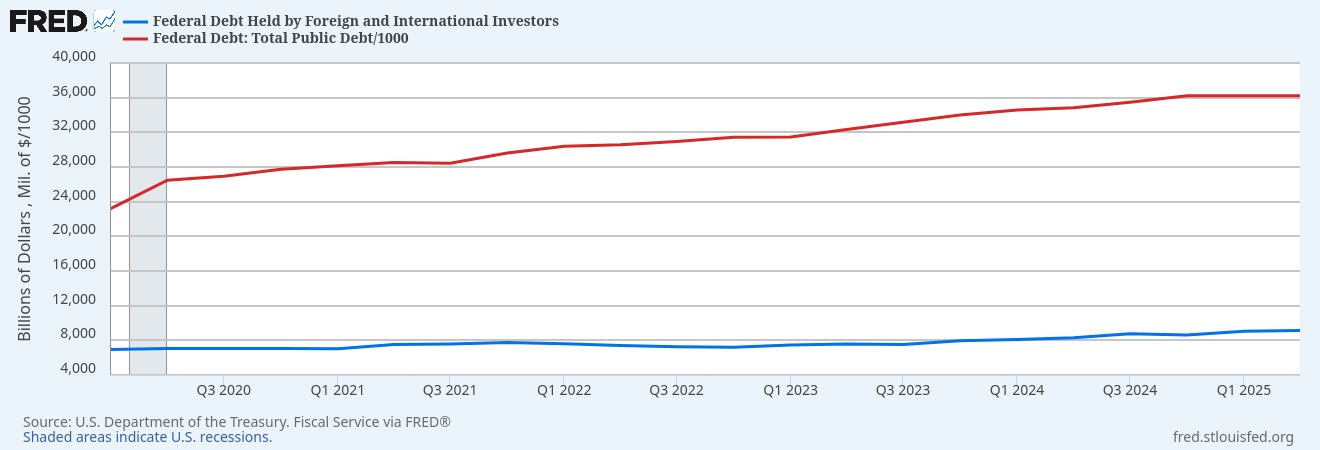
How bad can inflation get? We’ve had 5% inflation for short periods at numerous times. It didn’t really bother people that much, because it quickly fell back down. We had around 9% under Biden for a brief period and people lost their minds. But many places have seen inflation rates in the 20% or more range for prolonged periods of time. They still survived as countries. Even hyper-inflated countries have held together. At a 20% inflation rate, the German bank would see $325 returned in today’s money. If that bank had any real fear the US was going to 20% inflation, they’d avoid the bond until it had over a 20% interest rate. But most US debt is actually held by US individuals.

On net, this is a good position. If we want to buy something we make the magic tokens most people want to exchange. If we need more dollars, we can make more. We don’t even have to print them. We just put some numbers in a database. People are also willing to buy our debt, which we will pay back in those same magic tokens we make. Unless we do something stupid, that results in protracted, high inflation, we will continue to hold this unique position. The contenders for this rare status are the Euro and the Yen. No one wants Yuan or other BRICs currencies, not even the BRICS countries. Many countries hold a basket of currencies that include Yen, Euros, Swiss Francs, gold, and silver, but the US dollar is the workhorse currency.

There have been a couple of recent incidents, however, that may interfere with the dollar status. The first is seizing reserves. Specifically, a federal court seizing Argentine dollar reserves held in the US to pay creditors. For any country relying on the auspices of the Federal Reserve to hold their reserves (which many countries do), the chance they are seized by a US court has to be taken into consideration. (The US also holds the gold reserves of other countries as well). Unless you want to have palettes of $100 bills in a warehouse, you may want to hold bearer bonds, gold, and silver in your own country. Along with this was partially pushing Russia out of the financial system for the invasion of Ukraine. Although this was something I felt was necessary at the time, with the recent administration, European countries especially might be concerned. Could UK assets be seized if the UK does something that insults the orange idiot? Before now it was assumed that it would require a lot of legal mumbo-jumbo – but with the administration operating outside the law, it becomes a matter of fiat by the generalismo.

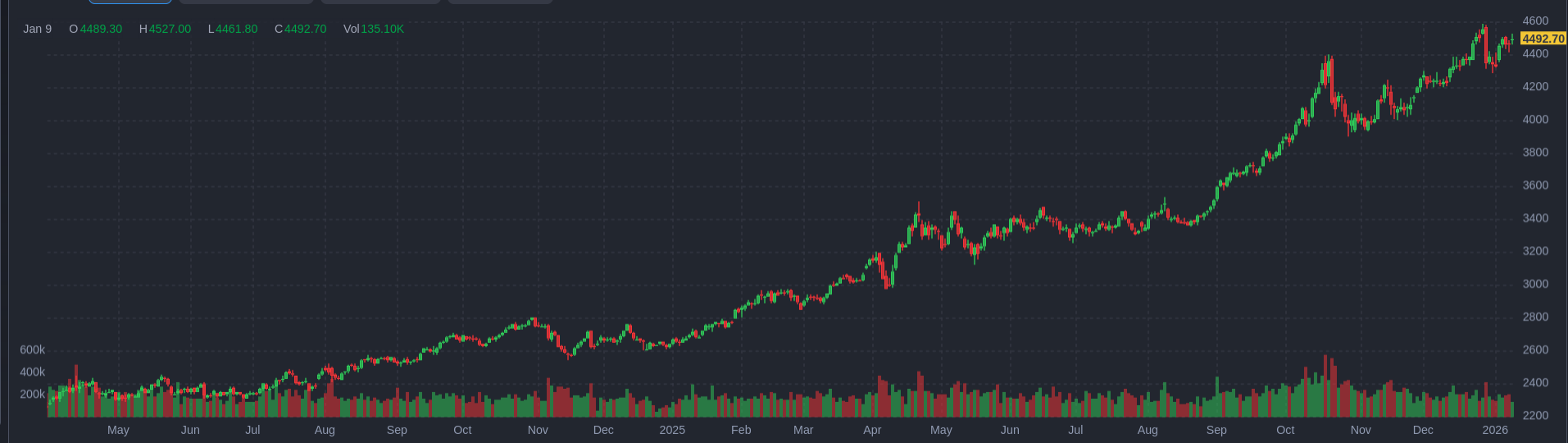
What would the world do? I really don’t know. The idea of crypto currencies stepping into this role is ridiculous. The volatility of any crypto makes holding it as a reserve nearly suicidal. Likewise, gold seems unable to handle the requirements of a much larger trading system than pre-1974 trade. It would also be a boon to the Russians, something many Europeans would rather avoid. However, as we’ve seen, gold has been been climbing steadily over the last year. And it’s hard to detach the timing from the chaotic nature of US policy. The Euro and the Yen are not there yet in peoples’ minds. The Yen may be closer to that role than the Euro, which seems too susceptible to political meddling from Europe. (Which should be a warning to the dollar).

What would happen to the US if the dollar no longer occupied its current position? I think it matters how we get there. If we get there because of an orderly move to more balanced baskets of reserves, not much. But, if we get there because of dollar weaponization or severe inflation, that’s a different story. For one thing, we would be paying higher interest rates on US debt. If it’s an inflation story, both US and foreign bond holders would want higher interest payments. Somewhat less if it’s a weaponization story, but they still would want compensation for added risk. The dollar would fall in value as people demand less dollars. As a country that imports quite a bit of stuff, this would push inflation.

But I suspect the biggest change would be the world no longer has to “grin and bear it,” when the US does something they don’t like. On one side is a fall into policies that degrade the value of holding dollars On the other side is a fall into the world of inflation. Maybe it isn’t a tight rope. Maybe it’s more like a balance beam, with more room for error than I believe. But at the end of the day, the loss of the dollar’s special position would not make America great again.

The Quantum Job Market

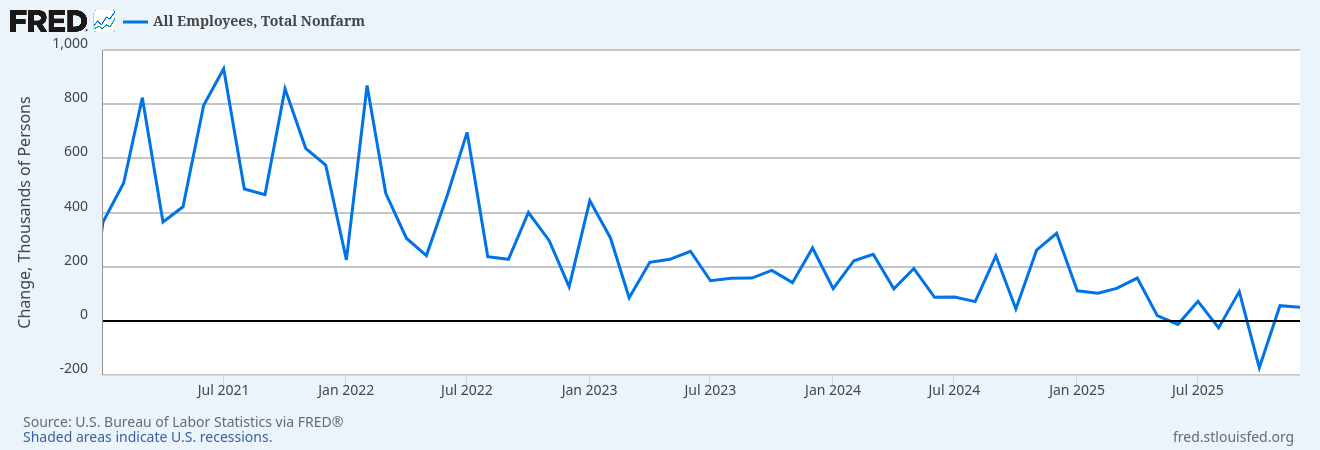
We have 3 numbers in fairly short order: JOLTS, first time claims, and the monthly jobs number. What do we have so far? The first time claims continue to come in well below ‘recession’ levels. From that number, the labor market looks tight. The JOLTS data, covered earlier, indicates a functioning labor market and not a great disconnect between people leaving jobs and people getting hired. And today we have the non-farm payrolls number. Let’s also add in the ADP number (which I do not think is as reliable as the payroll data). Both the payroll and the ADP number show a struggling labor market, according to historical metrics. Not a bad labor market, but a struggling labor market. Like most economic statistics, we care more about trends than the absolute number, but a non-farm payroll number indicative of a very healthy labor market would be above 150,000. Although it’s possible to get the occasional blip below 100,000.

Note the left hand side is the crazy period when the job market went nuts after COVID.

So far we’ve had about 160,000 jobs created over the last six months. That’s well below the number we need to absorb new entrants into the economy. The less reliable ADP number confirms the payroll data. The JOLTS data indicates a reasonable labor market and the first time climes show little job loss. This is where I think the first time claims may be under-reporting. If you lose your job, you might make slightly more money driving an Uber than collecting unemployment. I suspect other factors are depressing the actual number of people who would seek unemployment assistance. That’s not necessarily a bad thing, if you can make more money driving an Uber than collecting unemployment. You would be better off, even if you are grossly under-employed.

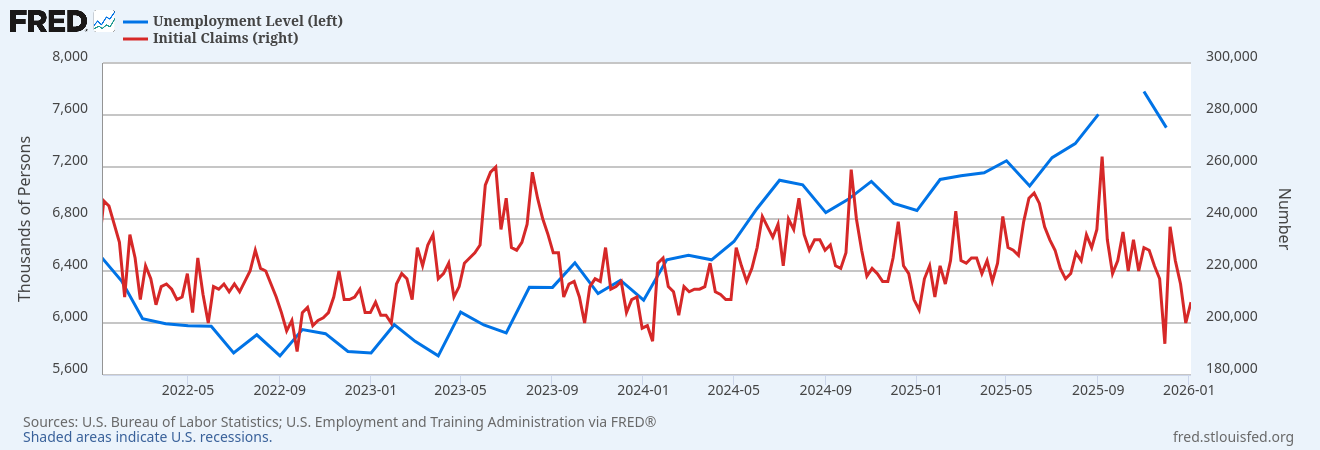
The red line represents initial unemployment claims, while the blue line is a survey of people looking for full time work.

This is why there is no magic single number, and no magic single sample of that number, that gives you a picture of the US economy. From the numbers, the labor market looks slack but not recessionary. It seems to back up the anecdotes of job hugging (where employers and employees may want to part ways but decide it’s better not to part ways right now), and new entrants having a difficult time finding a job. If it’s true that 70 million Americans engage in some kind of “gig” work, that’s nearly half the labor force (about 160 million participants). And maybe a weak jobs number isn’t as bad as it sounds if people can enter the gig economy instead of a “regular” job, and those people are under-counted. (Setting aside issues of job security, benefits, and the impact of under-employment). Is the labor market indicating recession?

There is something we need to acknowledge. Deficit spending is stimulative. At the end of the 2008 recession, there was a push-back on yet another democrat taxing and spending. And the stimulative policies were tempered by the resistance from republicans. (Although at levels that now seem quaint). That drew out the recovery period because fiscal policy was not injected into the problem. Spending more money than the amount removed through taxation stimulates activity and we may have ratcheted that up with the latest budget. We won’t know the final numbers until 2027. It will depend on actual receipts and actual outlays. There is some evidence the outlays will be higher than anticipated, with the DOGE effort showing an actual increase in government spending. If income tax receipts are weaker than offsets from tariffs, it could easily come in above estimates.

The current CBO estimates put the 2026 estimated deficit at 5.5% of GDP. The percentage of GDP is useful because it allows us to gauge what the real impact of the deficit, given the size of the economy. After all, a billion dollar deficit is a much bigger issue if the economy is only 10 billion dollars in size. The 2026 number may be above (likely) or below (unlikely) estimates given factors we won’t know until later. We won’t know until we actually see the impact of the new tax law, along with actual real spending.

The deficit coming down slows the economy in kind of a natural way, as activity boosts tax revenues and broader employment lowers spending on programs like SNAP and unemployment insurance. This natural brake pulls money out of the economy in higher tax revenues and lower spending, reducing the risk of the expansion becoming inflationary. However, we are doing two things that are expansionary for 2026, which are reducing tax rates and pushing the Fed to lower rates. In the face of already expansionary fiscal policy, this may push inflation for 2026. Unfortunately, it’s almost impossible to know the actual impact on inflation because we don’t know how the economy will react. The consumer in the lower 50% of income is in shambles. Most of the consumption is done by the top 20%, with half concentrated in the top 10%. There may not be the purchasing power for broad inflation, even if high end goods may see a level of inflation.

In addition, lower imports from tariffs boosts GDP, even if it means people are consuming less stuff. Could we be in a world where stagnation is masked as the GDP “increases” due to fewer imports? It’s mathematically possible. You could have patchy inflation depending on what goods you are measuring along with an improving GDP due to fewer imports. (You aren’t better off, you just don’t buy that sweater or bottle of wine, because it’s a little pricey). Combine this with jobs numbers being a less reliable measure of economic health (because workers don’t leverage unemployment insurance and transition to gig work), and you could have a stagnant economy, even if the numbers don’t look bad. You have low unemployment because of gig work and GDP growth from lower imports, even though you are under employed and just can’t afford things you used to buy.

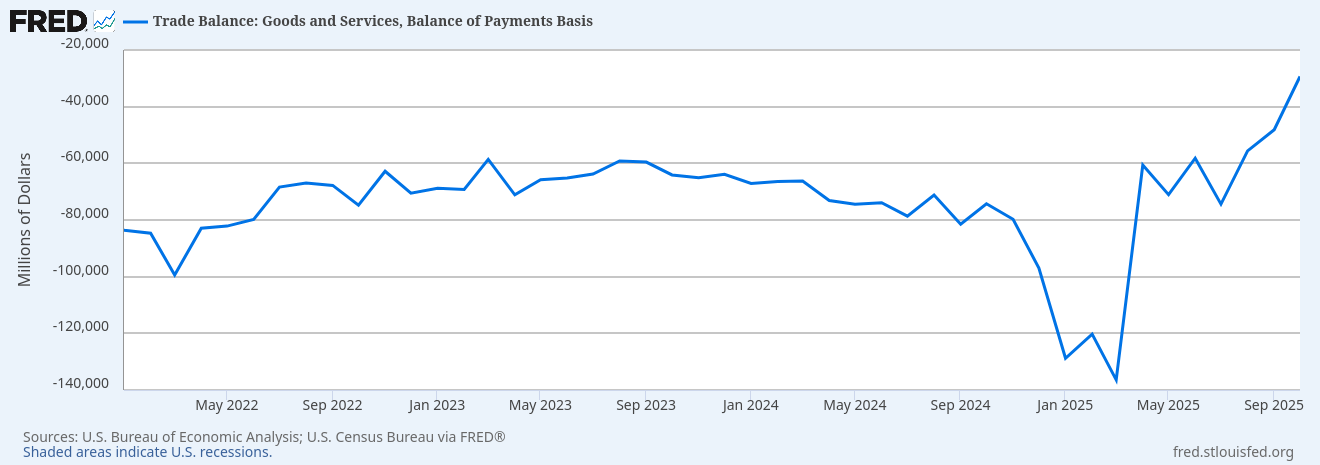
Note that numbers are negative, so sloping up and right means the lower imports.

At the end of the day, the purpose of economics is to understand how these voluntary and sometimes emergent systems of interaction between people create well-being. The purpose of 2% inflation or a target of 4.5% unemployment isn’t because the number is important, but because the well-being of many people seems to change at around those inflection points. If inflation drops below 2%, that is usually because economic activity is slowing and over time we will be worse off. If it goes above 2%, that’s a level people feel it erodes their buying power and they are less well off. If unemployment is too low, there is inflation as wages are bid up, while if it is too high, people are out of work and can’t find jobs. The goal of the specific metric should be to indicate when a change in policy is necessary because people feel their well-being is falling.

But it feels like we’re too focused on the numbers, rather than what they mean. I can’t count how many times it feels like the number itself is the target or the policy is being gamed to meet the target number. This includes “patching up” numbers like the CPI so they under report inflation. (There is mixed evidence on this. But we would expect the CPI goods basket to change as the basket of goods and services from 1976 is less applicable in 2026). When the economy changes, the old metrics used to gauge the health of the economy no longer make sense. Following unemployment claims or number of jobs created, if people are shifting to gig work that isn’t reported through these numbers, may no longer provide a meaningful metric. And yet, we don’t have a widely accepted substitute. Like a quantum system isn’t in one state or another until it’s observed, our economy is both good and bad at the same time, because we lack the metrics to observe it.

My Porcine Aviation Era

I have not had great experiences with AI development tools. I’m not a Luddite, but if the tool takes me more time than just doing it by hand, and I get the same results, it’s not a tool I want to use. In some cases, the code had subtle bugs or logic little better than the naive implementation. Or in other cases, the code was not modular and well laid out. Or the autocomplete took more work to clean up than it saved in typing. And in some cases it would bring in dependencies, but the version numbers would date back from the early 2020s. They were out of date and didn’t match to current documentation. For the most part the code worked, but I knew if I accepted the code as is, I would open myself (or whoever followed me) to maintenance issues at some later date. One might argue that the AI would be much better then, and could do the yeoman’s work of making changes, but I wasn’t sold on that idea. (And I’m still skeptical).

I would turn on the AI features, use them for a while, but eventually turn them off. I found it helped me with libraries with which I wasn’t familiar. Give me a few working lines of code and a config to get me going, and I’ll fix it up. It would save me a search on the internet for an out-of-date Stack Overflow article, I guess. I used prompt files and tried to keep the requests narrow and focused. But sometimes, writing a hundred lines of markdown and a four sentence prompt to get a function, didn’t seem scalable.

Well, pigs are flying and I found something that appears to be working. First, it involves a specific product. At the time of writing Claude Opus/Sonnet 4.5 seem to be quite good. Second, I have a better way of incorporating prompt files in my workflow (more on that below). Third, language matters. I found Claude gave me the same problems listed above when working on a Jakarta EE code base. But Rust is great. (Rust also has the advantage of being strongly typed and eliminating some of the issues I’ve had when working with Python and LLMs). Fourth, I apply the advice about keeping changes small and focused. Fifth, I refactor the code to make it crisp and tight. (More on that below). Sixth, ask the LLM for a quick code review. (More on that below).

The first topic I’ll expand on is changing my relationship with prompt files. Instead of attempting to create prompt files for an existing code base, I started writing a prompt file for a brand new project. I had Claude generate a starter and then added my edits. I believe in design (at least enough to show you’ve thought about the problem). This actually dovetails with my need to think through the problem before coding. I still find writing prompt files for an existing code base tedious. But, if I have to sit down and think about my architecture and what pieces should do, the prompt file is as good a place as any.

The other thing I want to cover is refactoring what the LLM hath wrought. Claude generated serviceable code. It was on par with the examples provided for the Rust libraries I was using. (Which also happen to be very popular with plenty of on-line examples). Claude would have had access to rich training data and pulled in recent versions (although I had to help a little). But the code is not quite structured correctly. In this case I needed to move it out of the main function and into separate modules. But mostly it was cut and past and let the compiler tell me what’s broken. Next, in the refactor, is to minimize the publicly exposed elements. Now I have code that’s cohesive and loosely coupled. The LLM by itself does not do a great job at this. Taste is more a matter for meat minds than silicon minds at this stage.

The final thing I want to touch on is using the LLM to review the code after refactoring. This gives me another data point on the quality of my code and where I might have had blind spots during the refactoring. I work with lots of meat minds and we review each others’ code on every commit. There are some good reviews and there are some poor reviews. And reviewing code is harder, if you’re not familiar with the specific problem domain. But the machine can give a certain level of review prior to submitting the PR for team review.

So that’s what I’ve found works well so far: green-field projects, in highly popular frameworks and languages, performing design tasks in the prompt file, using LLM best practices, refactoring the code after it’s generated, and a code review before submitting the PR. Auto-complete is still off in the IDE. And I’ll see if this will scale well as code accumulates in the project. But for now, this seems to produce a product with which I am satisfied.

[A small addendum on the nature of invention and why I think this works].

Peoples’ ideas are not unique. As one of my relations by marriage pointed out years go, when he moved above 190th street in Manhattan, there seemed to be a sudden run to the tip of the island to find “affordable” housing. In a city of millions of people, even if very few people have the same idea at the same time, the demand quickly gobbles up the supply. Humans build ideas up mostly from the bits and pieces floating around in the ether. Even “revolutionary” ideas are often traced back to maybe a interesting recombination of existing ideas. Moreover, people have sometimes been doing that “revolutionary” thing before but didn’t connect it to some other need or didn’t bother repacking the idea. What’s more important about “ideas” is not the property of the idea but the execution of the idea.

There is still something about invention, even if it is largely derivative, that the LLMs don’t appear to posses. Nor do they have the ability to reason about problems from logical principles, as they are focused on the construction of language from statistical relationships. Some argue that enough statistics and you can approximate the logical reasoning as well as a human, but I haven’t seen solid examples to date. The LLM doesn’t understand what to create, but it does summarize all the relevant examples necessary to support the work of realizing the idea. But even then, there are gaps that we have to fill in with human intention. Does this revolutionize coding for me? No, I estimate it makes me some percentage more productive, but in the 5-15% range. And of the time and effort necessary to realize an idea, coding is maybe 1/3 or less of the effort. And I worry that we’ll never get to the point this technology will be available at a price point that makes the provider a profit while being affordable to most people. After all, there’s a limit to how much you would spend for a few percentage points of additional productivity.

This is Nuts

I’m not sure how the government will prevent private equity or other large investors from buying houses. This is a world-wide problem. Let’s say you bought a rental. You don’t hold it in your name. You form an LLC or corporation and that holds the property. That limits what people can collect to the holdings of the LLC or corporation. That limits any liability for claims to the corporation. Some people have a few rentals. In some cases they’re vacation rentals, which doesn’t directly impact the cost of housing for non-vacationers.

I’m not sure what the legal basis for this is. I’m also not sure how it solves the availability crisis. There is some evidence that landlords in places like New York will hold back inventory to keep rents high, and that software to help landlords estimate rents may serve as a defacto collusion between landlords, but I’m not sure what the concrete evidence is for Blackstone reducing affordability. In fact, this is a global phenomena, with unaffordable housing across Europe and Canada. But there is cheap housing, like the famous 1 euro homes in Italy or Ireland paying people to move to remote towns on their coastal islands. There are just no jobs there. And for all the ranting about left wing socialism, state control of investment decisions is right up there.

Is the Job Market Actually Good?

There is never just one number that gives you the whole economic picture. In some cases the number itself is bogus (CPI) and what we really care about is the change in the number over multiple periods. That’s why policy is rarely made on just one reading. As much as people are complaining about the job market, maybe the actual job market is still in good shape? Today we got the JOLTS (job openings and labor turnover survey) numbers for the last month.

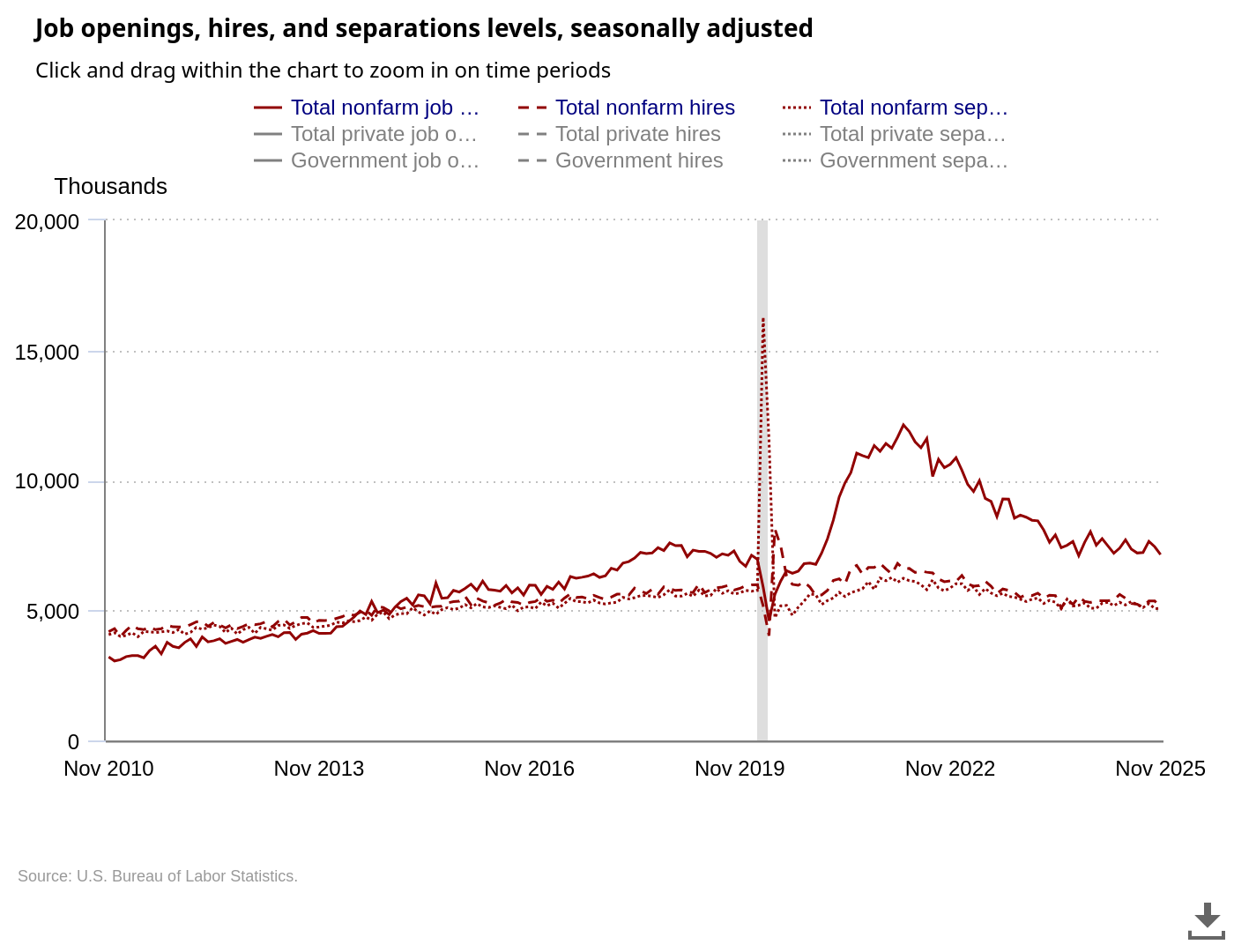
The chart from the BLS looks like it has a lot of openings, with the separations (layoffs and quits) slightly below hires. There is a giant grain of salt on the openings, in my humble opinion. There are a variety of reasons, but what I’ve seen personally are: 1) openings that are just trolling for resumes; 2) openings to justify H1-B visas; 3) ghost jobs; and 4) fishing.

The first are job openings that aren’t for ‘real’ jobs, they’re just to gather resumes from applicants. Who’s out there? What skills do they have? What are their compensation demands? Second are openings to justify H1-B visa requirements by demonstrating it can’t be filled by a current US worker. Third are the jobs posted to show a company is growing and exciting. And finally, they might get lucky and land a person that is way more qualified than they would normally be able to nab. I don’t trust the openings data to reveal important information, and instead I’m just going to focus on separations and hires over the last few months. The pandemic distorts the data.

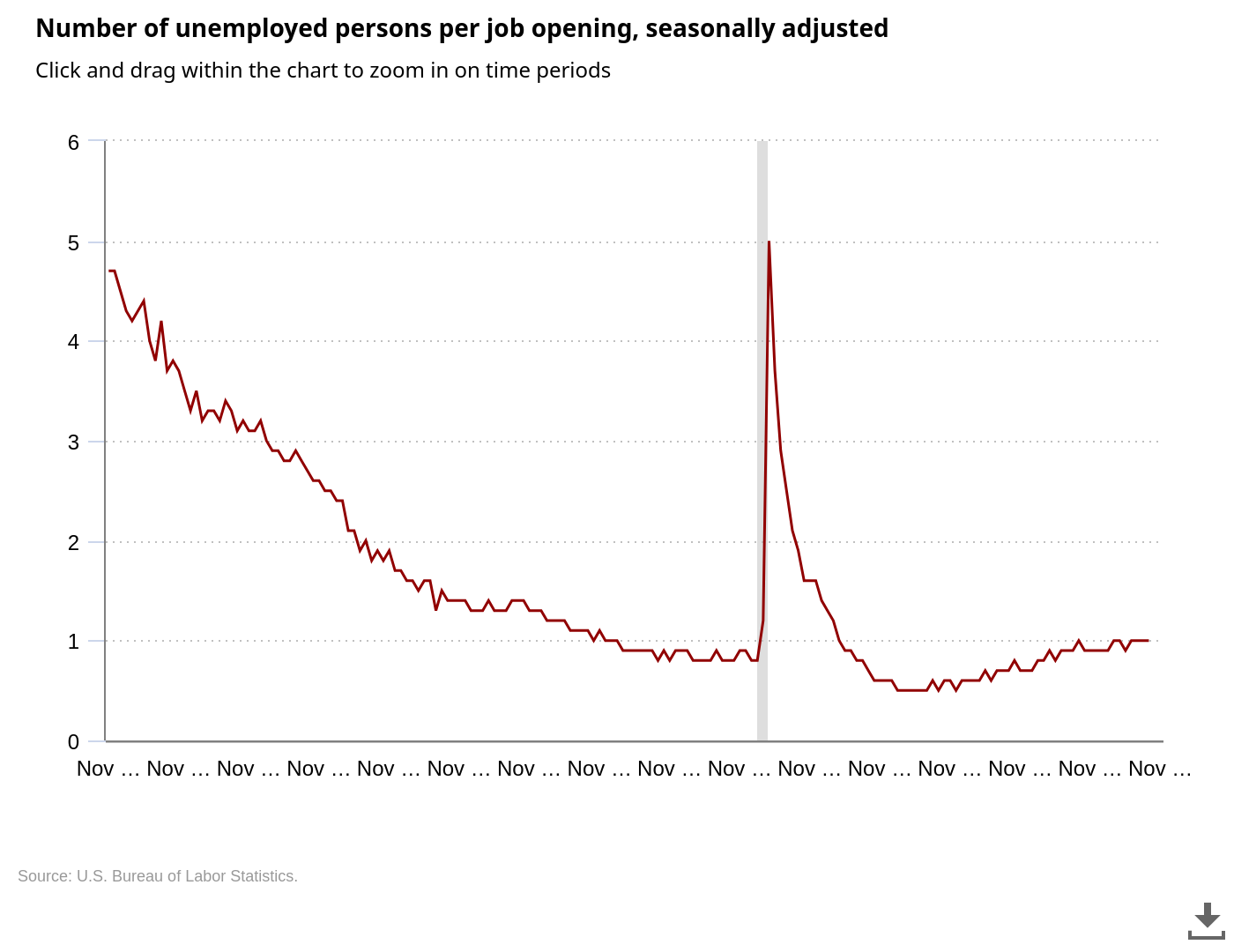
Here we see that both hires and separations are trending down. This would be consistent with the anecdotal stories of job hugging. Note that separations include both quits (which may often translate to an offsetting hire), and layoffs (which do not necessarily result in a hire). Looking at data from FRED, I suspect that quits have fallen off while layoffs are accelerating, but I haven’t done the math to validate that. However, we are pushing back toward more than one unemployed person per opening. And remembering my suspicion that a number of openings aren’t valid job openings, it means we are probably already more than 1 unemployed person per actual, real job openings.

Is the job market in good shape? I’m not sure it is, but I’m far from convinced it’s in bad shape. After all, it still appears we have slightly more hires than separations (which includes quits and layoffs). So if someone (on average) is getting hired when someone quits or is laid off, we are not in a bad state. And if we ignore the pandemic data, we see the number of unemployed people to open positions is much lower than the recovery after the 2008 recession. But we are certainly not in the post-pandemic world where we hit .7 unemployed people per opening. That was nuts. But if that’s all that you remember, and that’s your yardstick for the labor market, this middling to good labor market must seem like hell.

It Feels a Little Like a Lie

As Q3 GDP arrives, it’s above expectations. I hate anecdotal accounts as a basis for inferring trends, but we have had report after report of worsening conditions for individuals. Whether it’s visits to food banks or layoffs, or retailers pointing to weaker consumers, it feels like Q3 GDP should not have come in at 4.3%. I’m certainly not saying anything ridiculous, like the number is a fabrication or it should have been something negative. I live in the real world (or at lest do my best to discern the real world around me). Somewhere in the 3.5 to 2.5% range felt reasonable.

I’m still digging through the explanations, but one thing that sticks in the back of my mind is feeling like a 4 year economics degree was a joke. All the discussions about stability, or rule of law, or predictability as good soil for economic growth, are out the window. Apparently, you can run the economy like a drunken loon and it doesn’t matter. Or the government stepping in to buy stakes in companies is now a good thing (remember when the evil government stepped in to buy a stake in the big three)? Nosebleed deficits are now okay. Absolutely bonkers ideas from those responsible for our economy, like replacing income taxes with tariffs, is now calmly, if not happily, digested by the markets.

But the biggest shock is the degree to which tariffs don’t matter. It’s part of a larger narrative, where the lower income folks that make the stuff get the shaft and higher income investors and managers are doing better and better. (The managers and shareholders do well as profits, bonuses, and stock awards roll in for moving production overseas, while local workers lose their jobs. While the remuneration is tax efficient, at lower rates for capital gains, the unemployed eventually see their benefits cut because they’re ‘lazy’). We make life better and easier for the top earners while fucking the bottom quartile half three-quarters. Any discussion of taking the surplus from trade and using it to offset the negative impact as jobs shift overseas or are eliminated entirely is sidelined as socialism.

But I digress. We have had chaotic, possibly illegal, and arbitrary tariffs and restraints of trade (like who the fuck thought the government should get a ‘cut’ of GPU sales). And it doesn’t matter. Push for inflationary rate cuts. It doesn’t matter. Heck, I could be wrong, we might not get inflation. Make enforcement a function of bribes to a would-be monarch. No problem, apparently rule of law was not important as long as a bribe gets you what you want. Need to merge? Don’t look for clear guidance to support M&A, just give the grifter in chief and his cronies their vig. Policy clarity can be defined as knowing where and who to bribe.

Am I angry that GDP came in at 4.3%? It surprised me, but I’m not angry. I am frustrated that all the talk about the care and feeding of the economy, the hard choices we need to make to keep it running well, or the degree to which we need the best people running seems like a joke. All the ivy league, PhD, novella-sized CV people apparently were just tooting their own class horns. You took an economics at a community college and think we should return to the gold standard? Who the fuck knows at this point, maybe it will work. You’re a welder who thinks we should stop importing things from Turkey to boost GDP? Sure, why not. Think there’s a trillion dollars of spending that can seriously be cut? Sure, no problem, fuck the math.

Admittedly, this was a rant. Maybe we’re floating on a bubble that may pop badly. And then we might see the effects of stupid policies through the lens of a spiraling economy. And we’ll rediscover we need intelligent, skill people in charge. Or maybe not. Maybe Baumol and Blinder is as much a work of careful fiction as a theology textbook.

But that’s not something I want for me, my family, or my neighbors. Maybe we’ll see the government wade further into business by back-stopping any collapse with “free money” of cheap interest rates, loan guarantees, and buying even more equity in private companies. I remember when that kind of socialism was something Republicans vehemently opposed. Against all the good principles of being careful stewards of the pillars that hold up prosperity. Manipulating rates, funny money deficits, state owned companies, and corrupt officials were something we pointed to as markers of guaranteed economic suffering under tin-pot dictators. I never could have imagined it would be our future.