The Dollar’s Tight-Rope

The dollar is the most often used thing of value in which non-USA countries store their foreign currency reserve. First off, what’s a foreign currency reserve? These are often large sums of currency held by the central banks of various countries to stabilize their currencies. If there’s a sudden shock on the Swiss Franc, the government of Switzerland can buy or sell dollars to mitigate the shock. In some cases, the governments also use reserves to facilitate trade or government purchases. This was traditionally done with gold and silver. However, since 1974, it has largely been done with dollars. Dollars provided by a country that (until recently) was committed to international rules and institutions that facilitated trade and rule of law for disputes.

The dollar is not only a reserve, held by many countries including China and Russia, but also a preferred currency for many international exchanges. When you buy a barrel of oil, that contract is denominated in dollars. (Even though the Saudis did poke Joe Biden in the eye by executing some contracts with China in Yuan – it was a political move, not based economics). If a large bank, or a government, lends money to another country, it will generally do so in dollars. A German bank does not want useless Bolivars, Dinars, Pesos, Drachmas, or Rials. They want dollars, Euros, and Swiss Francs (probably in that order). The country or government receiving the loan also wants dollars. (Although Euros can be fine, as they translate quickly and easily into dollars).

This puts the United States in a unique position, as the world’s supplier of dollars. When we run a deficit, we borrow that money in dollars. If a German bank buys a US treasury bond (a loan to the United States government), it will be repaid in dollars. The repayment risk to the German bank is minimal, as the US can just print all the dollars it wants. The risk to the German bank is the US will be poorly managed, and the value of the dollar will be inflated away. Let’s say the German bank buys the treasury bond for $1,000, expecting to receive $50 in interest every year for the next five years and then the $1,000 principle. At a 2% inflation rate, that $1,000 will be worth about $900 in today’s money. But if the US engages in some very stupid decisions, and the inflation rate climes to 5%, that will be worth $775 in today’s money. Until recently, the US has had largely very sober, responsible economic managers, so the risk was minimal.

How bad can inflation get? We’ve had 5% inflation for short periods at numerous times. It didn’t really bother people that much, because it quickly fell back down. We had around 9% under Biden for a brief period and people lost their minds. But many places have seen inflation rates in the 20% or more range for prolonged periods of time. They still survived as countries. Even hyper-inflated countries have held together. At a 20% inflation rate, the German bank would see $325 returned in today’s money. If that bank had any real fear the US was going to 20% inflation, they’d avoid the bond until it had over a 20% interest rate. But most US debt is actually held by US individuals.

On net, this is a good position. If we want to buy something we make the magic tokens most people want to exchange. If we need more dollars, we can make more. We don’t even have to print them. We just put some numbers in a database. People are also willing to buy our debt, which we will pay back in those same magic tokens we make. Unless we do something stupid, that results in protracted, high inflation, we will continue to hold this unique position. The contenders for this rare status are the Euro and the Yen. No one wants Yuan or other BRICs currencies, not even the BRICS countries. Many countries hold a basket of currencies that include Yen, Euros, Swiss Francs, gold, and silver, but the US dollar is the workhorse currency.

There have been a couple of recent incidents, however, that may interfere with the dollar status. The first is seizing reserves. Specifically, a federal court seizing Argentine dollar reserves held in the US to pay creditors. For any country relying on the auspices of the Federal Reserve to hold their reserves (which many countries do), the chance they are seized by a US court has to be taken into consideration. (The US also holds the gold reserves of other countries as well). Unless you want to have palettes of $100 bills in a warehouse, you may want to hold bearer bonds, gold, and silver in your own country. Along with this was partially pushing Russia out of the financial system for the invasion of Ukraine. Although this was something I felt was necessary at the time, with the recent administration, European countries especially might be concerned. Could UK assets be seized if the UK does something that insults the orange idiot? Before now it was assumed that it would require a lot of legal mumbo-jumbo – but with the administration operating outside the law, it becomes a matter of fiat by the generalismo.

What would the world do? I really don’t know. The idea of crypto currencies stepping into this role is ridiculous. The volatility of any crypto makes holding it as a reserve nearly suicidal. Likewise, gold seems unable to handle the requirements of a much larger trading system than pre-1974 trade. It would also be a boon to the Russians, something many Europeans would rather avoid. However, as we’ve seen, gold has been been climbing steadily over the last year. And it’s hard to detach the timing from the chaotic nature of US policy. The Euro and the Yen are not there yet in peoples’ minds. The Yen may be closer to that role than the Euro, which seems too susceptible to political meddling from Europe. (Which should be a warning to the dollar).

What would happen to the US if the dollar no longer occupied its current position? I think it matters how we get there. If we get there because of an orderly move to more balanced baskets of reserves, not much. But, if we get there because of dollar weaponization or severe inflation, that’s a different story. For one thing, we would be paying higher interest rates on US debt. If it’s an inflation story, both US and foreign bond holders would want higher interest payments. Somewhat less if it’s a weaponization story, but they still would want compensation for added risk. The dollar would fall in value as people demand less dollars. As a country that imports quite a bit of stuff, this would push inflation.

But I suspect the biggest change would be the world no longer has to “grin and bear it,” when the US does something they don’t like. On one side is a fall into policies that degrade the value of holding dollars On the other side is a fall into the world of inflation. Maybe it isn’t a tight rope. Maybe it’s more like a balance beam, with more room for error than I believe. But at the end of the day, the loss of the dollar’s special position would not make America great again.

The Quantum Job Market

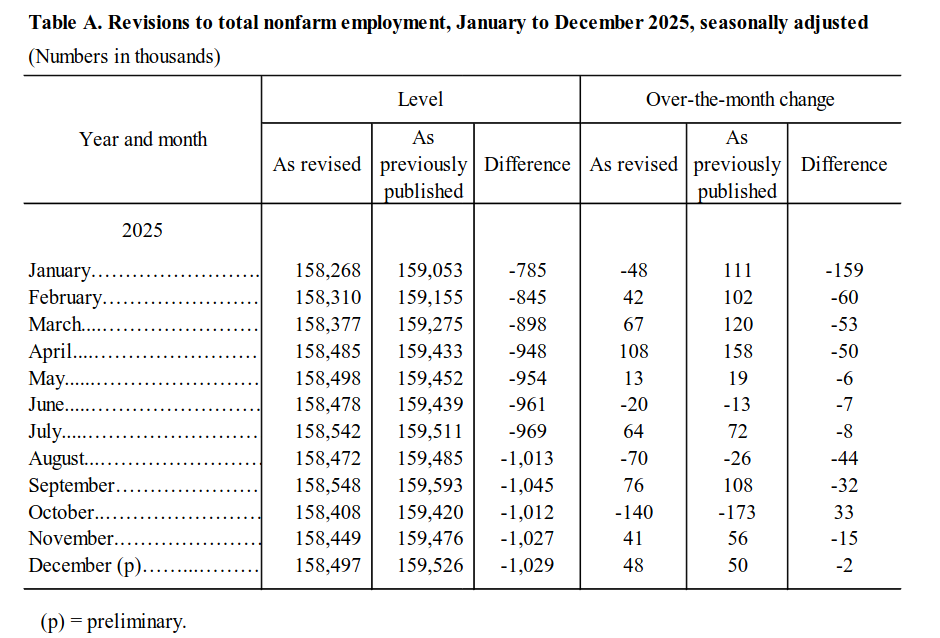
We have 3 numbers in fairly short order: JOLTS, first time claims, and the monthly jobs number. What do we have so far? The first time claims continue to come in well below ‘recession’ levels. From that number, the labor market looks tight. The JOLTS data, covered earlier, indicates a functioning labor market and not a great disconnect between people leaving jobs and people getting hired. And today we have the non-farm payrolls number. Let’s also add in the ADP number (which I do not think is as reliable as the payroll data). Both the payroll and the ADP number show a struggling labor market, according to historical metrics. Not a bad labor market, but a struggling labor market. Like most economic statistics, we care more about trends than the absolute number, but a non-farm payroll number indicative of a very healthy labor market would be above 150,000. Although it’s possible to get the occasional blip below 100,000.

Note the left hand side is the crazy period when the job market went nuts after COVID.

So far we’ve had about 160,000 jobs created over the last six months. That’s well below the number we need to absorb new entrants into the economy. The less reliable ADP number confirms the payroll data. The JOLTS data indicates a reasonable labor market and the first time climes show little job loss. This is where I think the first time claims may be under-reporting. If you lose your job, you might make slightly more money driving an Uber than collecting unemployment. I suspect other factors are depressing the actual number of people who would seek unemployment assistance. That’s not necessarily a bad thing, if you can make more money driving an Uber than collecting unemployment. You would be better off, even if you are grossly under-employed.

The red line represents initial unemployment claims, while the blue line is a survey of people looking for full time work.

This is why there is no magic single number, and no magic single sample of that number, that gives you a picture of the US economy. From the numbers, the labor market looks slack but not recessionary. It seems to back up the anecdotes of job hugging (where employers and employees may want to part ways but decide it’s better not to part ways right now), and new entrants having a difficult time finding a job. If it’s true that 70 million Americans engage in some kind of “gig” work, that’s nearly half the labor force (about 160 million participants). And maybe a weak jobs number isn’t as bad as it sounds if people can enter the gig economy instead of a “regular” job, and those people are under-counted. (Setting aside issues of job security, benefits, and the impact of under-employment). Is the labor market indicating recession?

There is something we need to acknowledge. Deficit spending is stimulative. At the end of the 2008 recession, there was a push-back on yet another democrat taxing and spending. And the stimulative policies were tempered by the resistance from republicans. (Although at levels that now seem quaint). That drew out the recovery period because fiscal policy was not injected into the problem. Spending more money than the amount removed through taxation stimulates activity and we may have ratcheted that up with the latest budget. We won’t know the final numbers until 2027. It will depend on actual receipts and actual outlays. There is some evidence the outlays will be higher than anticipated, with the DOGE effort showing an actual increase in government spending. If income tax receipts are weaker than offsets from tariffs, it could easily come in above estimates.

The current CBO estimates put the 2026 estimated deficit at 5.5% of GDP. The percentage of GDP is useful because it allows us to gauge what the real impact of the deficit, given the size of the economy. After all, a billion dollar deficit is a much bigger issue if the economy is only 10 billion dollars in size. The 2026 number may be above (likely) or below (unlikely) estimates given factors we won’t know until later. We won’t know until we actually see the impact of the new tax law, along with actual real spending.

The deficit coming down slows the economy in kind of a natural way, as activity boosts tax revenues and broader employment lowers spending on programs like SNAP and unemployment insurance. This natural brake pulls money out of the economy in higher tax revenues and lower spending, reducing the risk of the expansion becoming inflationary. However, we are doing two things that are expansionary for 2026, which are reducing tax rates and pushing the Fed to lower rates. In the face of already expansionary fiscal policy, this may push inflation for 2026. Unfortunately, it’s almost impossible to know the actual impact on inflation because we don’t know how the economy will react. The consumer in the lower 50% of income is in shambles. Most of the consumption is done by the top 20%, with half concentrated in the top 10%. There may not be the purchasing power for broad inflation, even if high end goods may see a level of inflation.

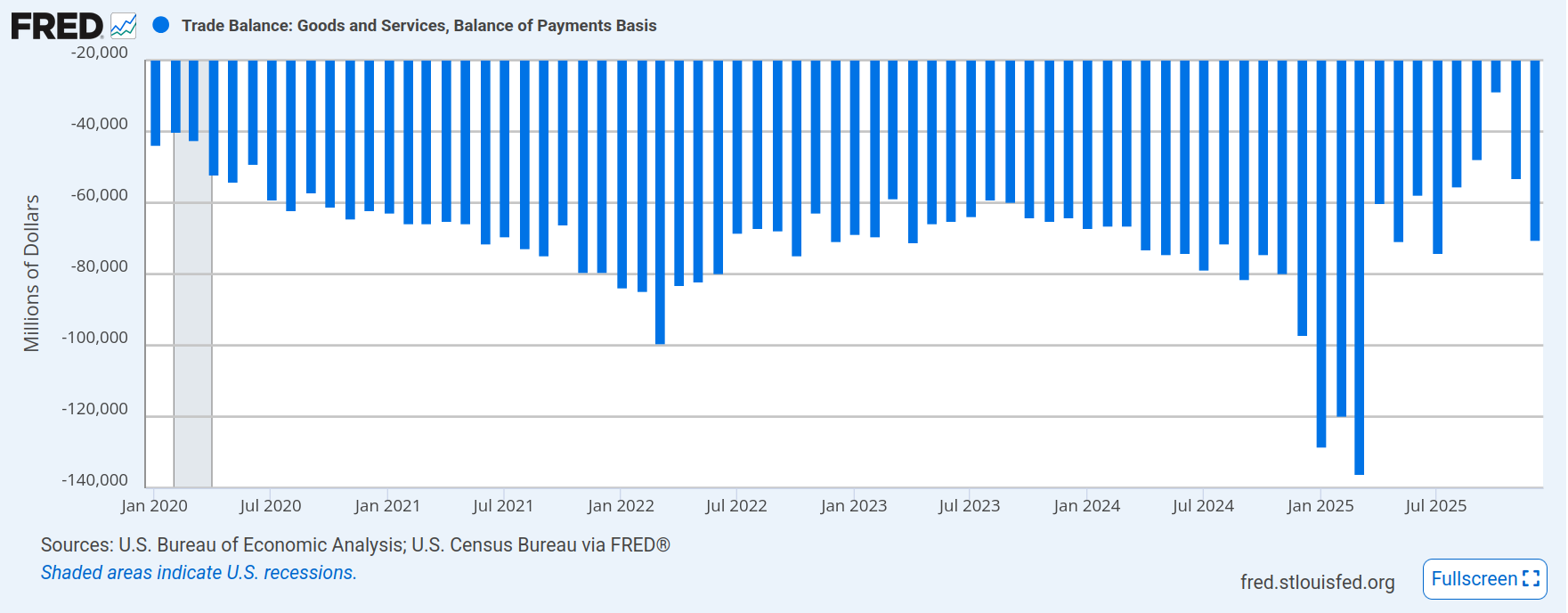
In addition, lower imports from tariffs boosts GDP, even if it means people are consuming less stuff. Could we be in a world where stagnation is masked as the GDP “increases” due to fewer imports? It’s mathematically possible. You could have patchy inflation depending on what goods you are measuring along with an improving GDP due to fewer imports. (You aren’t better off, you just don’t buy that sweater or bottle of wine, because it’s a little pricey). Combine this with jobs numbers being a less reliable measure of economic health (because workers don’t leverage unemployment insurance and transition to gig work), and you could have a stagnant economy, even if the numbers don’t look bad. You have low unemployment because of gig work and GDP growth from lower imports, even though you are under employed and just can’t afford things you used to buy.

Note that numbers are negative, so sloping up and right means the lower imports.

At the end of the day, the purpose of economics is to understand how these voluntary and sometimes emergent systems of interaction between people create well-being. The purpose of 2% inflation or a target of 4.5% unemployment isn’t because the number is important, but because the well-being of many people seems to change at around those inflection points. If inflation drops below 2%, that is usually because economic activity is slowing and over time we will be worse off. If it goes above 2%, that’s a level people feel it erodes their buying power and they are less well off. If unemployment is too low, there is inflation as wages are bid up, while if it is too high, people are out of work and can’t find jobs. The goal of the specific metric should be to indicate when a change in policy is necessary because people feel their well-being is falling.

But it feels like we’re too focused on the numbers, rather than what they mean. I can’t count how many times it feels like the number itself is the target or the policy is being gamed to meet the target number. This includes “patching up” numbers like the CPI so they under report inflation. (There is mixed evidence on this. But we would expect the CPI goods basket to change as the basket of goods and services from 1976 is less applicable in 2026). When the economy changes, the old metrics used to gauge the health of the economy no longer make sense. Following unemployment claims or number of jobs created, if people are shifting to gig work that isn’t reported through these numbers, may no longer provide a meaningful metric. And yet, we don’t have a widely accepted substitute. Like a quantum system isn’t in one state or another until it’s observed, our economy is both good and bad at the same time, because we lack the metrics to observe it.

It Feels a Little Like a Lie

As Q3 GDP arrives, it’s above expectations. I hate anecdotal accounts as a basis for inferring trends, but we have had report after report of worsening conditions for individuals. Whether it’s visits to food banks or layoffs, or retailers pointing to weaker consumers, it feels like Q3 GDP should not have come in at 4.3%. I’m certainly not saying anything ridiculous, like the number is a fabrication or it should have been something negative. I live in the real world (or at lest do my best to discern the real world around me). Somewhere in the 3.5 to 2.5% range felt reasonable.

I’m still digging through the explanations, but one thing that sticks in the back of my mind is feeling like a 4 year economics degree was a joke. All the discussions about stability, or rule of law, or predictability as good soil for economic growth, are out the window. Apparently, you can run the economy like a drunken loon and it doesn’t matter. Or the government stepping in to buy stakes in companies is now a good thing (remember when the evil government stepped in to buy a stake in the big three)? Nosebleed deficits are now okay. Absolutely bonkers ideas from those responsible for our economy, like replacing income taxes with tariffs, is now calmly, if not happily, digested by the markets.

But the biggest shock is the degree to which tariffs don’t matter. It’s part of a larger narrative, where the lower income folks that make the stuff get the shaft and higher income investors and managers are doing better and better. (The managers and shareholders do well as profits, bonuses, and stock awards roll in for moving production overseas, while local workers lose their jobs. While the remuneration is tax efficient, at lower rates for capital gains, the unemployed eventually see their benefits cut because they’re ‘lazy’). We make life better and easier for the top earners while fucking the bottom quartile half three-quarters. Any discussion of taking the surplus from trade and using it to offset the negative impact as jobs shift overseas or are eliminated entirely is sidelined as socialism.

But I digress. We have had chaotic, possibly illegal, and arbitrary tariffs and restraints of trade (like who the fuck thought the government should get a ‘cut’ of GPU sales). And it doesn’t matter. Push for inflationary rate cuts. It doesn’t matter. Heck, I could be wrong, we might not get inflation. Make enforcement a function of bribes to a would-be monarch. No problem, apparently rule of law was not important as long as a bribe gets you what you want. Need to merge? Don’t look for clear guidance to support M&A, just give the grifter in chief and his cronies their vig. Policy clarity can be defined as knowing where and who to bribe.

Am I angry that GDP came in at 4.3%? It surprised me, but I’m not angry. I am frustrated that all the talk about the care and feeding of the economy, the hard choices we need to make to keep it running well, or the degree to which we need the best people running seems like a joke. All the ivy league, PhD, novella-sized CV people apparently were just tooting their own class horns. You took an economics at a community college and think we should return to the gold standard? Who the fuck knows at this point, maybe it will work. You’re a welder who thinks we should stop importing things from Turkey to boost GDP? Sure, why not. Think there’s a trillion dollars of spending that can seriously be cut? Sure, no problem, fuck the math.

Admittedly, this was a rant. Maybe we’re floating on a bubble that may pop badly. And then we might see the effects of stupid policies through the lens of a spiraling economy. And we’ll rediscover we need intelligent, skill people in charge. Or maybe not. Maybe Baumol and Blinder is as much a work of careful fiction as a theology textbook.

But that’s not something I want for me, my family, or my neighbors. Maybe we’ll see the government wade further into business by back-stopping any collapse with “free money” of cheap interest rates, loan guarantees, and buying even more equity in private companies. I remember when that kind of socialism was something Republicans vehemently opposed. Against all the good principles of being careful stewards of the pillars that hold up prosperity. Manipulating rates, funny money deficits, state owned companies, and corrupt officials were something we pointed to as markers of guaranteed economic suffering under tin-pot dictators. I never could have imagined it would be our future.

First Time Claims Make Less and Less Sense

The number of first time jobless claims (a weekly statistic measuring the number of folks filing their first claim for unemployment insurance when they become unemployed) has been bouncing around 250,000 for the last year and change.

A related number, the continuing claims, which measures the number of unemployment claimants who are continuing to file for benefits has also been remarkably steady.

While it looks like there was a big jump in May, it was a change from 1,800,00 to about 1,940,000, of about 7-8%. And then it stayed steady. Meanwhile, unemployment has been slowly creeping back up over the last two years.

Meanwhile, we see a definite softening of new jobs created. The change in non-farm employment shows a degree of cooling in the economy.

What would we expect to see, if job creation is slowing, along with an up-tick in the unemployment rate? We’d expect to see more claimants for unemployment insurance. Fewer jobs, more layoffs, and lots of stories about graduates that can’t find jobs (who cannot apply for unemployment insurance), indicate a soft labor market. We see the average weeks of unemployment (how hard it is to find a job once you lose your job), tick up slightly but not decisively, by about 2 weeks, but still within statistical noise.

With today’s CPI coming in a lot softer than expected, this will give the Fed a green light to cut. But as much as we see evidence of a slowing job market, we don’t see more and more people applying for unemployment, what gives? Is this just what a more normal employment market looks like after the go-go job markets of 2021 to 2023? When there were many times more jobs open than there were candidates?

First, we have to remember a few things that may be complicating the first time claims picture. First is that the new graduate cannot claim unemployment. If a new high-school or college graduate cannot find a job, they cannot claim benefits because they haven’t worked for an employer that paid into the insurance pool. If you quit because your commute would be 2 hours (after you moved because even your boss was saying WFH would be the new normal), you are not eligible. If your employer claims it was for cause, you are not eligible. That’s why many employers will try to cite ’cause’ as the termination reason, even though they’re firing dozens or hundreds of people at the same time. Nor are independent contractors. if you were an independent IT contractor at US AID and your contract was terminated, you are not eligible. You basically have to work on a “W-2” basis for an employer that terminates you for non-performance (or criminal) reasons.

Then there are other reasons, such as deciding not to claim benefits, because you can make more money driving for Uber. (Or at least you think you can make more money driving for Uber). If you make more money than your benefit check at a part time job, you can’t claim benefits. Some people won’t claim it out of principle. And some people live in states that felt too many workers were getting cushy at home instead of returning to the workforce and made it harder to claim benefits.

Does an increase in first time claims (or continuing claims) predict a recession? No. It is a trailing indicator. Generally corporate profits fall, along with Wall Street’s expectations of future profits, as the economy slows. At that point corporations realize revenue won’t grow, so they have to cut costs to keep their margins. One quick way is to lay off staff. Often, this is a time for the company to prune their deadwood projects. These are projects they’re putting money into because it seemed like a good idea at the time, but no one seems to be able to kill it now that it’s shown to be a dud. Managers are human, too, and subject to biases like the ‘sunk cost’ fallacy. This is the push that management needed. But sometimes they just reduce head-count to the point of pain, because they can coast on their accumulating inventory until business improves. Only after output falls (a recession begins) does employment really contract.

But it is still striking there’s been so little movement in first time claims. It feels like you could place bets on it being between 220,000 and 240,000 next week and the week after. Do I think it’s being manipulated? No. While it was popular among the right to say Biden’s numbers were all fake and made up, I never thought that claim was based in reality and I don’t think there’s any skulduggery now. Did Trump send a worrying signal by firing statisticians? Yes, but I believe the core of the process is still very much intact. Are the numbers massaged? Yes, sometimes seasonality needs to be taken into account, otherwise the increase or decrease would be overstated and the period to period changes are harder to compare. And if you think that’s an issue, most numbers are also released without seasonal adjustment. So, go look for yourself. Are numbers revised? Yes – because sometimes data doesn’t come in on time. This is especially true of the employment survey, with some employers submitting data weeks after the data was due.

What we may be seeing is a change, or a beginning of a change, in the relevance of this number. Due to a variety of factors, it’s becoming less sensitive to changes in the health of the labor market. If you lose your job, your ability to access smaller benefits may be reduced. And employers may be getting better at incentivizing you to quit and unable to access your benefits. For example, we need you to report to work 3 states away and we won’t help you move. The first time claims may be very slow to move, if at all. Like we are seeing unemployment hit 4.6% but little to no change in the first time claims.

What if Data Center Space Were Free?

First, what is a data center? It’s a slightly archaic term, meaning where the firm aggregated its computer data. It’s from the age of centralized computing. While desktop computers were intended to run on household current, shared computers (mainframes, VAXes, Enterprise databases, etc) were to be installed in rooms with commercial power and air conditioning. These were often installed with special raised floors, allowing cables to run beneath your feet. The space where we put servers has changed, but not radically. Modern servers, although they use processors that are of the same instruction set as desktop and laptop processors, have constantly screaming fans and power requirements that can strain a typical 15 amp household circuit or typical office circuit. And rather than a raised floor, the cabling is now overhead.

The first big change was going from on-premise to hosted infrastructure. Prior to the 2000s, if you went to an internet company, you would likely be taken to their data center. It would be in the same building, or one building over, from their offices. Was there a server problem? Walk over to the data-center and take a look. (Tip: if the servers all looked the same, you could eject the CD ROM tray to help you find it). Starting in the late 1990s and through the 2010s, the data-center moved to a shared facility. Now, the data center might be hundreds of miles away. You might never visit it, or take the tour once before signing up. You ship your equipment to the site and they put it in racks for you, connecting cables as you specify. Or in some cases, lease the equipment from them. From the 2010s on, the move became to the cloud. In the cloud you are renting the equipment in very short time increments. The cloud provider gives you an API to manage the systems.

When you rent space in a data center you are paying for power, networking, and floor space. Power is a combination of the power your draw and some part of the infrastructure, like the backup generator. In a shared data center, you are generally responsible for your own uninterrupted power supplies. Networking is a function of how much of the bandwidth you intend to consume, or you can provide your own network pipe. Within the category of floor space you can add features like physical security, but it is essentially your portion of the footprint of the data center. All the other costs like staff to make sure the physical structure is operational, or someone to attach a cable, are either baked into those costs or billed separately. If you’re a small company looking to host a set of servers, you would likely pay for a rack (a single tower of servers) or a cage (essentially a fenced in area with a lock on it). That square footage combined with the power and network bill is your monthly fee for hosting your servers.

The cloud obscures all that and layers on management. You no longer have to set up your servers, storage, and networking. The cloud provider does that for you. You can still provision a VM or create a virtual (fake) network, but the physical hardware is hidden from you. Your interface to the computers is the API that cloud provider publishes. The costs can be per hour, minute, or gigabyte to seem ridiculously low. How can you justify managing your own servers when it not only involves all the costs mentioned above, but hiring and managing an IT staff, compared to those low costs. There are times when companies have been nearly bankrupted by their cloud spend, but for many it still feels like a deal. And it’s highly flexible, even if getting the costs down means buying into multi-year, inflexible arrangements more akin to leases.

But that’s not the real draw of cloud. Remember floor space, power, and networking? When a data center runs out of floor space, construction time is measured in years. It may not be practical to deliver more power. And even adding more networking always seems to take the networking providers months just to turn on a bit of fiber. God knows why. If you have your equipment in a data center and need to add more, the answer could be ‘no.’ It requires you to figure out where to put the equipment and how to communicate between the two data centers (although some providers had a solution for this). For all intents and purposes, the power, floor space, and networking in the cloud are infinite. And they handle other issues like fail-over, assuming you are willing to pay for it.

But we may be heading to an interesting situation, should the AI hype cycle crash. We will wind up with a lot of data center space heavily over-subscribed with power and networking, with no clients. We might be in a glut of modern data center space that is re-possessed by PE firms and regional banks lending to the projects. This would be like the glut of dark fiber that made YouTube and other social media initially affordable. You might have a group of lenders that’s suddenly trying to get rid of a largely completed data center at a fraction of what it cost to build. All you need to do is walk in and secure agreements for power and networking. The infrastructure will be there in varying degrees of completion. From powered on to cement slab.

What we lack is a view of operating systems that spans multiple computers. The cloud would still have an advantage for many companies that denuded themselves to system administrators to hire cloud administrators. It’s also hard to cost compete with a company that can smear those costs over a much larger number of systems. The idea of companies taking their data centers back in house isn’t what I think is likely. But it may open the door for newer and cheaper competitors. If not general cloud competitors, then maybe specialty providers that provide storage only or back up facilities in case there’s an outage? These new data centers would already have fat pipes to reach out to AWS or Azure.

Maybe another option is to finish the building and bring computer controlled manufacture. You would have plenty of power for laser cutters or mills. Even industrial processes like powder coating or electroplating require a significant amount of power. These data centers are being designed with more than enough power to spare. Like we divide existing data centers into ‘cages,’ these could also be divided up into cages for specific manufacturers. The data centers are also equipped with loading docks for semis. You want to make something like a bed frame that requires a CNC cutting board after board of MDF and grade ‘A’ plywood? No problem. You have a linear, football field sized building, where it gets cut, finished and packaged in one long assembly line. Maybe it would serve high-tech, multi-modal manufacture? You sit in a suburb of DC as you basically run a CNC cutter in Lousiana?

The down side is the AI chips themselves will have a very limited shelf life. Although using firms are extending the depreciation targets, the goal of the chip makers is to produce a chip so much better than the two generations ago, that it isn’t economically viable to operate the old chip. That’s a three year lifespan. Not because it can’t do the work, but because the electricity cost is too high. Maybe some of them could be used to support vision and robotics tasks related to manufacturing, but that may be only a small subset of what’s being purchased today.

Government Handouts are the Exit

It’s almost undeniable that the only reason the US economy has started slipping into a recession, or would have slipped months ago, is that investment in AI has driven about 1 to 1.5% of GDP. That’s an insanely huge figure. Not AI profits – which are years away even in optimistic projections. Unlike investments in roads, for example, about 60% to 70% of the AI investment is in chips that become obsolete in three years, but maybe as little as two years. The growth is happening so fast that power companies can’t keep up, which has lead to basically using old jet engines to turn hydrocarbons into CO2 to power those chips. All to give you an answer that might or might not be right, or just to generate offensive AI videos like Mahatma Gandhi eating a burger. Just to recap: the only thing keeping us from a recession is money being plowed into quickly obsolete “assets” (it’s hard to call them that – they’re almost a consumable), powered by setting even more climate change. The cement buildings, the data centers, left behind have a multi-decade life, but no one needs that much data center capacity. And if they’re unoccupied, they will go to shit.

So far the financing for this has gone beyond traditional investment to weird circular financing where company A invests in company B, who buys products and services from company A. Company A can then point to future orders and sales. Company B points to more investment. Everyone’s happy. Number go up. Company B then makes absurd projections of incomprehensible investments that need to be made, causing investors to snap up associated companies, and everyone happier because more number go up. But that’s okay, Company C promises (not necessarily delivers) future investments in A, making more number go up, after A promises to buy 3 times that much in company C’s products and services. At no point is numbering going up because Company B is anywhere near making back a significant amount of what it spends on short lived assets and jet fuel to power its data centers.

But surely this is good because it will make us all richer, right? Not really. If you think that, you haven’t been following along. I’ll give you a minute to catch up on how wealth inequality is both bad and accelerating. The benefits will be concentrated in the hands of the wealthy. Most of the benefit will be concentrated in the hands of people like Sam Altman or Mark Zuckerberg (who’s been searching for some new idea – any idea – since Facebook). The bonuses to execs and large share holders would be fantastic, if there any real chance of any of this earning back any money.

David Sachs and Sarah Friar made a statements which might indicate how these companies intend to square this circle of constant investment, no profit, and concentrated wealth. They will make the argument that if the government does not step in to support their narrow version of AI, the economy falters, and we go into recession. To keep that from happening, all we need to do is to make people like David Sachs wealthier, by bailing out their AI bets when the start to go bad by backstopping their loans or printing more money by driving down interest rates. (And therefore boosting inflation back up). I don’t think these are isolated musings. I think their air is probably thick with ideas in this vein, and these are just a couple of leaks. Maybe testing the waters? Or just they keep talking about it, so it’s a natural topic of discussion.

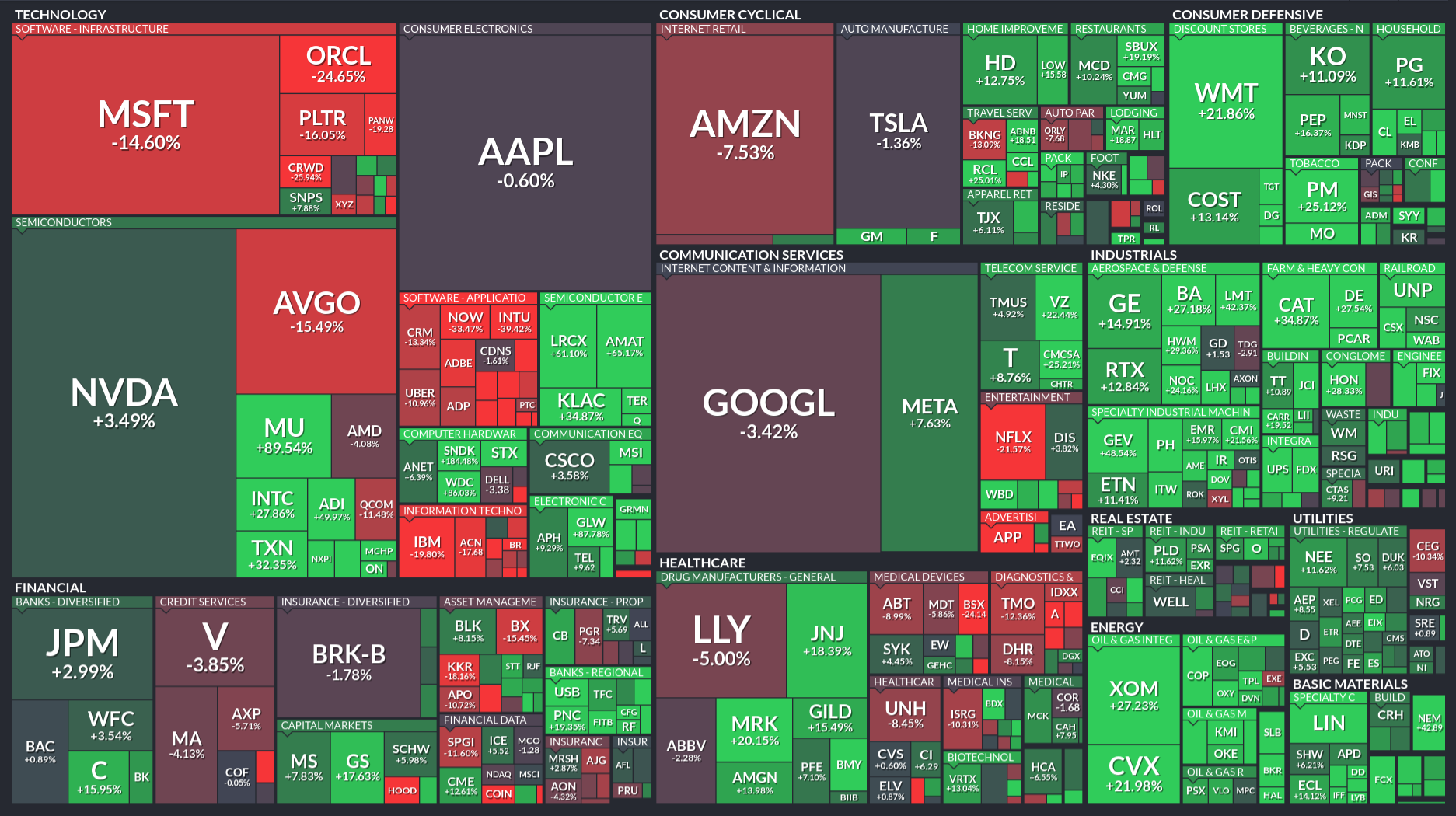
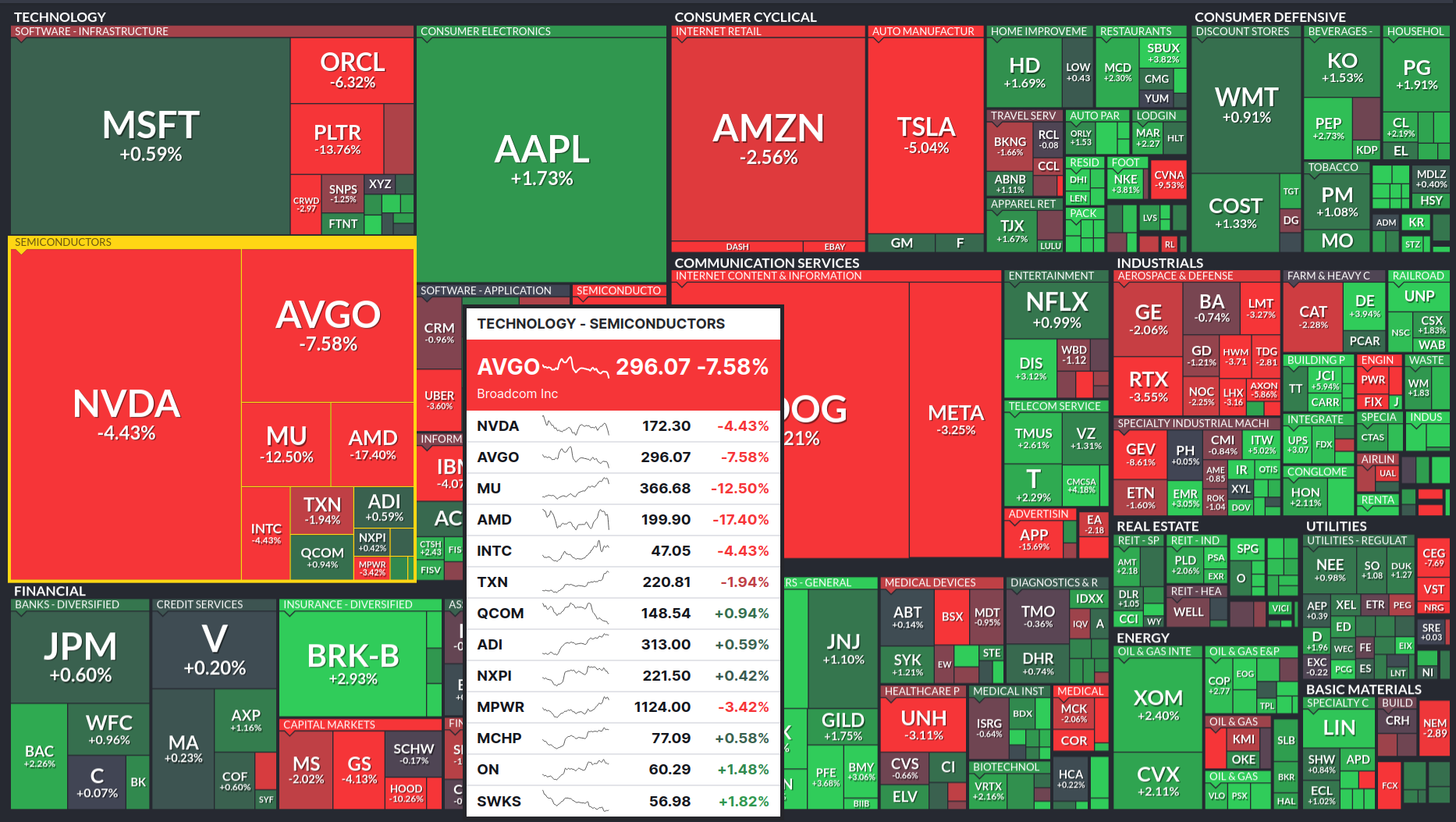
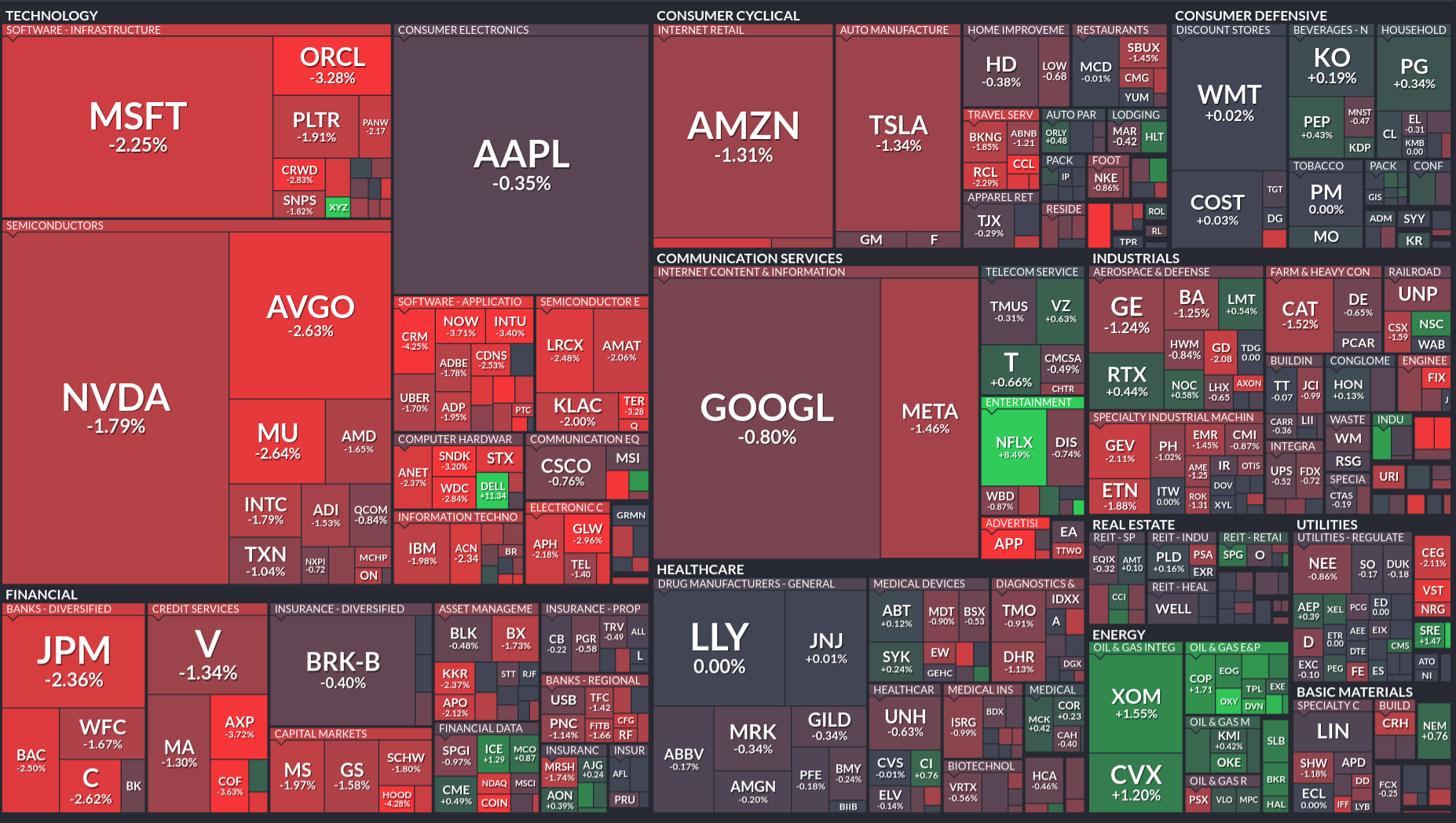
They have done everything in their power to make stochastic parrots seem like the next nuclear bomb. The country with the AI lead (whatever that means) will win the next wars. Tell that to Ukraine, who is using very much human piloted drones to attack 60 year old tanks and drones piloted by human Russian pilots. If businesses don’t adopt AI, or find that AI adoption is more limited than what they thought, and the profit potential seems to be a small fraction of what were overly optimistic projections, AWS or Microsoft’s investments in AI won’t seem like a good use of cash. Rather than lighting giant piles of money on fire, they should have bought back their stock. NVDA doesn’t look like a hot stock if the demand for their chips start to sputter. And Broadcom (AVGO) and ORCL start to falter at that point. (ORCL is already about 1/3 down. META – which has been floundering for its next idea – will also be seen to have wasted cash. The only dangers LLM based AI presents to the modern world is its ability to quickly mint disinformation and memes, and the financial crater it will leave when people no longer expect massive (or any) profits from the likes of Open AI. When that happens, and they stop lighting their money on fire, GDP shrinks and the US will probably slip into recession.

I was about to end there, but that isn’t quite the whole story. Because it isn’t just Wall Steet burning cash on stochastic parrots powered by jet engines. I feel like I would be remiss if I forget to mention all the private equity and funds that are investing in data center construction. To build the data center, largely unregulated private equity firms (which can borrow from regulated banks) have been making loans. If this all goes sideways, the 300,000,000 loan held by a PE firm for a data center could go to near zero, the small fraction recoverable only after years of bankruptcy litigation. Maybe there’s enough of these loans to make the systemically important, regulated banks sweat blood as their PE customers start to sputter. As long as number go up, the loan is getting serviced, but once number stop going up, we could have a massive, sudden influx of cockroaches. This includes some funds who buy notes or make loans as part of their income portfolios. You could wake up to read a horrible story that PIMCO is suddenly knee deep in bad loans in what should have been a safe, income generating, portfolio. And just to give you an idea of how poorly people view risk right now, you only need to look at the historically low spread between junk and investment grade bonds.

The Fraud Is Coming

Michael Burry is shorting some tech companies. With the market as frothy as it is, that’s not exactly prescience. Unless you’re as good a market gambler as Burry, I wouldn’t recommend it. (And if you were as good as Michael Burry – you would already have a lot more zeros in your net worth). It is still true the market can stay irrational longer than you can be solvent. But what Burry isn’t just pointing out the emperor has no clothes. He is pointing to financial engineering. Why is that important? Why does presenting the information in a slightly better fashion matter?

The pressure is on to show something. All the public companies in the AI orbit, with elevated stock prices because they’re part of the “AI-play,” need to show earnings. The non-public AI startups do not need to show earnings. Oracle, Broadcom, Micron, etc. need to show revenue. Immediately they do not need to show revenue, as they sign contracts. That’s future revenue, and the stock price goes up as a multiple of earnings. With expected future earnings rising, the value of the company increases, even though current earnings may not have moved. A company that trades at 15 times their earnings begins trading at 30 times their earnings, based on the expectation of making more money in the future. But at some point, the imaginary future money needs to become real money in the present to justify that multiple.

Could companies like Palantir and Oracle be over-stating their income by altering the way they treat depreciation? Maybe as much as 20%? That’s what Burry sees. When companies structure their earnings to provide a better light than what would otherwise be the case, we refer to that as lower quality earnings. It may be legal and within the GAAP (generally accepted accounting principles), but it suggests the actual earnings are inflated. This is completely legal, as long as it is disclosed. Eventually, the lower quality earnings should result in a lower multiple. But in the short term, investors may ignore it or simply accept the statements of the companies that the new accounting practices make more sense. Longer term, investors tend to give companies that do a lot of financial engineering side-eye. Eventually reality will set it and the fundamental reasons they aren’t doing well will overtake the financial engineering.

But where there’s that much pressure to push earnings, it means there is building pressure to fake earnings. This can be done by either aggressively booking sales when the sale isn’t really complete and moving liabilities off the balance sheet. I would suspect the former is already unfolding. When everyone is desperate for more data center space, more power, more networking, and more processors, booking a sale early may not seem like a big deal. You feel the actual sale will almost certainly close in the very near term. Or you can call the next firm in line, waiting to snap up the same scarce resource. So why not report it in this quarter to juice your numbers a little? But it doesn’t take long before some firms start booking speculative sales, to keep the line on the sales chart going up and to the right. One of two things will happen, either the auditors will stumble over this and realize there’s fraud going on, or (more likely) a short seller will sniff it out. The former is bad enough when firms are forced to restate their prior earnings, as some executives go ‘spend more time with family,’ and shareholders bring suits. But the latter is devastating, usually resulting in obliteration, with the fraud investigations coming later.

The other approach is to engage in balance sheet engineering. A loan or an obligation to make payments in the future are recorded as liabilities. There are ways to move the liabilities off the balance sheet of the parent company, for example, by using special purpose vehicles to actually carry the obligation. Company X doesn’t owe the money. The money is actually is actually owed by Able Baker, a joint venture between X and Y. Company X doesn’t record the liability, even though the counter-party (the lender) can collect from Company X, should Able Baker default. The auditors may miss this if Company X misrepresents the true nature of the obligation (commits fraud). No one will notice a thing as long as the market that props up Able Baker is healthy. Once that changes, and Able Baker defaults, Company X may find itself illiquid.

On overstated earnings or engineered balance sheets you can quickly build other frauds. For example, understating the risk of loans to those companies. Lenders may be aware that something fishy is going on, but continue to lend to the companies, collecting fees on deals that should never have been closed. Even in the best possible light, it means suspicious insiders put aside suspicions to chase the deal. After all, the entire market can’t be wrong. And everything looks good for now. If the demand for the underlying market dries up, the loans held either by the direct lenders or the positions investors have in that lender, are worth pennies on the dollar. (Or nickles, now that we’ve stopped minting pennies). Suddenly, the lender (now likely to be a private equity firm rather than a bank) is exposed to losses large enough to wipe out its equity. Investors that invest or lend to the private equity firms suddenly find their positions wiped out as well, creating significant counter party risk. Which can ripple through other sectors of finance through reinsurance products. And liquidity dries up as everyone becomes unsure of any of their counter-parties actual financial health. What threatened to bring down the entire house of cards in 2007/2008 was the overnight lending market between banks was shutting down.

What makes this especially troubling in the current environment is a confluence of factors. First is the inability to actually jail corporate executives of very large companies. Even if there is fraud, we fine the corporation rather than hold its officers criminally liable. Let me do the math for you. Let’s say you put together a 300,000,000 dollar deal where your bonus is 5%. If you commit the fraud necessary to close the deal, you will be paid 15,000,000 dollars. Should you even get caught, you will have to give most of it back but won’t go to jail. And you keep all the other bonuses you also received. It’s likely the government will settle with your former employer. And if you’re not caught, and the company goes under, they still owe you the 15,000,000. You can sue for it in bankruptcy court, or from the company that acquires your old employer. If the company gets bailed out with public money, contractually, they will still need to pay you the 15,000,000. But what if it isn’t fraud and it’s just making a bet you wouldn’t otherwise make? There is are incentives to take outsized risks. After all, they’re losing other peoples’ money. So you will likely make 15,000,000, or maybe as little as 3,000,000 on the off-chance you’re caught. You won’t go to jail. And you won’t lose any of your houses just because you lost your job.

But coupled to that is a president who is willing to pardon anyone who is a supporter. He has commuted or pardoned people for political advantage. Like CZ to make good with the crypto crowd. Or the violent protester from January 6. It could be that even though there is criminal fraud, having donated to the campaign, the ballroom, the inauguration, and made statements pleasing to the ear of the administration, is sufficient to insulate your from Federal prosecution. And if you’re in a state such as Texas, it might also insulate your from state prosecution. We may find that explicit fraud was committed, people knew and traded on the fraud, but the fraudsters supportive of the administration are pardoned. In other words, they get to walk away with a lot of zeros in their bank account and no accountability.

If it were “free money,” I wouldn’t care. But what happens when a PE firm, lending money for data center construction, suddenly finds itself the proud owner of a bunch of half built data centers? Or even finished data centers filled with useless, expensive, and rapidly depreciating assets because AI demand isn’t what many expected? And what happens to the pension fund that put 250 million into that PE firm? And multiple other PE firms who also couldn’t resist deals around AI? Or the bank that provides liquidity for the PE firm? It’s not “free money,” it’s coming from somewhere. And that somewhere could be a wide-spread, systemic problem. How does the Federal government backstop PE firms, who are not insured or regulated like banks? Does the government step in and buy stock in the fraudulent company, injecting good money after bad? How do we put possibly trillions of dollars of bailout into firms but let the fraudsters walk away with all their money? Does the government step in and buy the data centers? Do the fraudsters stay in charge if they made enough dulcet noises of support for the administration?

Let’s put together a package that “doesn’t cost the taxpayers a dime.” It involves backstopping the loans, purchasing shares in troubled companies, and buying some data centers. All with money is effectively printed by the federal reserve or raised from “investors” with guaranteed loans. Essentially, this injects a pile of money into the economy, which will fuel inflation. It would also expand the debt, causing even more worry about the US debt burden. A burden the US has every incentive to ease by devaluing the dollar and inflating its way out of the crisis. And like the COVID relief bills, a lot of that money will go into creating even more income disparity. Not only will the wealthy (including fraudsters) walk away with the money they made on the way to the crash, eventually they will reap the reward of the stimulus injected to moderate the economic damage. And while the previous administrations tried to put some limits on how either the post 2008 or COVID stimulus could be used, I doubt this administration will suffer that burden.

I don’t know if or when the AI trade unwinds. I suspect it’s ‘when,’ and the longer it goes on, the more I suspect it will unwind badly. There is little I’m hearing that makes me sanguine about an orderly end to this. On the spectrum there will be true believers to outright fraudsters. Like flies to shit, fraudsters are drawn to environments where people making money would rather not look too closely as long as money is being made. If anyone did look closely, the party’s over no one is making money. After all, a little ‘wiggle room’ makes the market possible. To repurpose Mao, this is the water in which the fraudster swims. Whether its repacking bad home loans, creating accounting practices at suspiciously rock-star energy companies, or the sales figures at ‘world leading’ telecom companies, no one wants the gravy train to come to an end. But rest assured, the longer the massive (and frankly stupidly large) sums of money are changing hands (or not actually changing hands) over various AI deals, the more openings fraud will find.

AI Wins the Shutdown

It’s Monday, November 10, and I’m going through the news. The shutdown may be coming to an end. Welcome news to some, although I believe the Democrats caved. The Republicans indicated they were willing to scorch the earth over ACA subsidies. These are the payments that help people buy health insurance, when they can’t possibly afford 15,000 or 20,000 a year in premiums. It seemed as though Republicans were willing to let air travel fall apart in front of the holiday season rather promote access to healthcare. All while the government feels they have enough money to possibly send $2,000 rebate checks from the taxes collected through tariffs. And the Democrats blinked. The government, assuming the house approves and the administration doesn’t have a spaz and veto the bill, will likely re-open.

What stocks do you think would be doing well on that news in the pre-market? They airlines? Yes, they’re up. Defense contractors? They’re mixed. What about health care? Mixed to net negative. What’s ripping? AI hardware and semi-conductor companies. NVIDIA is up over 3%, while the strongest airline, UAL, is up just barely 2%. The DOW and the SP500 are up largely because of just the AI and related semiconductor stocks.

On the Russel 2000, there’s more broadly positive price movement. The second tier defense contractors are doing well. When the Russel 2000 does well, it is a proxy for investors being more willing to take risk. In the sense that ending the shutdown is positive for the economy, taking on more risk through AI and smaller companies follows. With the gross dysfunction abated, it is more likely companies will make money. But the undercurrents of self destruction over providing health care to people is still there. One party is willing to burn it all down, including intentionally withholding food assistance to their base. They are willing to ignore their roll in checking even illegal acts. I don’t know if my outlook on the future is as sanguine as the other investors stepping up to shoulder more risk.

I feel like we’ve lost our ability to discern what is good and bad. All we know to do is calculate which option gives us more money. What you build is not important. Who you defraud is not important. What you destroy is not important. The dystopia you are creating is not important. And with enough money you can buy a legacy. All that matters is making as much money as possible. The invisible hand free of moral and ethical constraints. Even democracy and the constitution fall by the wayside if there is money to be made. Greed is not just elevated to ‘good,’ along with other good values. Greed is the only thing that matters.

There’s a Bad Smell

If you don’t think something is very wrong, you’re not looking very hard. Recently, the cost of the average new car in the US topped $50,000. The median household income in the US (meaning the half way point, if you arrange all peoples’ incomes from lowest to highest) was about $83,000. The mean was about $66,000, suggesting a lot of skew from a bunch of very high incomes at the top end of the data set. So the “average,” under some definition of average, American household would pay about 70% to 80% of their income for the average new car.

If we go back 30 years, to the mid 1980s, median income was about 24,000 in 1985. (Not adjusted for inflation). If you adjust it for inflation, we have to face the ugly fact that 40 years has only taken us from $64,000 of 1985 median household income in today’s dollars to $83,000. Meaning that with all the advancements we’ve seen, and all the gains in productivity, our earning power grew just 35% or so. That’s less than a 1% improvement per year. But in the 1980s, a nice Buick or Dodge set you back less than $10,000. You could get economy cars for $5,000 – $7,500 price range. The average new car set a family back less than 50% of its income. Less than a third, if the bought an economy car. Even if you adjust for inflation, the average new car should be in the $25,000 to $30,000 range. To get to that that “less than 50%” range in today’s actual prices., you need an income of at least $100,000, if not slightly more.

This is the difference between purchasing power, wealth, and income. Partly it’s inflation, and partly it’s not inflation (to the degree inflation measurements aren’t arbitrary). The price of an “average” new car has risen faster than inflation. So has housing. So has medical care. So has education. If you could easily afford an average car in 1985, but struggle to buy an average car in 2025, you are poorer as far as cars are concerned. If you could afford to go to the doctor’s office in 1985 but not 2025, you are poorer along that axis. However, an IBM PC computer or original Macintosh cost maybe 10% of your 1985 median household income. Today, that (relatively) high-end computer is in the 3-4% category. We’re much richer on that axis. The necessary stuff is more expensive, but escapism is cheap.

I would argue that the things that matter, like food, housing, and transportation are why we feel poorer today. Setting aside the paltry growth in inflation adjusted median household income (while upper incomes have grown much faster than inflation), having to put yourself in deep debt to do “normal” things hurts.

The fact we are drowning in televisions, computers, and other gadgets doesn’t compensate for not being able to afford college. If I were to ask most people struggling to buy a house, would you rather have: more expensive TVs and computers or cheaper houses? They would opt for the house. If I asked the person trying to get one more year out of the ride that gets them to their job, if they wanted cheaper cell phones or cheaper cars, they’d opt for cheaper cars. Or a public transportation system that didn’t feel punitive in its cost and inefficiency.

You need transportation, you need a house, you need to go to the doctor and the dentist. Those seem more and more like luxury items. That’s what feels so wrong about today. I caught a passing notice about Paul Krugman saying China has passed the US in purchasing power parity. They may have. I haven’t read it. I’m a little tired of Krugman, who lost credibility with me as an economist, for focusing on too many nakedly partisan issues. But we all feel it. If you make more money next year, it doesn’t really feel like you got ahead. In fact, it feels like you’re falling further and further behind.

So you tell me, after 40 years of progress, with companies worth trillions of dollars, and with two people in a race to be the first trillionaire, does it feel like we’ve advanced? Do you feel wealthier? Does that seem like a system that’s working for the benefit of most people? Do numbers like GDP and a soaring stock market paint a rosy picture, so we we learn to ignore what our lying eyes are trying to tell us?

Kreskin Not Needed

We don’t need a great fortune teller to explain what’s going to happen. We have been letting high income people and large companies avoid paying their share of taxes. Do they pay taxes? Yes. But it’s not unusual for a high income earner to pay at a 15 to 20% rate. Their employees might be paying at the 25-35% rate.

We recently had an anti-trust ruling on Google that, while they were a monopolist who caused a lot of market damage, stifled competition, and hurt their customers, nothing will happen to them. The same “nothing’ happened to Microsoft decades earlier. Nothing happened to Wall Street executives after the mortgage markets imploded due to their fraud. Nothing is likely to happen to Apple in its anti-trust case. Meta’s AI chat bots have lewd conversation with children, while admitting to basically stealing their training data from authors. Nothing will happen to them. Unusual options trades on thinly traded companies just before major announcements feel like they’re happening on an almost daily basis. No one is being picked up for insider trading.

What happens at the end of this, when we let major companies and the rich skirt on their tax burden, when we’ve destroyed the competitive business landscape to help make them a little more money, when we’ve gone into debt over and over again, in administration after administration, to cut their taxes or drive away burdensome regulations? What’s going to happen is that the people in the bottom 95% will be left to bear the burden of cleaning up after a party that they didn’t attend. They will own nothing, because anything worth owning will be held by the rich, who have super-charged the rate they accumulate wealth. They will use those piles of cash to buy anything worth having, from housing, to farm land, to water rights, to pristine wilderness.

The wealth gap between the top 1% and the bottom of the top 10% is becoming stupidly large. Never mind the middle 50% of Americans. And this is happening all over the world. A little faster in some countries, and a little slower in others. But at the end of the day, the super-rich will walk away just fine, but it will be rank and file citizens that will have to pay back the debt. At some point the acceleration of debt will be so unsustainable that either brutal austerity or massive inflation will follow.

And who owns that debt? Who do we need to pay back? It is the super-rich, the large investors, and the large corporations.