The price of gold used to be fixed as a matter of law. The price for gold was set by the US at $20 an ounce. A one ounce gold coin was worth $20. During the depression, Roosevelt raised it to $35. That was not the same as a default on US debt. But it was a default on US debt. The day before the change you could trade $20 for an ounce of gold and an ounce of gold into French Francs. The day after, it would take $35 to buy the same amount of gold. Since the Franc had not been depreciated, it meant you could buy fewer French Francs. But international trade and finance was much smaller in 1933. If you were an American sitting on a pot gold, you were suddenly 75% richer, but you were forced to sell your gold to the US government at the stated price.
Within the United States it meant the Federal Reserve could print more money, as the same amount of specie backed 1.75x the amount of dollars. (At a time when the supply of dollars was fixed to the amount of gold held by the government). In addition, it made US exports cheaper, as the same amount of French Francs netted your more dollars to buy American made goods. The United States continued to pay the coupon on their debt. But, could do so with cheaper dollars. If I recall, this was eventually ruled by a court as a default, but it wasn’t a default in the sense you stop paying your bills. You just made it easier to pay your dollar denominated bills.
The US is a reserve currency. Meaning that instead of gold, countries are willing to hold dollar denominated assets (along with dollar deposits) as something freely convertible to Euros, Rials, Drachmas, Lira, or however the local Sheckel is denominated. There are few people or few countries that would not take the US dollar as they can sit on it or turn it over immediately for something else in a highly liquid market. And US issues government bonds are both dollar denominated and pay interest, accumulating more dollars. Holding gold as a reserve does not cause the gold molecules to generate more gold. In fact, the dollar gets more valuable when the Federal Reserve raises interest rates and more people demand more dollars to buy more US bonds. As long as the value of the dollar holds, the reserves are safe.
The problem is the United States is indebted to the tune of 125% of GDP (compared to Europe’s average 85% and Japan’s over 200%). There is no magic number that says X% of GDP is a threshold above which a reserve currency falters. And the rules of the United States (with the primary reserve currency) may be different than the reality for Japan’s Yen (when is in the ‘other reserves’ category). Since the US makes the dollars in which its debt is denominated, you don’t have a repayment risk like you have with, say, Argentina. Argentina can’t (legally) make more dollars to pay its dollar denominated debts. It has to trade real good for those dollars. Meaning a default and devaluation of the peso by Argentina largely makes the population poorer (as a whole) although some individuals (with big dollar holdings) richer.
This is why the analogy to a household budget or comparisons to Argentina don’t work with America. A household that could print its own currency, if widely accepted as a reserve currency, could borrow as much as it wants. Dad could buy a Mercedes Benz S class, promising to repay in “family bucks.” They family prints “family bucks” so repayment risk isn’t a problem. The problem is they flood the market with “family bucks” and the currency gets devalued. This also breaks down because the size of the market for US dollars is incredibly huge. It’s well beyond the needs of the United States, as China and Australia may use dollars in their trade (for example). It would be more akin to everyone everywhere using Family Bucks, so printing a few extra Family Bucks is not a problem. The market absorbs it like pissing in the ocean.
So the holders of US dollars and debt are perfectly safe, right? No, they are not. There are risks for investors. In order of my belief in their likelihood are devaluation through inflation, and a partial default. These are “cut off your nose to spite your face” solutions to America’s fiscal and social problems, but we have an administration that wakes up every day with a nose cutting cleaver in hand. Right now the world is searching around for alternate reserves. Gold has almost doubled in price in the last year. And as much as gold can skyrocket in value, it has also crashed. It is much more volatile than holding Euros or Swiss Francs. No sane person wants much gold exposure as a stable reserve, but the Euro and Yen aren’t ready to take over the dollar. So why are people moving away.
Let’s start with inflation, which I think is the more likely avenue. It’s not quite the same as the dollar being devalued against gold in 1933, but similar. Easy money and an inflation causes the value of the dollar to fall. For example, if you have 6% inflation, it will take about 12 years for goods and services to lose half their value. If you paid $30,000 for a car, in 12 years the same car would cost $60,000. (Your mileage may literally vary as different goods and services will respond differently). But it also means if you buy a 12 year bond for $1,000, it will only be worth $475 in current dollars at the time of redemption (when you get the face value of the bond back). By comparison, it would be worth $785 (in current dollars) if we stayed with 2% inflation.
When inflation risk is seen as a temporary aberration, interest rates do not move much. If bond buyers suspect sustained inflation they will need a combination of coupon payments an final redemption that is worth the risk. The US has no repayment risk. If bond buyers suddenly believe that inflation will be sustained and around 6%, they will pay a lot less than $1,000 for the bond. Or, if it’s a new bond, they will want a much higher interest rate on the bond. In the long run it is not a great strategy for dealing with debt. In the short run it is a way of reducing the value of the existing debt. But it would reduce the debt to GDP ratio as nominal GDP would expand much faster than real GDP. Inflation is up, interest rates are up, our exports are cheaper, and foreign imports more expensive.
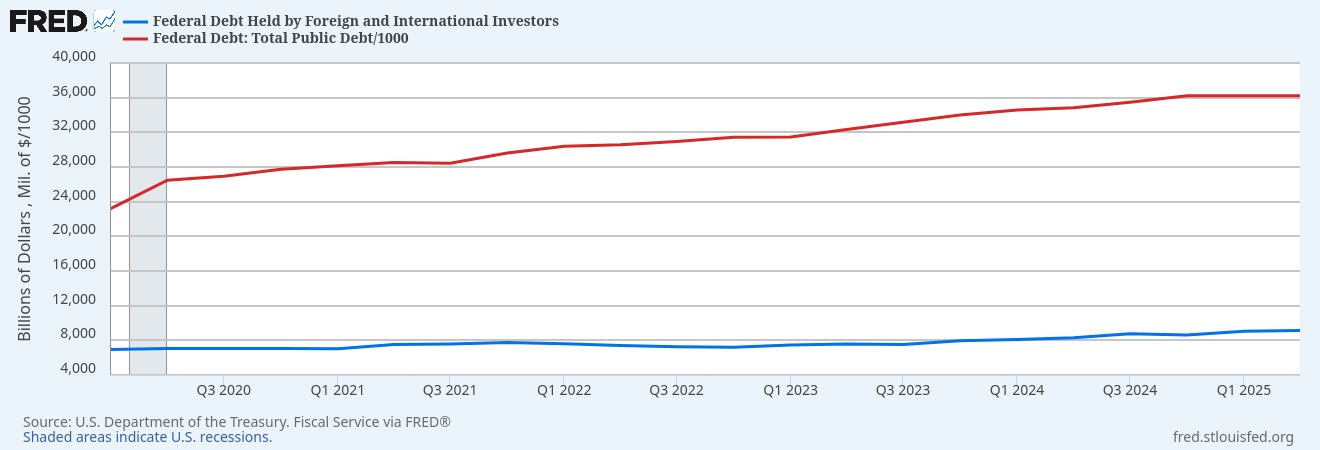
As I’ve indicated, it’s assumed the US would always pay its bond interest and principal. (What actually happens to the principal is a new bond is issued to pay the principal). But the fact a default hasn’t happened in living memory does not mean it won’t happen tomorrow. The vast majority of US debt holders are US organizations or individuals. I hold some number of US bonds. But a portion are held by foreign governments, organizations, or persons. Sometimes it’s hard to determine if something is truly a “foreign holding,” but the government of France holding treasury bonds as a reserve is a pretty clear example. In this case, the nose severing instincts take over and interest payments to foreign holders are capped or stopped.
This doesn’t help with the over-all level of the debt, but the interest payments on that debt. It could cut those interest payments by as much as a 25%, if completely stopped. This would present a weird market situation, as a US buyer does not immediately see the value of their US bonds deteriorate. They bought the bond thinking a 4.5% rate was good enough for the next five years and that’s what they’ll get. A foreign buyer, however, sees an immediate impairment to the value of the bond. If they sold it to another foreign holder, that buyer would require a heavy discount on the bond. They would have to sell it to a US holder for the best price.
The destruction of value as a US bond holder would happen as foreign sellers cause the price of bonds to plummet and I need to hold to maturity to avoid a capital loss. Second, the foreign sellers would want to convert back to their local sheckel, meaning they sell dollars. They want to sell the US bond, for example, and buy Euro bonds or Korean bonds. (Japan is an interesting question right now). As they convert dollars to Euros, that drives down the value of the dollar and drives up the value of the Euro. This is another form of devaluation. Suddenly, our exports are cheaper, foreign imports are more expensive, interest rates are higher, but internally not much has changed.
Of course there’s nothing stopping them from pursuing both policies by destroying the independence of the Fed to lower rates and raise inflation, while capping foreign bond payments at 2%. Not to mention some bond holders may be afraid that if sanctions are applied for political reasons, as has happened to the ICC, they may not be able to access their reserves. In addition to the possibility the US economy may be impaired in the long term from civil unrest or a breakdown in the rule of law. In short, the once sober and boring US financial system is approaching shit-hole country chaos. That boring, law respecting, dullness helped make the US *the* reserve currency to hold in a world that has largely moved away from gold (other than a kind of last resort medium of exchange).
While the impact of import prices and export demand is not critical to the United States the same way it is for Germany (about 25% of US GDP is trade related versus 80% for Germany), it higher import prices are inflationary. US exporters would benefit, but would also face higher interest rates and higher prices for their input materials. Of course, all the US would feel the higher interest rates, driving up mortgage rates and car loan rates. I think it would be similar to the oil shock of the 1970s, which contributed to stagflation. In a strange way oil is like another currency (although you can’t hold it forever like gold). As the dollar devalued against oil, it helped stimulate inflation. (It was not the sole or primary cause – but it was a notable contributing factor). We might get stagflation or a recession we can’t spend our way out of (because of high debt levels) and nor can we stimulate using monetary policy (without risking hyper-inflation).
But at the end of the day, it only deals with existing debt. Newly issued debt would adjust to the new reality, with foreign holders seeking higher rates or avoiding the US. If we pursue either of these bad ideas (or some other policy that is effectively a devaluation that I’m missing right now), without reducing the persistent budget deficit, we will just wind up accelerating the slide to economic ruin. Not that it isn’t a long slide. There may be investors that still buy US assets, just ones that are inflation resistant and not bonds.
I don’t think people just switch to gold. For one thing there is the volatility of gold, which can have big swings relative to currency markets. Second, the supply of gold is fixed in the short term, meaning it’s possible to be unable to enter into a gold denominated transaction not because you lack the goods, but because no one can come up with the gold. This currency crunches would happen in the US prior to the adoption of modern banking and the Federal Reserve. People wound up trading scrip (IOUs) until enough currency returned to that region so they could settle the debts. It created unnecessary boom-bust cycles. But it can be recession inducing when these runs happen. What about 21st century gold? Crypto-currency is likewise fixed and even more volatile than gold, making it an even worse choice.
The current off-ramp may be the Euro, the Yen, and a basket of other currencies of other trading partners. It will likely need to be a diverse basked, since not everyone wants to hold some of these currencies. It will make transactions more expensive and balancing reserves trickier than it is today. And the dollar will continue to participate in that basket. It took decades for the British pound to stop being a widely held reserve currency from the time it was evident the UK was becoming a middle power. But it will mean the US will lose its cheap finance, its leverage, and its low interest rates.




 I wish I was like you/easily amused