How to Weaponize Your Own Mess

What links the working class elements of Brexit and anti-globalist American right is a belief the world order has exploited them. The messaging and thinking isn’t precise, because these are not informed opinions. David Ricardo has been right for the last 211 years, from 1815 to today. Trade makes both countries wealthier. What Ricardo didn’t say is how that wealth would be distributed (although I think he assumed it would be a broad lift in living standards). Also implicit in the reasoning around trades is that other aspects like environmental or human rights protections would be respected. In the ideal view, one country doesn’t become the efficient supplier of a good because it’s willing to work enslaved people to death in toxic conditions.

There’s an old economics joke. Stick your head in a 400 degree oven and your feet in liquid hydrogen. On average, you’re fine. A lot of inequality is elided away in mass averages. It comes to light when we break these statistics into quintiles, quartiles, or the top/bottom X percent. There are are so some synthetic measures, like the Gini co-efficient for the US is 41 while 29 for Germany, while the GDP per capital in the US is about 90,000 while Germany 57,000. On a per-capita basis it’s better to be an American. But the likelihood that you share in that wealth is lower. It’s kind of like people wax poetic about medieval times but forget that in all likelihood they were a peasant working as a near slave for the feudal lord.

What has happened in the UK and the US is that the distribution of benefits from trade have not been distributed evenly. There was a belief that the system would work it out in the end. You lose your job in the industrial North of the UK or the rust-belt of the US but something else comes along. Like you leave the assembly line and start designing AI accelerator chips or turn to writing software. In fact, what was needed, was a re-distribution of wealth by the state so the benefits of globalization were more evenly distributed. By the way, the Gini coefficient for the UK is about 35.

The benefits of trade were delivered unequally, benefiting capital more than labor. That capital also became militant about not raising taxes or wealth redistribution. After all, are you advocating for class warfare by asking billionaires to pay a reasonable tax rate? Why do you want to tear society apart this way? Go back to your squalid little pens and rejoice in the social order, you troglodytes. Oh, and breed more little troglodytes because we’re running out of consumers.

It cost Bezos a mere 75 million to produce the Melania movie as a not-so-under-the-covers bribe to the Trumps. That money was found when Jeff turned his couch over and collected what fell out. That’s how much money he has. He has been a principal beneficiary of freeing trade and intends to keep every red cent he’s ever earned from it. For Microsoft or Apple to put up money for vanity projects like the destruction of the East Wing of the White House to make way for a gaudy ballroom, it is not a sacrifice. These are companies that don’t worry about millions of dollars. That is a rounding error in their day to day change in capitalization, and the personal wealth of their founders and leaders.

But… But… But… Look at the tariffs! Those are anti-trade. True, but you also need to look how they’ve been turned into a patronage system (by offering individual companies a way out in exchange for obsequiousness or out-and-out bribes), and the loopholes and exemptions lower the effective tariff rate. But for the Trump backers, it means they will pay a lot less money in taxes. If a Harris presidency might mean an extra 50 million in taxes, spending 5 million on PACs is a reasonable investment. Which is how the rich view politicians. As investments. In fact, they got a boon with Trump.

Those same people who benefited from trade. Who were the main beneficiaries of the 2008 bailout, and seemed to wind up with the lion’s share of the COVID stimulus, have weaponized far right parties to prevent any attempt at redistribution. Making people so angry they put the party of the oligarchs and plutocrats in power is a master-stroke of genius. And all the while absolutely castrating the opposition, who is just as needful of their patronage. They are like the clever player that starts the NPCs combating with one another while they watch and plunder the resulting treasure. Exploiting the lack of social cohesion, and the politicians desperate for money, keeps them in effective power and keeps their money safe.

Before you start reaching for the revolutionary pitch-forks, keep in mind that a bulk of these folks seem to survive each revolution. They are the cockroaches during upheavals. Whether it was the Russian revolution, or the French revolution, or the American revolution, a lot of these folks wind up on top. Our best bet is not revolution. It’s putting aside our emotions, our clever memes and slogans, and our sense of “team” to actually look around. Using our clear-eyed view of the world around us to vote for change. I don’t expect a lot from Mamdani, but he is the result of the ‘establishment’ left foisting an unpopular candidate that preserves the status quo. People gave the establishment left the great, big, stanky middle finger rather than support a sex pest.

Take in the world with a fresh eye. Look at the fact Amazon and many other companies benefit handsomely from trade, that trade will bring in wealth, but maybe that wealth shouldn’t be concentrated into so few hands. Look at the private equity players who purchase companies with debt, load those companies with more debt, sell them, bank their proceeds as capital gains or income, to do it all over as those companies declare bankruptcy. Minting their income through debt, massively reducing their tax burden, but in the process devastating the lives of millions of individuals. And realize they’re the ones priming the coffers of groups like the Heritage foundation.

At the end of the day, nothing changes until we change. We continue to be the NPCs screaming at each other about this or that issue, while the players sit on the sideline and laugh. Red team versus Blue team, while the green players reap the rewards. If you want any better evidence, in the first Obama administration, the democrats had both congress and the White House could have easily fixed the loophole that allows private equity partners to earn their money at a top rate of 15%. They did not. Because the private equity partners are the people the phone banks staffed by your congress person call to raise money. Now those same groups have decided their future money interests are better served in an autocracy, and they’re using the misery of millions of Americans to do that. A misery they created in the first place.
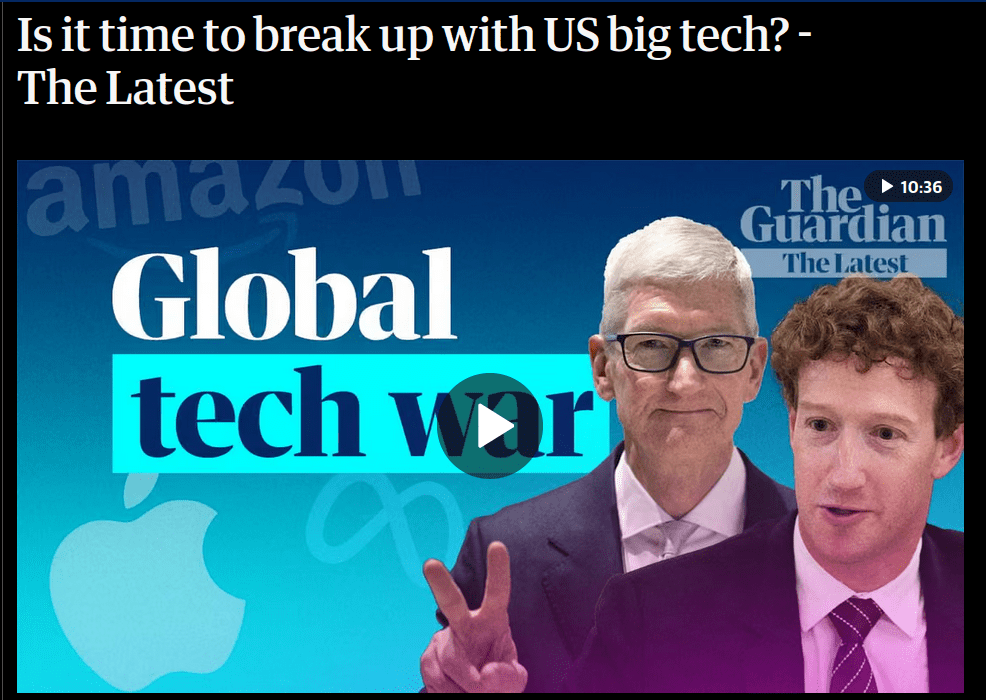

Tech Bros Are Going to Lose Europe

The Guardian asks. First off, it’s not that the European version of these services do not exist or need to be built from scratch. But that’s not the reason to switch. Until now, US elections, even 2016, produced reasonable outcomes for Europe. Now they have an agent of chaos more than an ally. A country that foments division among its alliances and has stated that a weaker Europe is in American interests. And so much of their communication is funneled through American companies. Companies that have shown a willingness to cooperate with an administration that shows a willingness to use the levers of government in a retaliatory manner. This retaliation could be illegal, but there has been little interest in the Republicans to stop it and there seems little ability (either talent or power) for the Democrats to put an end to it.

Even if the cost is a little higher (with the US being the low cost producer), it is the insurance you pay for having a functioning society. For the same reason you might choose the Grippen over the F-35. Maybe have some F-35s, along side a mix of other fighters. Should the relationship with the US result in a suspension of the contract for maintaining the F-35, or the US out-and-out prohibits their use in the defense of Europe, there is a plane Europe can fly. The resulting insurance against being effectively disarmed by America may be worth additional cost. As would be securing broader sources of many products and services.

But let’s say the 2028 election produces a left-of-center Democrat who is able to assume power. What is the guarantee they don’t pursue some of these policies because of political expediency? There are many instances where a policy unpopular with the winning voter coalition are continued. There is no guarantee that the new administration drops those policies on its first day in power. And what if it loses power to the ideological continuation of the Trump administration? What happens if, in four years, Marco Rubio decides it’s better to rule in hell as a populist autocrat than to serve in heaven? At this point, from an outside observer, I would imagine even Donald Trump Jr. would not be an impossible outcome in 2032.

But there is something coming with AI generated search results I think Europe underestimates. They can be primed to deliver answers that promote division and fringe movements. This could include AI summaries of documents or the generation of material from AI. These could be over-the-top, cringe inducing, obvious trolls to very subtle wording or choosing what information to present. And should Europe complain, threats of tariffs or outright cut-off of these services follows. Or EU leaders are sanctioned and cannot access their digital (or financial) assets.

So yes, Europe needs to figure out what would help. Making it cheaper to start businesses in Europe? Sure. Ensure these companies have guaranteed revenue through government contracts? Maybe. Changing the laws to withdraw from the anti-circumvention features foisted on the EU by previous trade negotiators? That’s a good idea. If Apple threatens to cut off iPhone access to the UK, for example, return the favor by making it legal to jail-break your iPhone and install alternate services. Tax the profits of tech companies to help pay for it? Even if you wind up taxing your own tech companies, the money might come back to them in other grants or contracts.

Right now the US companies have market dominance. Let’s say they have 95% of the office software market. The EU shouldn’t try to retake the 95% at once. It should just focus on reducing dependence on the US to 85%. From 85%, 75% feels possible. Because a lot of tech is based on network effects, as other companies plug in to the services of other companies, each tranche becomes an easier target. Just start with critical pieces, like your ability to share documents securely and e-mail. And start with the easiest part to control, your own bureaucracies. At some point you’ll need to worry about other cloud services, or even the content on social media, but it will be from a stronger place.

PPI Came in Hot

What we have now is the PPI coming in a little hot. What I’m looking at specifically is core PPI came in hot. (Stripped of the more volatile components. This is what I would expect from tariffs. We tend to think of tariffs as impacting just end user commodities, like wine or automobiles. But it also impacts goods used to make goods, such as the input steel or the machine needed to punch that steel.

Is it really from tariffs, which would definitely be a competing factor. There are multiple mechanics at play. One is how sticky producers expect tariffs to be. If you see a TACO moment coming, or a Supreme Court about to throw out the tariffs, you don’t want to annoy your customers with a sudden price hike. Especially if the court allows you to recoup your tariffs from the treasury. You could eat the costs and burn down the inventory built up prior to the tariff being applied, hoping to replenish it in a low or no tariff environment. This strategy has a limited life span. We’ll know February 20, whether it’s a realistic strategy.

Next is the swiss-cheese nature of the tariffs. There are significant exemptions or carve outs that lower the effective tariff rate well below the statutory rate. Just ask Apple. You say it’s a 25% tariff but then exempt several sub-products or specific companies, meaning the macro effect of the tariff might be 10%.

Then we have supply chains re-adjusting. Some companies may have imported part of something from China, like the motor, castings from Mexico, shipped it up to Canada for paint and assembly, and then back to the US for the electronics, partly imported from China and assembled in Mexico. They might look at that machine and decide it’s better to just make it in Canada and pay one import tariff.

Next, some companies just paused imports for a while, meaning you couldn’t buy the imported thing, as they were figuring out how to file the paperwork for the product. Now they’ve figured it out or adjusted their supply chains and can now start importing those goods.

There are a set of reasons as to why the tariffs may have had delayed impact. And those impacts sit on top of the month to month noise in the PPI. That noise is a product of both problems in data collection (with respondents more likely to be late in their replies) and just variability in behavior. It could very well be that the tariffs would have had a more noticeable impact over the last few months, except for noise. Or this month is the aberration and the actual tariff impacts have been swiss-cheesed into a nothing burger. And as we get 12 or 18 months of data, it will become more clear.

Back Door Default

The price of gold used to be fixed as a matter of law. The price for gold was set by the US at $20 an ounce. A one ounce gold coin was worth $20. During the depression, Roosevelt raised it to $35. That was not the same as a default on US debt. But it was a default on US debt. The day before the change you could trade $20 for an ounce of gold and an ounce of gold into French Francs. The day after, it would take $35 to buy the same amount of gold. Since the Franc had not been depreciated, it meant you could buy fewer French Francs. But international trade and finance was much smaller in 1933. If you were an American sitting on a pot gold, you were suddenly 75% richer, but you were forced to sell your gold to the US government at the stated price.

Within the United States it meant the Federal Reserve could print more money, as the same amount of specie backed 1.75x the amount of dollars. (At a time when the supply of dollars was fixed to the amount of gold held by the government). In addition, it made US exports cheaper, as the same amount of French Francs netted your more dollars to buy American made goods. The United States continued to pay the coupon on their debt. But, could do so with cheaper dollars. If I recall, this was eventually ruled by a court as a default, but it wasn’t a default in the sense you stop paying your bills. You just made it easier to pay your dollar denominated bills.

The US is a reserve currency. Meaning that instead of gold, countries are willing to hold dollar denominated assets (along with dollar deposits) as something freely convertible to Euros, Rials, Drachmas, Lira, or however the local Sheckel is denominated. There are few people or few countries that would not take the US dollar as they can sit on it or turn it over immediately for something else in a highly liquid market. And US issues government bonds are both dollar denominated and pay interest, accumulating more dollars. Holding gold as a reserve does not cause the gold molecules to generate more gold. In fact, the dollar gets more valuable when the Federal Reserve raises interest rates and more people demand more dollars to buy more US bonds. As long as the value of the dollar holds, the reserves are safe.

The problem is the United States is indebted to the tune of 125% of GDP (compared to Europe’s average 85% and Japan’s over 200%). There is no magic number that says X% of GDP is a threshold above which a reserve currency falters. And the rules of the United States (with the primary reserve currency) may be different than the reality for Japan’s Yen (when is in the ‘other reserves’ category). Since the US makes the dollars in which its debt is denominated, you don’t have a repayment risk like you have with, say, Argentina. Argentina can’t (legally) make more dollars to pay its dollar denominated debts. It has to trade real good for those dollars. Meaning a default and devaluation of the peso by Argentina largely makes the population poorer (as a whole) although some individuals (with big dollar holdings) richer.

This is why the analogy to a household budget or comparisons to Argentina don’t work with America. A household that could print its own currency, if widely accepted as a reserve currency, could borrow as much as it wants. Dad could buy a Mercedes Benz S class, promising to repay in “family bucks.” They family prints “family bucks” so repayment risk isn’t a problem. The problem is they flood the market with “family bucks” and the currency gets devalued. This also breaks down because the size of the market for US dollars is incredibly huge. It’s well beyond the needs of the United States, as China and Australia may use dollars in their trade (for example). It would be more akin to everyone everywhere using Family Bucks, so printing a few extra Family Bucks is not a problem. The market absorbs it like pissing in the ocean.

So the holders of US dollars and debt are perfectly safe, right? No, they are not. There are risks for investors. In order of my belief in their likelihood are devaluation through inflation, and a partial default. These are “cut off your nose to spite your face” solutions to America’s fiscal and social problems, but we have an administration that wakes up every day with a nose cutting cleaver in hand. Right now the world is searching around for alternate reserves. Gold has almost doubled in price in the last year. And as much as gold can skyrocket in value, it has also crashed. It is much more volatile than holding Euros or Swiss Francs. No sane person wants much gold exposure as a stable reserve, but the Euro and Yen aren’t ready to take over the dollar. So why are people moving away.

Let’s start with inflation, which I think is the more likely avenue. It’s not quite the same as the dollar being devalued against gold in 1933, but similar. Easy money and an inflation causes the value of the dollar to fall. For example, if you have 6% inflation, it will take about 12 years for goods and services to lose half their value. If you paid $30,000 for a car, in 12 years the same car would cost $60,000. (Your mileage may literally vary as different goods and services will respond differently). But it also means if you buy a 12 year bond for $1,000, it will only be worth $475 in current dollars at the time of redemption (when you get the face value of the bond back). By comparison, it would be worth $785 (in current dollars) if we stayed with 2% inflation.

When inflation risk is seen as a temporary aberration, interest rates do not move much. If bond buyers suspect sustained inflation they will need a combination of coupon payments an final redemption that is worth the risk. The US has no repayment risk. If bond buyers suddenly believe that inflation will be sustained and around 6%, they will pay a lot less than $1,000 for the bond. Or, if it’s a new bond, they will want a much higher interest rate on the bond. In the long run it is not a great strategy for dealing with debt. In the short run it is a way of reducing the value of the existing debt. But it would reduce the debt to GDP ratio as nominal GDP would expand much faster than real GDP. Inflation is up, interest rates are up, our exports are cheaper, and foreign imports more expensive.

As I’ve indicated, it’s assumed the US would always pay its bond interest and principal. (What actually happens to the principal is a new bond is issued to pay the principal). But the fact a default hasn’t happened in living memory does not mean it won’t happen tomorrow. The vast majority of US debt holders are US organizations or individuals. I hold some number of US bonds. But a portion are held by foreign governments, organizations, or persons. Sometimes it’s hard to determine if something is truly a “foreign holding,” but the government of France holding treasury bonds as a reserve is a pretty clear example. In this case, the nose severing instincts take over and interest payments to foreign holders are capped or stopped.

This doesn’t help with the over-all level of the debt, but the interest payments on that debt. It could cut those interest payments by as much as a 25%, if completely stopped. This would present a weird market situation, as a US buyer does not immediately see the value of their US bonds deteriorate. They bought the bond thinking a 4.5% rate was good enough for the next five years and that’s what they’ll get. A foreign buyer, however, sees an immediate impairment to the value of the bond. If they sold it to another foreign holder, that buyer would require a heavy discount on the bond. They would have to sell it to a US holder for the best price.

The destruction of value as a US bond holder would happen as foreign sellers cause the price of bonds to plummet and I need to hold to maturity to avoid a capital loss. Second, the foreign sellers would want to convert back to their local sheckel, meaning they sell dollars. They want to sell the US bond, for example, and buy Euro bonds or Korean bonds. (Japan is an interesting question right now). As they convert dollars to Euros, that drives down the value of the dollar and drives up the value of the Euro. This is another form of devaluation. Suddenly, our exports are cheaper, foreign imports are more expensive, interest rates are higher, but internally not much has changed.

Of course there’s nothing stopping them from pursuing both policies by destroying the independence of the Fed to lower rates and raise inflation, while capping foreign bond payments at 2%. Not to mention some bond holders may be afraid that if sanctions are applied for political reasons, as has happened to the ICC, they may not be able to access their reserves. In addition to the possibility the US economy may be impaired in the long term from civil unrest or a breakdown in the rule of law. In short, the once sober and boring US financial system is approaching shit-hole country chaos. That boring, law respecting, dullness helped make the US *the* reserve currency to hold in a world that has largely moved away from gold (other than a kind of last resort medium of exchange).

While the impact of import prices and export demand is not critical to the United States the same way it is for Germany (about 25% of US GDP is trade related versus 80% for Germany), it higher import prices are inflationary. US exporters would benefit, but would also face higher interest rates and higher prices for their input materials. Of course, all the US would feel the higher interest rates, driving up mortgage rates and car loan rates. I think it would be similar to the oil shock of the 1970s, which contributed to stagflation. In a strange way oil is like another currency (although you can’t hold it forever like gold). As the dollar devalued against oil, it helped stimulate inflation. (It was not the sole or primary cause – but it was a notable contributing factor). We might get stagflation or a recession we can’t spend our way out of (because of high debt levels) and nor can we stimulate using monetary policy (without risking hyper-inflation).

But at the end of the day, it only deals with existing debt. Newly issued debt would adjust to the new reality, with foreign holders seeking higher rates or avoiding the US. If we pursue either of these bad ideas (or some other policy that is effectively a devaluation that I’m missing right now), without reducing the persistent budget deficit, we will just wind up accelerating the slide to economic ruin. Not that it isn’t a long slide. There may be investors that still buy US assets, just ones that are inflation resistant and not bonds.

I don’t think people just switch to gold. For one thing there is the volatility of gold, which can have big swings relative to currency markets. Second, the supply of gold is fixed in the short term, meaning it’s possible to be unable to enter into a gold denominated transaction not because you lack the goods, but because no one can come up with the gold. This currency crunches would happen in the US prior to the adoption of modern banking and the Federal Reserve. People wound up trading scrip (IOUs) until enough currency returned to that region so they could settle the debts. It created unnecessary boom-bust cycles. But it can be recession inducing when these runs happen. What about 21st century gold? Crypto-currency is likewise fixed and even more volatile than gold, making it an even worse choice.

The current off-ramp may be the Euro, the Yen, and a basket of other currencies of other trading partners. It will likely need to be a diverse basked, since not everyone wants to hold some of these currencies. It will make transactions more expensive and balancing reserves trickier than it is today. And the dollar will continue to participate in that basket. It took decades for the British pound to stop being a widely held reserve currency from the time it was evident the UK was becoming a middle power. But it will mean the US will lose its cheap finance, its leverage, and its low interest rates.

It’s a Bleak Battle

I expect the administration was taken a little aback by Republican voices expressing discontent. I think the 40% that is the bottom of Trump’s approval probably excused the extra-judicial killing by paramilitary forces in Minneapolis. Many in the Republican party barely said a word about the rest of the brutality. I think the push-back was unanticipated and they weren’t ready for it. The canker-lipped spokesperson of the administration had a muted statement. They are regrouping, not defeated. They have flooded the zone with a sea of shit and this is like saving exactly one house from partial inundation. One mole whacked down as other pop up.

We’re back to the two party system of the Autocrats and Ineffectuals. The Autocrats want to rough-up blue areas of the country before the next election. Their goal is establish control, purge voter roles, and stifle turnout where possible. And while they had a setback in Minnesota, their continued success in building a system of patronage was on display at the Melania premier. With corporate executives finding clever ways to pump money directly into the hands of the Autocrat kingpin and his family. And as they take ownership of Tik-Tok, popular voices from the actual opposition are being banned. The platform was essentially handed to one of the regime backers.

Meanwhile the Ineffectuals will continue to send very strongly worded letters. But will seek to work with the administration where they can. Because it’s important they aren’t perceived poorly by Chuck Schumer’s imaginary friends. They must show they dutifully adhere to the old norms. However, these are difficult times so they may insist on some modifications to the funding bills to keep the government open. [Note that they may withhold votes to fund DHS unless “metro surge” is ended except ICE is enforcement is already mostly funded through the next few years.] Because it’s important to get concessions from a party that does not feel they need to honor any deals.

Gavin Newsom? Great haircut, but he is begging for money from the same people Trump is tithing. He talks a good talk, but no corporate dollars are really in danger at the end of the day. Does he have a “social media game?” Sure, maybe. But he’s the smart money bet by the Ineffectual establishment. Chances are he’ll flop like many of their other darling candidates. You know, the same political establishment that tried to foist Andrew Cuomo on the city of New York. A discredited sex pest. Of course they got Madmani … Mandady … Mamdani. Who seems like a nice enough guy but may be in over his head. And if it weren’t for the fact the establishment ran the worst candidate shy of Anthony Wiener, would still be enjoying his seat on the assembly.

It’s fucking dismal. It’s beginning to feel like the remaining Republicans don’t give a fuck, want to keep their heads down, and get through the next election. Although quite a few won’t. Or shouldn’t, given a reasonable election. I would say the possibility of Trump trying to cancel that next election is small. But I think they issue is we haven’t figured out how he challenges it. Trying to stop vote counting on January 6, 2021 to stay in power was a truly shit idea, but it wasn’t predicted. I think we just haven’t figure out what he’s going to do. And how the Ineffectuals will bumble and fumble the ball. Using a football analogy, we’ll see how far they get into the red zone before inevitably turning it over.

I would say, had we a real opposition, an attempt to subvert in election in 2026 should lead to a nationwide shutdown. Or at least a blue state/blue enclave shutdown. But more likely two or three hours of, middle aged people standing by the road, not blocking traffic, and waving signs, as honking cars drive by. Of course, that depends on how cold it is. But the Autocrats will dutifully line up behind imaginary election fraud, sacrificing our future as a democratic republic to try to maybe hold the Senate? Or maybe try to seat only some of the newly elected Ineffectuals? They don’t care about the future because the rapture is apparently right around the corner. And the Ineffectuals might send yet another strongly worded letter. Maybe Chuck Shumer’s imaginary friends have some insight on how to handle that crisis, should it come to pass?

Comply or Die [Kind of a Rant]

Tim Miller at the Bulwark said it best on a pod cast. The “Don’t Tread on Me,” Gadsden flag waving, concealed carry crowd has become the Comply or Die crowd. Right now people are hot and the longer the occupation of Minneapolis continues, the hotter they’ll get. And in a country that has more guns than people, where all 50 states have laws that allow people to carry concealed firearms, it’s almost guaranteed that ICE and CBP agents will come across armed people. It’s also possible someone just throws on some fatigues and and a mask and pretends to be ICE to do god knows what. (CBP appear to have more regular uniforms but some ICE members look like they showed up in their personal gear).

It’s a little over nine months until the next election. Although it seems impossible now, as a country we have the ability to forget the scenes of yet another extra-judicial killing by armed paramilitaries. After January 6, 2021, it seemed that Donald Trump was un-electable in the United States. And yet, here we are. I don’t think the pressure for mass deportations is going away and I don’t think the administration will let of the pedal for very long. I strongly suspect Steven Miller, that fucking ghoul, will be back demanding more arrests. That angry little fascist cosplayer, Bovino, is likely going to pop up some place else with some other gig. And I’m sure it will be just as cruel. He’s too “central casting” for this administration.

Friedman suggested we play a game “ICE or Hamas.” Try to figure out if the masked paramilitary is a terrorist or a US Federal employee. The truth is, they’re both terrorists. They’re both trying to terrorize populations into submission. This is clearly evident as the Federal Government makes demands in exchange for “letting up.” They both try to use brutality to try to instill that fear. Maybe they’ll go smaller and in more cities. Maybe they’ll just go to blue enclaves in red states. Maybe they’ll start raiding farms. Who knows? But to further the fascist state, you need to have thugs do intimidate the masses.

This is exactly the second amendment crowd’s wet dream. Masked federal gunmen coming in to take peoples’ rights. But the second amendment crowd has never been about all citizens’ rights to have firearms. Or about all citizens’ need to defend their rights. They wanted to show up at a protest, armed to the teeth, to try to intimidate the other side. This is yet one more example of the lying through their teeth we’ve seen from many of these rights absolutists. Just like the thinnest skins on freedom of speech are with people who demand you don’t censor their racist comments. They are liars.

Is Europe Better Positioned than we Think?

The problem of coalition maintenance is on full display when Europe has to make tough decisions. There is no such thing as a European. There are German, French, Dutch, Italians, Spaniards, and so on. There are no Europeans. Each leader of, sometimes fragile, domestic electoral coalitions has to walk a tight-rope between international, European-wide, domestic, and even regional issues. I don’t say this with any derision at all. These are people who practice state craft at a level American politicians can’t seem to muster. And Chinese and Russian politicians, such as they exist, will practice only in the most vague and muted sense. For example, Russia primarily using non-Russian minorities as fodder in Ukraine, to prevent unrest in the Russian population.

In a crisis, like columns of Soviet and their allied armor crossing through Poland and headed to Germany, the US would effectively short-cut the decision making and command the response. The US could also impose standards on systems to avoid the problem of ten different versions or calibers of the same piece of gear. It was a practical standardization supported by America’s ability to design and produce products at a scale larger than even a collection of countries. Especially in the 1950’s through the 1980s. But, at least during the cold war, there weren’t member countries actively working with the Soviet Union (although France was more than a thorn in the side). Hungary is almost Russian aligned. Turkey is more than soft on Russia – but they seem to ultimately prefer the prosperity Europe has to offer. But good state craft has either muted or side-lined Turkey, Hungary, or Slovakia’s ability to be a problem for NATO.

At this point I can’t imagine a NATO member who isn’t thinking about what they need to do to mitigate the absence of US leadership. I’m sure many are also trying to understand how they deal with a US threat. Without America, NATO will lose the third party that effectively deflects and absorbs domestic fallout from unpopular decisions, such as the 1980s IRBM deployments. In the next twenty-four hours, there is no substitute for the US forces stationed in Europe. But their reliability is now questionable to a degree it was not six months ago. By 2030 or 2035, an increasing portion of those US troops, aviators, and seamen need to be replaced by Europeans. Whether you see the fiscal situation of the US as unsustainable, the state failing as paramilitaries start ethnic cleansing in US cities, or an electorate tired of overseas commitments, US participation is no longer guaranteed. What is guaranteed is a Russia that wants to re-absorb portions of Europe, destabilize the rest, and is a client state of the trading partner that could offset the negative impact of US tariffs (China).

There is some good news. Currently, the EU plus the UK is a larger economy than Russia plus China. China not only has a worse form of the same demographic problem plaguing Europe, but dictatorships are inherently unstable. The inability to flow information in China is not a strength. It is a weakness. Russia doesn’t require large, blue water navies to manage. Europe has a safe lake separating it from Africa and the near east. Europe has a highly educated population. The US is currently destroying its appeal to foreign researchers and graduate students, opening a door for Europe to reverse the brain drain. Much of Europe has a more sustainable fiscal policy than the United States and the Euro is also on track to be the next major reserve currency. Not because of great European decision making, but because the relief valve from American deficit spending is likely to devalue the currency and inflate away the problem.1 There is not enough Swiss Franc and Gold to support international trade. China has an opaque and highly interventionist approach to the Yuan. And crypto currencies are useless because their volatility means the value of your goods can change 5% or more in one trading day.

I know Peter Zeihan has dim opinions on Europe, with other regions as more attractive, such as the Texas-Mexico border region. But even good demographics, an ample supply of energy, and plenty of other resources are useless if you cannot create a stable country or educate your population. If Europe can mange the collective decision process, or figure out how to turn it into a strength, Europe may be more than okay. For example, the Texas-Mexico manufacturing story may be mute if North American political upheaval combined with Mexican drug warlords results in chaos. With three to four times the population and more than 10 times the GDP as Russia, Europe can afford the capabilities needed to counter Russia. Trade can be managed across the Mediterranean and down the African coast with only coastal navies, or through the Suez. If trade with China were to fall off due to contested sea lanes, there is still India and parts of Europe to fill the gap. This does not mean Europe will be a major power projecting force to every corner of the globe. But it will be far from dire straits.

  1. The US debt is 125% of GDP while the EU is around 85%. But more importantly, the US is showing little restraint in going higher. ↩︎

The Problem with a Coalition

Different European states want different things out of the US relationship. The Baltic states need to avoid a losing game of attrition with Russia, likely starting with an invasion of little green men. (I can’t imagine a direct invasion like Russia tried in Ukraine). Italy likely wants to sell stuff to America. The UK needs both defense help and is probably still fantasizing about some trade deal. Germany needs the export market. It may be easy to agree on the idea Europe should respond as a general principle. But the large coalition makes choosing a specific action hard, as the retaliation could come in a way that hurts one member much more than the other. A collapse of NATO, which I suspect may be inevitable, would hurt the Baltic states more directly than, say, Spain. While a tariff war would hurt Italy and Germany at a time when their economies are struggling.

More trade with China might make some countries happier, but would be a threat to the German industrial base. And, frankly, if Europe wants to have security, they need an industrial base. In fact, they need both a low tech base for shells and artillery tubes, and a high-tech base for drone and counter-drone operations. They are sensitive to energy demand, but pushing South to Africa may mean getting involved in stabilizing their trading partners. That would require them to build the military capability to project strength down to Africa. This might be culturally difficult for some countries, although some compromises are easy when shivering in the cold is your other option. I could imagine Italy, France, and Spain working to secure energy supplies from Africa, but I can’t imagine the average UK or Finnish voter wanting to do the same. And they would have to compete with China and Russia. Maybe as part of a broader trade deal, a push to establish a military presence to the South might have some appeal.

Europe’s numbers are not great from a demographic standpoint. From a GDP and population standpoint, they compare favorably with the US. They have about 120,000,000 more people than the US. They have good technical skills and educated populations. They could offset the demographic issue with automation. However, the US holds a lot of the technology cards. But upending trade deals around IP law, such as weakening patent protections or allowing companies to reverse engineer products, could backfire for some countries, particularly the Nordics. But there might be an area of broad compromise, if they tax digital services that are largely provided by the US, such as on-line advertising. Depending on the company they make between a quarter and a third of their revenue from Europe. This could be billions of tax dollars in short order. But despite the valiant efforts of Schleswig-Holstein, it’s unlikely they could do away with Microsoft, Google, and AWS, entirely.

One thing that is certain, it is unlikely they can defeat the US in an armed conflict. For one thing, they spend just over half of what the US does on defense. For another, they depend on US weapon systems that can be deactivated by the US. This has been a great deal for US defense contractors. And future business for those contractors could be a point of leverage. The US also provides and manages a lot of the space based assets for NATO, along with intelligence. The EU does not have the infrastructure to fill that capability gap. In fact, the US is key to command and control. The EU has a much better arctic capability, but the US can just overwhelm with numbers and technology. In addition the size of the US surface and submarine fleet would deny Europe access to Greenland.

The one thing Sweden, Germany, and Poland could do is to develop a nuclear capability. But a nuclear capability is more than just making bombs. The actual bomb itself is well within the capability of Swedish, German, and Polish engineers. And they have economies or a specific need to quickly develop a bomb. Maybe it takes longer with Poland due to their limited budget, but the would be motivated. Next they need a delivery vehicle, which would likely be a cruise missile or IRBM. Submarine launched missiles would take a while longer. The UK, although it does have nuclear warheads, they travel on US missiles. That would need to change to have a complete solution. And for a second-strike capability, submarines are a better fit. Of course, like many projects, it depends on the focus and execution by the member country. If they start by hiring a company to write the request to set up an office to manage the project to design the 50 year plan for a nuclear deterrent, in order to set the parameters for a European nuclear policy, they’ll fail. They need to skunk-work it through, quickly, quietly, and in a way that denies Russia the ability to use nuclear extortion to stop the project.

Depending on the escalation, it’s not that the US is invulnerable. Although the majority of American debt is held by Americans, the Europeans hold much more of the debt than China. They don’t have to set much of it alight to cause problems for the US. It’s likely they have a carrot here, as well as a stick. Without willing buyers at the long end of the yield curve, US interest rates will struggle to drop. Long term rates are actually rising even though rate cuts are likely (something of which I am painfully aware). Europe can offer to purchase an additional tranche of US debt with maturities in the 20-30 year time-frame. And if the US attempts to backslide, they can quickly stop their purchases. It would push down long term rates, as the supply of long bonds is a little constrained. The paper issued by the treasury for the last few years has been in the short end of the market. The US is not a default risk (although there are some people in the US who think that’s a possible policy). It is an interest rate and inflation risk, with inflation and currency devaluation being the fastest way out of its high debt levels.

It’s not that there aren’t a lot of solutions. Some better than others. And the Europeans have been good negotiators. Access to the US market has been the major carrot the US trade negotiator has used with Europe. But the existing tariffs, and constant threats of additional tariffs, have soured the taste of that carrot. The difficulty is finding something the member countries (including some that lean toward Trump) can agree upon. I’m sure some Europeans imagine that once the mid-term elections happen, Trump will be checked. That he has, at most, another year of being able to act before the next Congress takes their oaths. But let’s say the Democrats who win also have a populist streak, or the Republicans are able to rally and hold the Senate. The ability of Democrats to “stop Trump” would be muted. And a future election could bring another edition of an anti-European, populist leader. I would look at Trump as evidence of the sentiment lurking in parts of the US toward the rest of the world. And that in the face of a “might makes right” bully, having the moral high-ground is not as good as being able to lay out the bully. That needn’t be militarily. But the reliance on the US, especially for technology, can’t be a continued modus operendi for Europe. But the status quo is a lot easier than a new direction, when so many different voices have the power to say ‘no.’

Europe Needs to Implement a Digital Services Tax

If the EU wanted to do something more than the absolute minimum proportional response (if that), they should do the following three things.

  1. Resurrect the digital services tax.
  2. Get off US infrastructure.
  3. Promote interoperability.

I don’t say this lightly as I work on that US infrastructure. But the road has not gotten better. It has gotten worse and there is no indication it will get better. If Greenland, than why not Iceland? Why not the Faroe Islands? Heck, why not Air Strip 1? Let me be clear about what could happen in the future. Not what could happen next week, but maybe in a few months, if things continue to escalate.

First, the US puts EU leaders on the sanctions list as they did to a judge at the ICC. This would make it impossible to access any of the services provided by Office or Google Cloud. Their 365 e-mail account gets locked, along with all their files, and they are unable to perform almost any financial transaction that involves a bank or on-line retailer. In other words, they are locked out of their work accounts, personal accounts, and are limited to almost a cash existence. Imagine Kier Starmer, Merz, or Meloni having to find an individual in their office that can use MS office on their behalf. This might lead to countries backing out of the various agreements and treaties that allow sanctions to be comprehensive. Which could inadvertently result in Russians getting sanctions relief. Some EU banks, with US ties, may find themselves in the impossible position of satisfying the US and the EU at the same time. They would like pressure the EU to back down.

The US government taps AWS, Microsoft, Oracle, and Google and suggests that hyper-scalers slow-roll or stop updates to Sovereign cloud offerings in these countries. Within a period of weeks, as certificates expire, these clouds will begin to fail. In addition to the US DoJ, legally or illegally, demanding access to the data stored for European governments and European companies. Essentially, the US would likely have a carte blanche to access Google or Microsoft hosted mail and messaging for those governments. These offerings were meant to give the European governments, militaries, police, and intelligence agencies high-quality, secure cloud services. They might have local operators, but they are completely dependent on US companies providing updates. Even though the data centers reside in the EU, the US parent company has a degree of control over the systems that could result in the data being exfiltrated and their services being disabled.1

This is horrifying and what the end of NATO could look like. To get ahead of it, Europe needs to prime the discussion now, because it takes way too long to agree on anything. The first part is straight-forward. It is mostly US companies selling digital services to Europe. Or start fining them to implement desired EU policies such as more open App stores and anti-monopoly rules. Just restarting these discussions may add pressure on US companies that control much of social media and digital infrastructure. They will pressure their own advocates in Congress. If anything, fining X should be a priority across the board. Social media and internet services companies could threaten to pull out of one country, like Denmark, but the would not want to pull out of France, the UK, Germany, Italy and the Nordics. But the “big” countries have to all agree or the “small” countries don’t stand a chance.

Next, they should start discussing (again because of the length of the talk runway) plans to move to EU providers for key infrastructure. The ability to run a railroad or run a water treatment system should not depend on the whims of an aspiring autocrat 5,000 kilometers away. This, by the way, applies to some power systems supplied by China, which could be cut off to help their client state, Russia. Europe needs to put “sole source” laws into place indicating to only buy the product, device, or service, only if no European supplier exists. Or local partner laws, like China has had, to force technology transfers. But the process of moving off that infrastructure is not quick. It will also be expensive, as cloud providers try to create one way valves. Cheap to get data in but expensive to get data out. That cost could be offset with a digital services tax.

Next, the EU should promote adversarial interoperability. The EU should actually (not just make face noises about it) withdraw from provisions of the trade agreements that prevent EU companies and citizens from jail-breaking their devices. This is necessary to prevent a foreign power from bricking your infrastructure. If it is completely legal to replace the tractor firmware with your own firmware, you don’t have to worry about John Deere turning it off, remotely. (Like they did to the ones Russia stole from Ukraine). If EU citizens are allowed to jailbreak their devices, or reverse engineer apps on those devices, they could decide to have X – but without the Nazis. Or they could elect to install an App Store that only charges the listed Apps 5% instead of 30%, where even US companies would want to be listed. Interoperability should include, taking all the data you like from Facebook or Instgram as a scrape, get rid of the adds and unwanted content, and have that as your version of social media. (Although social media is largely a tool used by adversarial nation state actors to conduct influence campaigns and not a great loss if it did go away).

This is getting ugly, stupid, and weird. America has enough legacy income and wealth to get by for a long time, as the institutions that have underpinned its success get wiped out. There is anger on both the left and the right against the institutions, as they have been used too often as spring-boards for their leaders, who profit from them. For example, the possible insider trading both at the Fed and in Congress. And when those people leave, they get plumb jobs in industry or finance, shaping the rules and laws in their employers’ favor. Court rulings that make government bribery charges against officials almost impossible to prove. Parties that have allowed themselves to be captured by monied interests to the point they align only in places where the welfare of dollars are at stake. Europe does not have to get dragged down by the US as it implodes. In the process, tearing apart countries and the conscience of the EU member states.

It’s not that Europe doesn’t have its own challenges. In some ways life without America will force some countries to come to grips with the level of commitment necessary to provide their citizens with security against Russia, Iran, and China. And their aging populations may require them to re-think their approach to their own welfare states or economics, given new security needs. They may take a more active role in the middle east in order to prevent waves of refugees from each successive crisis that god-forsaken part of the world continually spawns. They might have to project power into Africa, both to deal with refugees and secure energy for their countries. And finally, with no expectation of the US nuclear umbrella, German, Poland, and the Nordics need to plan for developing nuclear weapons and a strong second-strike capability. They have relied on the US too much, who was both willing and able to pay for these missions. I can’t imagine the 79 million Americans who voted for Trump being willing to stick their necks out of Polish, Romanian, or Estonian sovereignty.

But they should do this as a United Europe. All these problems are bigger than just one country and require cooperation between multiple countries. That spirit of cooperation and strong institutions is the model that will bring every region a better quality of life. Once upon a time, your impact on the world extended no further than your neighbors, then your city, and then a nation, and now problems are so large they are trans-national. The US is attacking the basic idea there is value in these alliances. They are an agent for a rolling back of progress, along with Russia, and a China that views trade as wealth extraction from the rest of the world. If the world of cooperation, alliances, economic and social progress is going to defeat the world of angry isolation, it needs to rise to the moment. One way to do this, is to be explicit that the US intimidation could come at the cost of the part of the economic order helps enable US digital hegemony.

  1. Note that the UK has to ask the US for permission to fire its nuclear missiles. France does not. And if the US exits NATO, the UK should prioritize fixing this problem. ↩︎

The Estimate of the Floor on Trump’s Support Is Wrong

An AP-NORC poll found that Trump’s support doesn’t seem to fall below 40%. Individual issues or slight re-framing of specific issues may be higher or lower, but the approval rating doesn’t drop below 40%. I don’t know what it would take to break the lower floor at this point. It’s not the poor job people believe he’s done for the economy. Certainly, it’s not tyranny and overreach by a corrupt president. I also suspect that invoking the insurrection act in Minneapolis won’t do be that bridge too far. And there may be additional stops along the way, such as just above 35% where his die hard supporters truly wouldn’t abandon him for shooting someone on 5th avenue.

It’s pointless to talk about what the Republican party was even twenty years ago. Right now it is a vehicle for Trump through which Trump exercises his power, some wealthy people see a chance to line their pockets or reshape the world according to their egos, and for many Americans to vent their anger at a changing world. I think the break down of the polling data by race and gender illuminates some of what motivates that support. Of course it’s not a perfect alignment, and sometimes it just pushes against that 40% floor, but there is a difference between the way white Americans view this president and all other races view the president. Even among Hispanics, about a third still approve of the president. And a difference between the way women and men view the president.

I have long maintained that 40% support is more than sufficient for keeping an autocrat in power. When Gaddafi fell, it was because his support fell to near zero. When Nikolai Ceausescu fell, his support had cratered near zero. There just weren’t enough people willing to go into the street for them and plenty of people out to get them. Same with Mussolini, or Czar Nickolas, or Assad, Ferdinand Marcos, Louis XVI, or any one of a number of autocrats. Maybe some supporters saw the writing on the wall and realized it would only make it worse, but not change the outcome, if they died rallying around the dictator. Maybe some didn’t want to be torn apart in the bloody aftermath, and hoped their spurt of “good will” would cover up a lifetime of sins. Some of the autocrats even tried to stem the tide by giving in on some demands to gain some support, but at best that only delayed the inevitable. Maybe some genuinely lost faith. But at the end of the day, almost no one was willing to run to their aid.

Right now, Trump stands around 40%. A lot of things have to go bad before that drops to near zero. Maybe the economy is too good and their bellies are too full. The fallout from destroying the American system hasn’t hit them. And in some cases a lot will have to go wrong before it does. Regardless, there are plenty of people who would still rally and defend the president. We saw it recently as the war power resolution died in the Senate. A move congress would normally support to maintain their own influence on foreign policy. This defeat means we are even less likely to see restraint in moving against (and I can’t believe I’m writing this) Greenland. (Something the perfume guy thinks he turn into a few more dollars in his personal wealth).

I also think that, at least in the present moment, that 40% number is artificially low. I think it’s more like a 45% or even 50% approval when it comes time to vote. For many reasons, ranging from the fact our monkey brains love a big, angry, chest-thumping primate to lead the herd, to our need for security in a world made less secure by Trump. But mostly because I think a large number of people are not comfortable with their racist and chauvinistic attitudes. When they think “welfare,” they don’t think of the white family down their own road, but the people of color in ungrateful “Democrat” cities leaching off their hard work. Or people who ascribe their economic insecurity to the deterioration of cultural norms that centered men. Despite the statistics, despite the fact the deepest red states are the biggest beneficiaries of federal spending, despite the fact men are just not showing up, they see white America and male America as providing while much of non-white America and women as selfishly taking advantage. They may say they “disapprove,” but when are forced to choose, they choose Trump.

Trump also has a working patronage system. That helps bring the monied interests in line. He has a friendly Supreme Court, and is able to pressure any Republicans (either through threats to their continued re-election or threats to their families) to toe the line. The goal is to keep pushing so any particular act is only outrageous for a short time. Most people fail to understand that if you shoot one woman at a protest, that’s a lead story. If you shoot people on a regular cadence, eventually we just track the totals. Much like mass shooting are now almost part of the background static of our lives. He realizes his best defense is not to cross the line until he needs to back off. It’s to cross the line by just the right amount and keep on crossing it. It will take months for a court to stop him, if ever. Among the uneducated it appears he did have the right. And among the educated, he’s secured the right in practice. His opponents are pushed back, defending the new line.

I don’t know how we got here. I’m not even sure where “here” is. I do believe the single most important thing we can do is to vote in the upcoming midterm elections. Not because it will usher in a group of leaders who will turn a tied against the president, but because it will reduce the avenues he has for action. He wants to boost military spending by 45% and the ICE budget has exploded to insane levels. Cutting either of those will make the democrats look weak to some voters, something they would rather not risk for the 2028 general election. But it would at least restrain those impulses. And like all authoritarians, the current crop knows growing the military and law enforcement is a means of being able to exercise internal control. Adding more boots to the Army will be just as much about holding a large territory in martial law, as it will be to counter China. (Which I think will largely be allowed to do what it wants in a little while). The best thing we could do is deny him to tools to occupy more than a handful of mid-sized cities.

I say the estimate of his support is wrong because it allows us to come to the wrong conclusions. Like if support drops below that magic number, it’s a sign it’s slipping and the end of Trump is coming. That’s a completely incorrect assumption. It could be that it needs to drop below 20% or 10%. Maybe with 5% die-hard supporters, concentrated in law-enforcement and the military, an autocrat survives. But also, at the end of the day, it’s not 40%. If people were forced to choose between Trump and a Kamala Harris they choose Trump because he’s the right race and the right gender. They don’t consciously scream “white power” as they vote. It is their unconscious bias, a lack of education, and disinterest in the norms and laws that are violated. He is backed by the recipients of a patronage system that provides resources to promote him, his policies, and his candidates. Patrons who have no obvious interests beyond their egos and their money. And that’s why he’s not weak at all at this point. I wouldn’t even say he’s cornered. I think his supporters and backers realize any discussion of Trump being on the ropes is a full dose of hopeium. And that’s why I don’t see too many of them doing anything to hedge their bets.