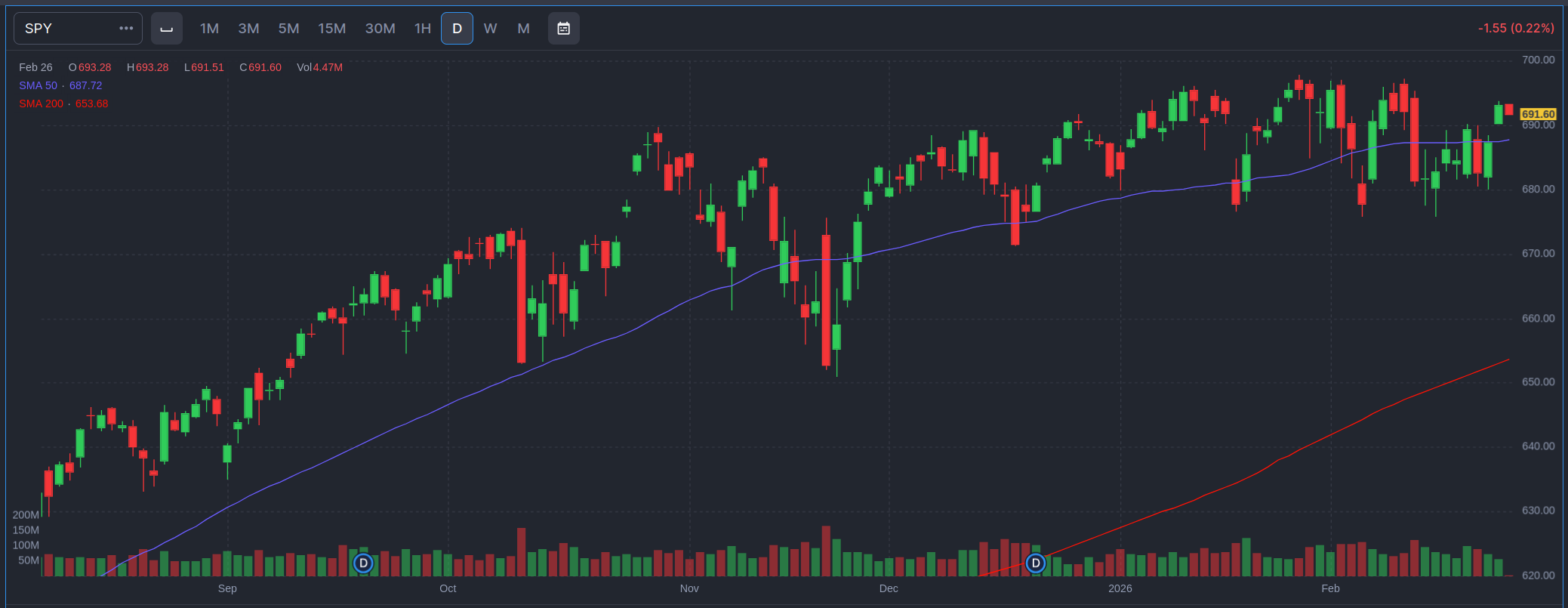
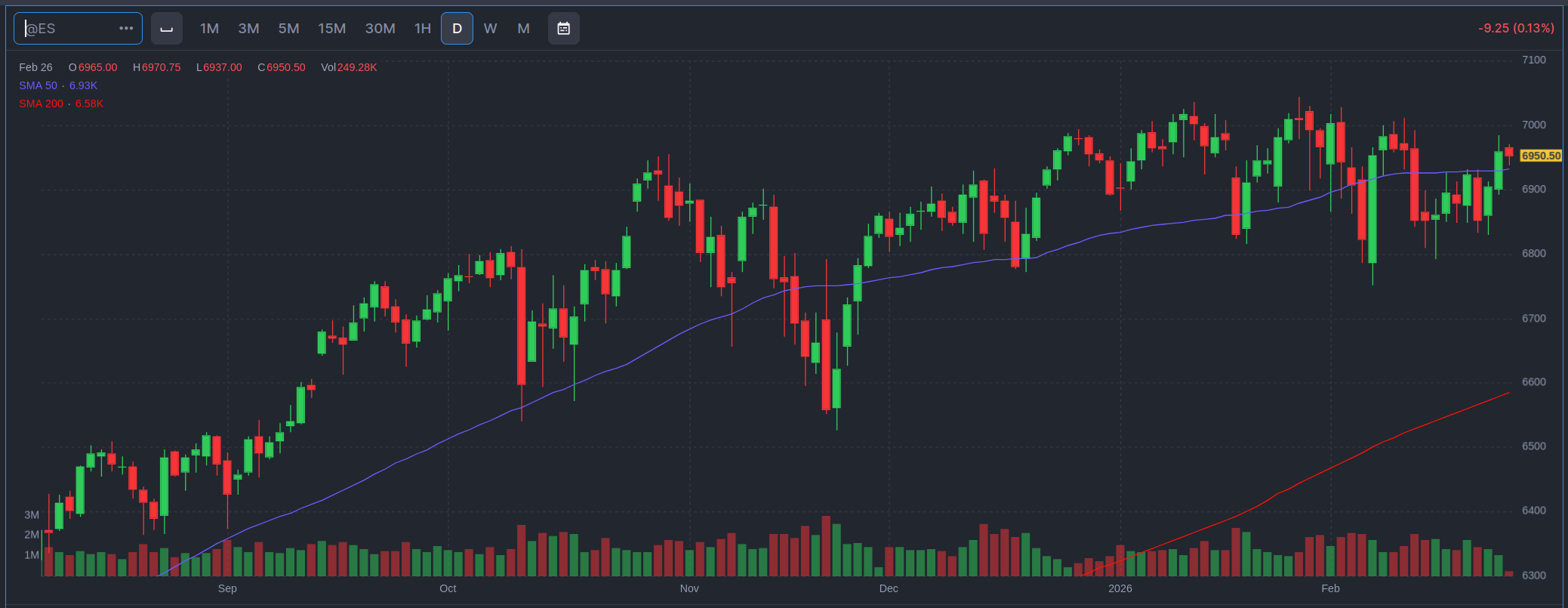
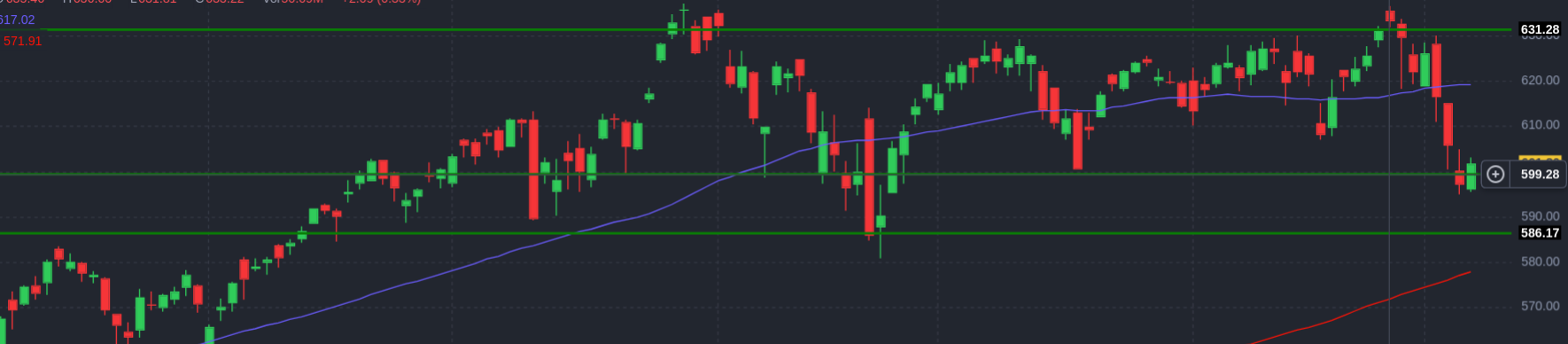
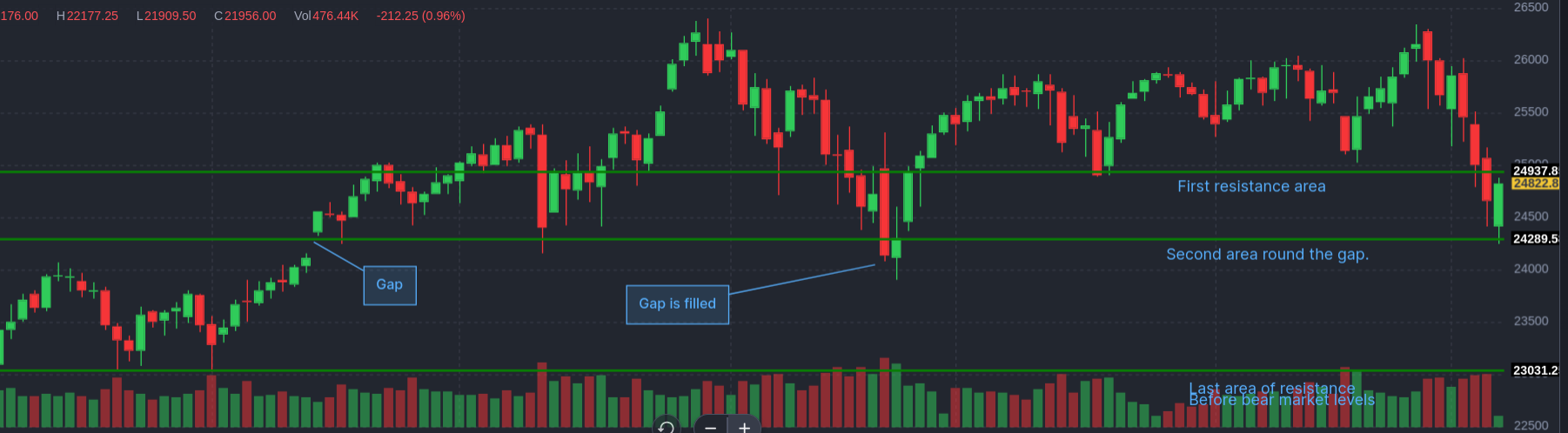
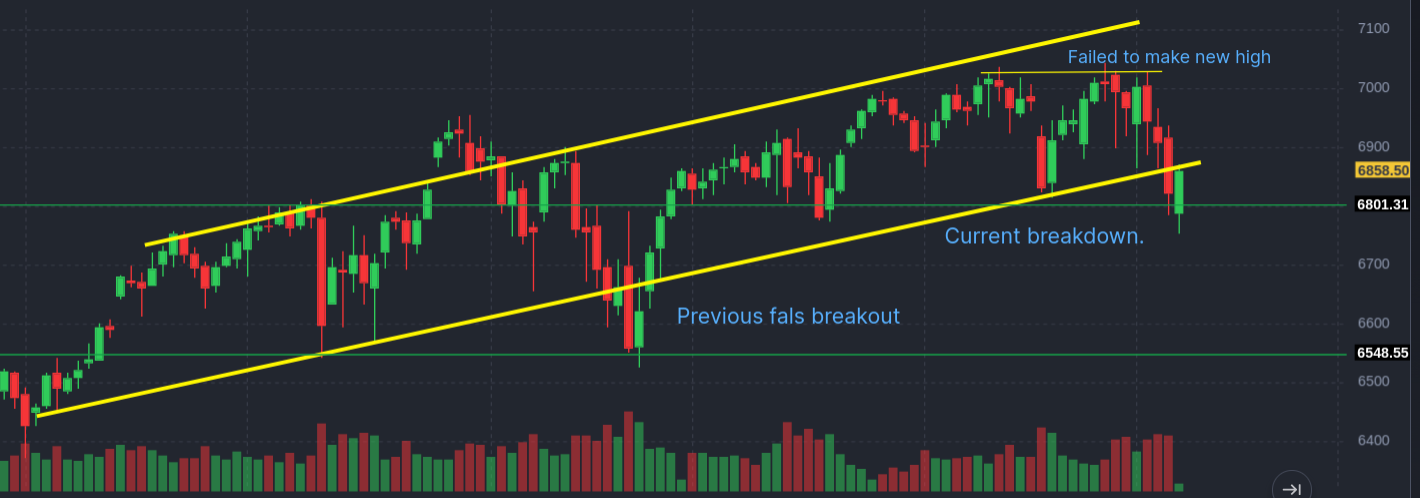
This is the “cash” index ($SPY) for the S&P 500. That’s different from the index that most people look at, which is actually the price of a futures contract on the S&P 500. The price action is a little different, but not radically different. But the S&P 500 that everyone talks about in the news is actually an expectation of the S&P 500 price in the very near future, traded almost continuously. So there are fewer gaps in the price action. The cash index primarily trades during normal trading hours in the US. The chart below is the futures contract and is smoother, with fewer gaps, but it’s basically the same movement.
But what is it really? It’s the behavior of the 500 companies included in the index. The 500 best companies? The 500 most representative companies? The 500 largest companies? Yes and no to all of those questions. These companies fall into sectors: technology, consumer cyclical, consumer defensive, financial, communication services, healthcare, industrials, real estate, utilities, energy and basic materials. From the heat map below you can get a sense of their relative size and how they’ve performed over the last three months. Sorry, if you’re red-green color blind, but for squares that are large enough, you get the percentage change.
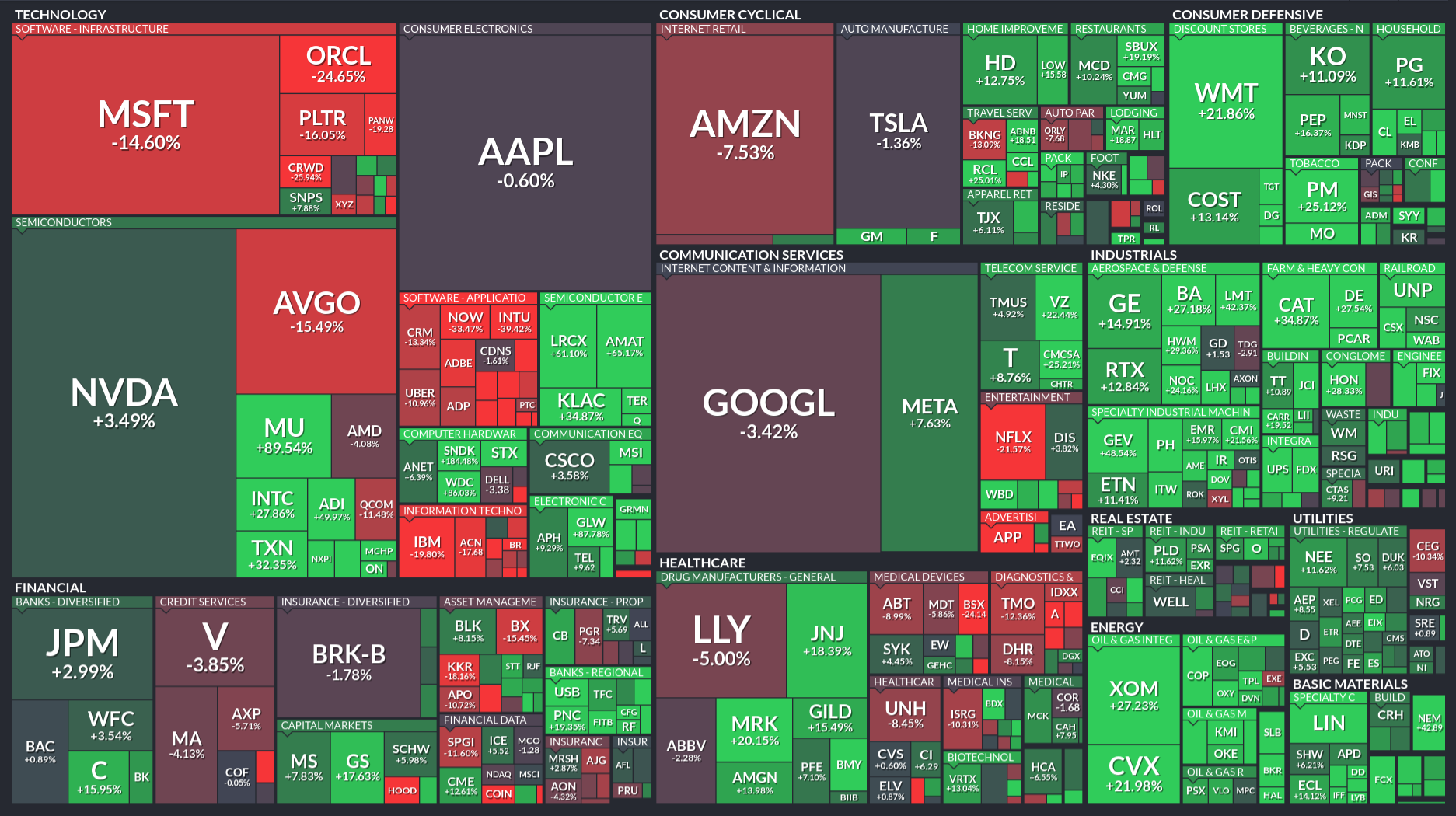
We have different stories about the expected behavior of the sectors under different economic conditions. For example, during a recession, when people are losing their jobs, we expect consumer defensive stocks to hold their value while consumer cyclical stocks to fall. And if we look at the 3 month performance, we can see that defensive stocks have out-performed the aggregate cyclical stocks. These stories aren’t perfect, like maybe TJ Max (TJX) is doing okay because people are bargain hunting more, and maybe McDonald’s (MCD) is doing better because people can’t afford nicer restaurants.
We’ve had a set of contradictory stories. Financials have hit hard, and consumer cyclical and communication services and technology have been meandering to falling. That suggests a slowdown. But material providers, energy, and industrial stocks are rallying. That suggests the early part of a recovery after a recession, when output is picking up. And consumer defensive and utilities are doing great, which is a sign of a slowdown.
What might be going on? I suspect there are two sets of behaviors. Part of the behavior can be ascribed to macro-economic movements and part can be ascribed to idiosyncratic movements. Idiosyncratic is really a short-hand way to say the fish is swimming upstream for a different reason than the current is moving the rest of the fish down stream. I think, in part because the yield curve may be flattening, that the market is anticipating an economic pullback.
That explains the behavior that utilities, financials, consumer cyclicals, consumer defensives, technology, and communication services are exhibiting. I think any strength in technology is coming from the AI bubble. The AI bubble is powering some of the industrials, along with a re-arming of Europe and a possible expansion of the defense spending. The policy chaos and dollar de-risking explain energy prices and basic materials. If the dollar de-values, then the price of commodities and energy will increase for American consumers. If the dollar falls, without doing anything, Exxon Mobile (XOM), Chevron (CVX), etc. will make a lot of money. As will miners.
So here’s the score card. The long term bet being made by most investors appears to be for a weaker economy. That’s not certain. They can be wrong. But that’s what most of the sectors are telling me. (And therefore I could be wrong). My confirmation is that maybe the yield curve is flattening. (But I could be wrong). The dollar is expected to weaken (as per official US policy), and falling interest rates will further weaken the dollar beyond the chaos that is driving countries away from the dollar. That means energy and basic materials have a tail wind. Until such time as we demand less energy because economic activity slows down, and even then we could see prices increasing on net.
Anyway, that’s how I square the circle.
And this is not investing or investment advice to you, or anyone. It’s is provided for your entertainment purposes only. And if you are investing, contact a professional before making any decisions. Buying and selling stocks, futures, or any investment is a risky activity and can cause you to lose money, including the principal which you invest.
 I wish I was like you/easily amused