What Are You Looking At?

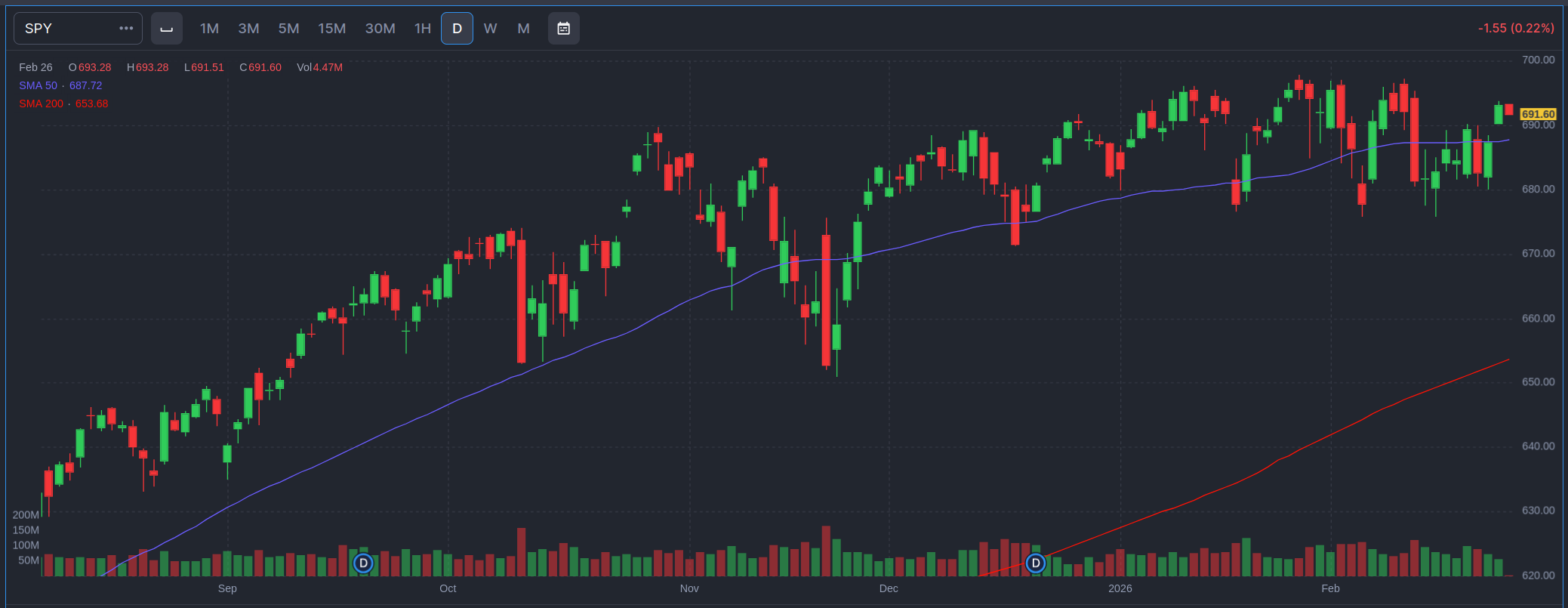
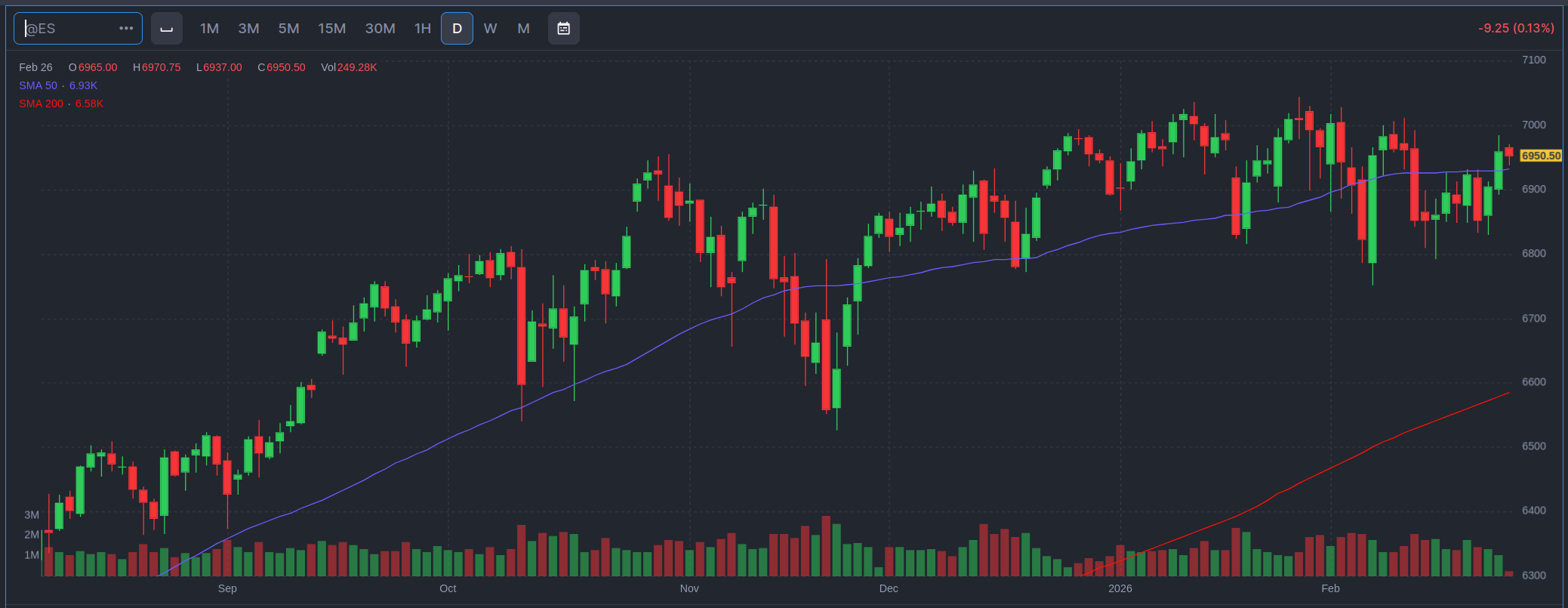
This is the “cash” index ($SPY) for the S&P 500. That’s different from the index that most people look at, which is actually the price of a futures contract on the S&P 500. The price action is a little different, but not radically different. But the S&P 500 that everyone talks about in the news is actually an expectation of the S&P 500 price in the very near future, traded almost continuously. So there are fewer gaps in the price action. The cash index primarily trades during normal trading hours in the US. The chart below is the futures contract and is smoother, with fewer gaps, but it’s basically the same movement.

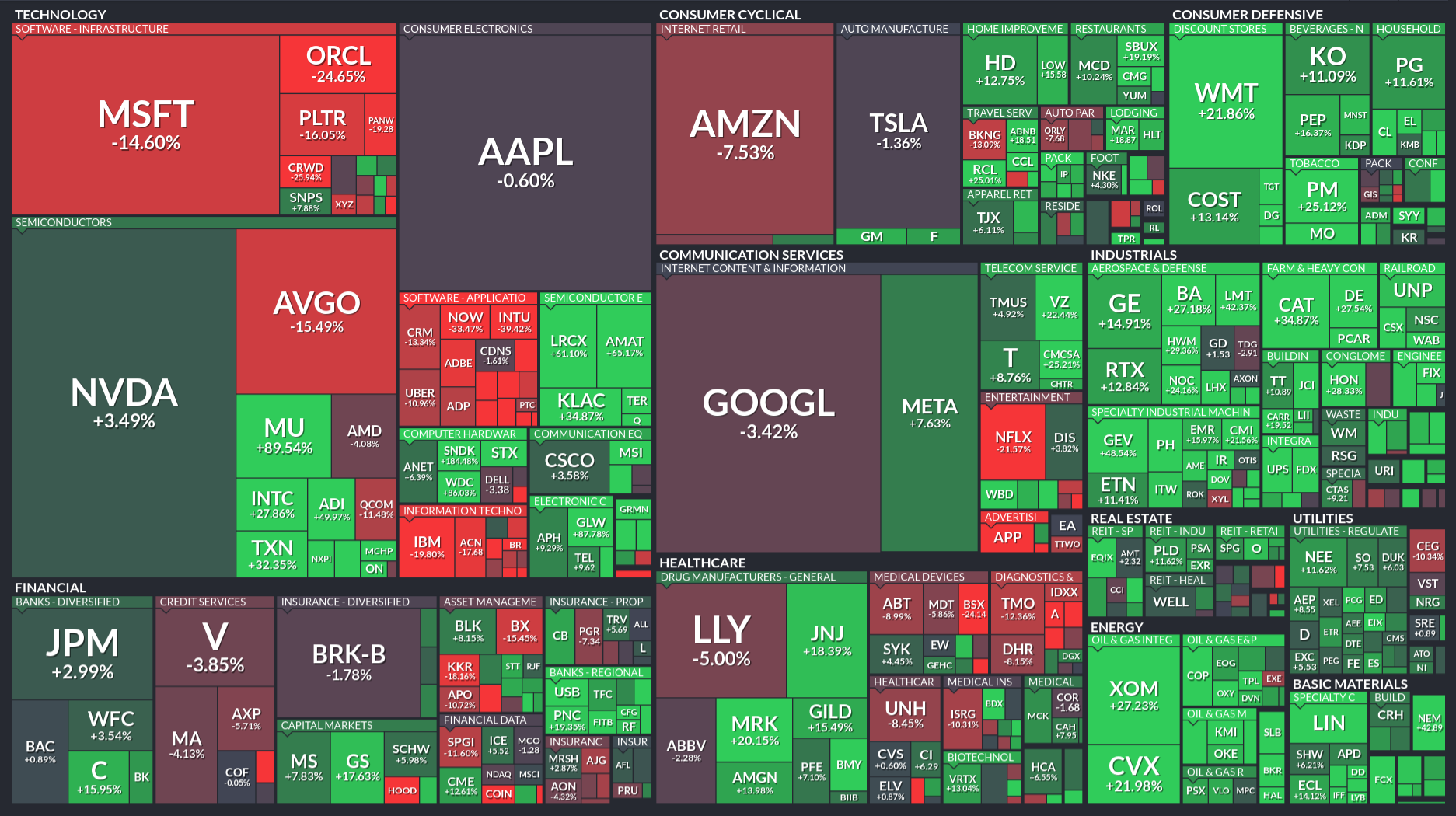
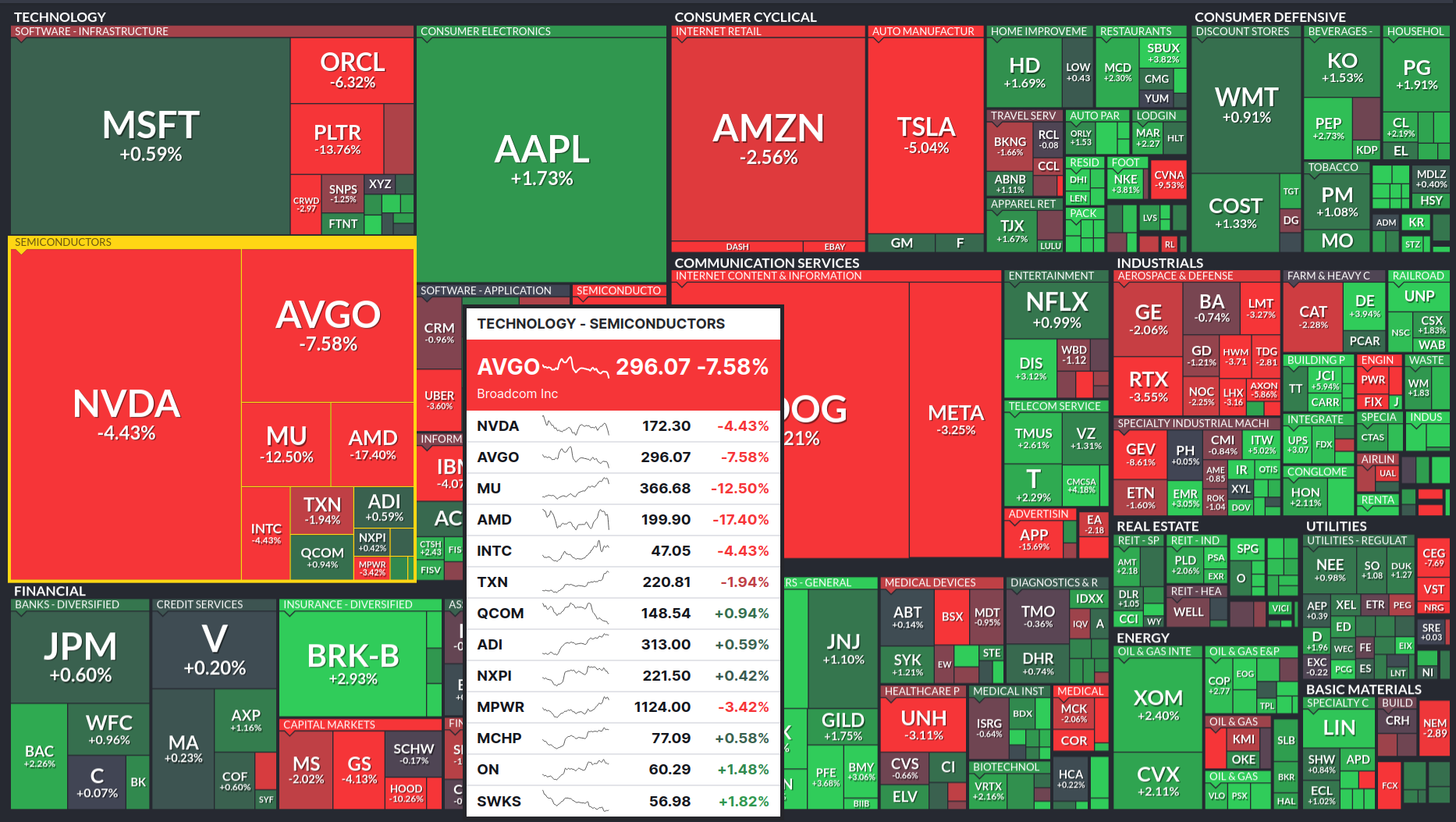
But what is it really? It’s the behavior of the 500 companies included in the index. The 500 best companies? The 500 most representative companies? The 500 largest companies? Yes and no to all of those questions. These companies fall into sectors: technology, consumer cyclical, consumer defensive, financial, communication services, healthcare, industrials, real estate, utilities, energy and basic materials. From the heat map below you can get a sense of their relative size and how they’ve performed over the last three months. Sorry, if you’re red-green color blind, but for squares that are large enough, you get the percentage change.

We have different stories about the expected behavior of the sectors under different economic conditions. For example, during a recession, when people are losing their jobs, we expect consumer defensive stocks to hold their value while consumer cyclical stocks to fall. And if we look at the 3 month performance, we can see that defensive stocks have out-performed the aggregate cyclical stocks. These stories aren’t perfect, like maybe TJ Max (TJX) is doing okay because people are bargain hunting more, and maybe McDonald’s (MCD) is doing better because people can’t afford nicer restaurants.

We’ve had a set of contradictory stories. Financials have hit hard, and consumer cyclical and communication services and technology have been meandering to falling. That suggests a slowdown. But material providers, energy, and industrial stocks are rallying. That suggests the early part of a recovery after a recession, when output is picking up. And consumer defensive and utilities are doing great, which is a sign of a slowdown.

What might be going on? I suspect there are two sets of behaviors. Part of the behavior can be ascribed to macro-economic movements and part can be ascribed to idiosyncratic movements. Idiosyncratic is really a short-hand way to say the fish is swimming upstream for a different reason than the current is moving the rest of the fish down stream. I think, in part because the yield curve may be flattening, that the market is anticipating an economic pullback.

That explains the behavior that utilities, financials, consumer cyclicals, consumer defensives, technology, and communication services are exhibiting. I think any strength in technology is coming from the AI bubble. The AI bubble is powering some of the industrials, along with a re-arming of Europe and a possible expansion of the defense spending. The policy chaos and dollar de-risking explain energy prices and basic materials. If the dollar de-values, then the price of commodities and energy will increase for American consumers. If the dollar falls, without doing anything, Exxon Mobile (XOM), Chevron (CVX), etc. will make a lot of money. As will miners.

So here’s the score card. The long term bet being made by most investors appears to be for a weaker economy. That’s not certain. They can be wrong. But that’s what most of the sectors are telling me. (And therefore I could be wrong). My confirmation is that maybe the yield curve is flattening. (But I could be wrong). The dollar is expected to weaken (as per official US policy), and falling interest rates will further weaken the dollar beyond the chaos that is driving countries away from the dollar. That means energy and basic materials have a tail wind. Until such time as we demand less energy because economic activity slows down, and even then we could see prices increasing on net.

Anyway, that’s how I square the circle.


And this is not investing or investment advice to you, or anyone. It’s is provided for your entertainment purposes only. And if you are investing, contact a professional before making any decisions. Buying and selling stocks, futures, or any investment is a risky activity and can cause you to lose money, including the principal which you invest.

A Little Perspective

NVDA is going to announce earnings on Feb. 25. Like everyone else, I think I’m more interested in the forward guidance on sales than sales over the last quarter. I think we’re all looking for an indication of any pull-back in AI capex spending. This would not just be an issue for Nvidia, but also for companies ranging from turbine generator suppliers to utility and real estate companies. Looking at current levels for the NASDAQ, the recent high was about 26,000. A historically normal bear market pull back takes us to just under 21,000. That’s at the bottom end of a congestion area from last December. The S&P 500’s recent high was just above 7,000, meaning it’s 20% retracement is in the 5,600 ballpark.

The difference between a regular bear market pullback, that cleans out some of the deadwood, and something bigger is only visible in the rear view mirror. When the stock market started dipping before the GFC, a lot of people thought this is just about clearing some deadwood from the system. Once it’s done, the infinite money glitch will restart. Jim Cramer gets a lot of shit for the “Buy Bear Stearns” call just before it went tits up. But he wasn’t the only one who genuinely believed Bear Stearns was in a bind but would find its way out. In part because they didn’t have all the information necessary to make that call. They did not know what Bear and its counter-parties knew. They have opinions on dozens of individual stocks and are not specialists who follow just one company. As Bear kept dipping, they thought it was time to buy. The bias sell side analysts have toward buying just made them look that much dopier when it happened.

Contrast what happened with the sharp pullback and return during the start of the COVID lockdown. The S&P 500 went from almost 3,400 to 2,200, well over 20% and came back fairly quickly. In six months it was pushing new highs as we sat around swimming pools, masks on, glaring at the neighbor jogging by without their mask. Okay, that was one stock versus a whole market, but after the 1929 crash, the stock market came back in what’s called a bull trap. Price came back, people bought in, and then resumed their slide. In fact, the prices came back to nearly the 1929 top.

I don’t know, Jim Cramer doesn’t know, and no one knows if Nvidia’s earnings announcement will cause investors to double down, pull back, or continue to waffle in the trading range. Or pull back for a couple of months, come down 20%, and then come back. As Yogi Berra said, predictions are hard, especially about the future.

But it’s good to clear out the deadwood. For example, the zero days till expiration options trading may be contributing nothing more than volume, income for brokers, and some volatility. I would say it would be nice to wash those folks out of the market, but I suspect a majority are not professional traders. They think they are, but they’re just gambling on whatever free broker they’re using. It would also be nice to nip the prediction markets betting on the market in the bud. But again, that’s not done by people whose wealth moves by six or seven figures on a daily basis. It’s done by people who can’t replace their fridge, if it breaks.

But then again, other than time horizon and belief, what makes someone betting Tesla will move up at least half a percent today, different from me? I have a longer timeline. And for the last 100 years, we’ve seen the US economy grow and wealth accumulate in assets like stocks. Over a long enough time-line (with an important asterisk there about when you buy in and when you cash out), people have generally done well. But we wouldn’t be the first example of a country killing its golden goose for the dumbest of reasons. London has played second fiddle to New York for some time, but Brexit has accelerated its trajectory into irrelevance. Now, its best financial innovation is possibly loosening laws to become more like Dubai, where it’s anything goes (including fraud). Once, even after the US economy eclipsed the British Empire, London was the financial and insurance center of the world.

At some point, the hyper-scalers will need to stop buying Nvidia hardware unless they figure out profits from AI. The market is already giving Google, Amazon, and Microsoft the side eye for heavy capital spending to support AI. The punishment by the street for not investing in AI might be worse right now. But at some point, if AI isn’t making real money (and not just redeeming credits issued in exchange for ownership in Open AI or Anthropic), money spent on AI chips or data centers would be better used to buy back stock. At that point Pinchai, Nadella, and Jassy might decide to stop advertising their AI capex spend, as it would be driving down the stock, and focus on “core competency.” They will pivot by laying off a bunch of people and fucking over a bunch of contractors who anticipated the completion of additional data centers. Oh well. Somewhere between now and that possibly distant future, I expect to break Nvidia to break down from its trading range. Unless it doesn’t.


This is not investing or investment advice to you, or anyone. It’s is provided for your entertainment purposes only. And if you are investing, contact a professional before making any decisions. Buying and selling stocks, futures, or any investment is a risky activity and can cause you to lose money, including the principal which you invest.

Another Look at Nvidia

This is not investment or investing advice. It is for entertainment purposes only. Contact your investment or tax professional before making any investment decisions.

A couple of days ago I took a look at Nvidia, to kind of show how I look at where the stock is headed. I actually prefer to buy ETFs or funds than stocks, but I do buy some individual stocks. And some of what I say is also applicable to those funds and ETFs. Although you have to look at them individual and figure out if the ETF or fund matches your objectives. I learned this early on when I bought into some funds to see the sector outperform the fund, only to realize the weighting the fund used wasn’t what I expected.

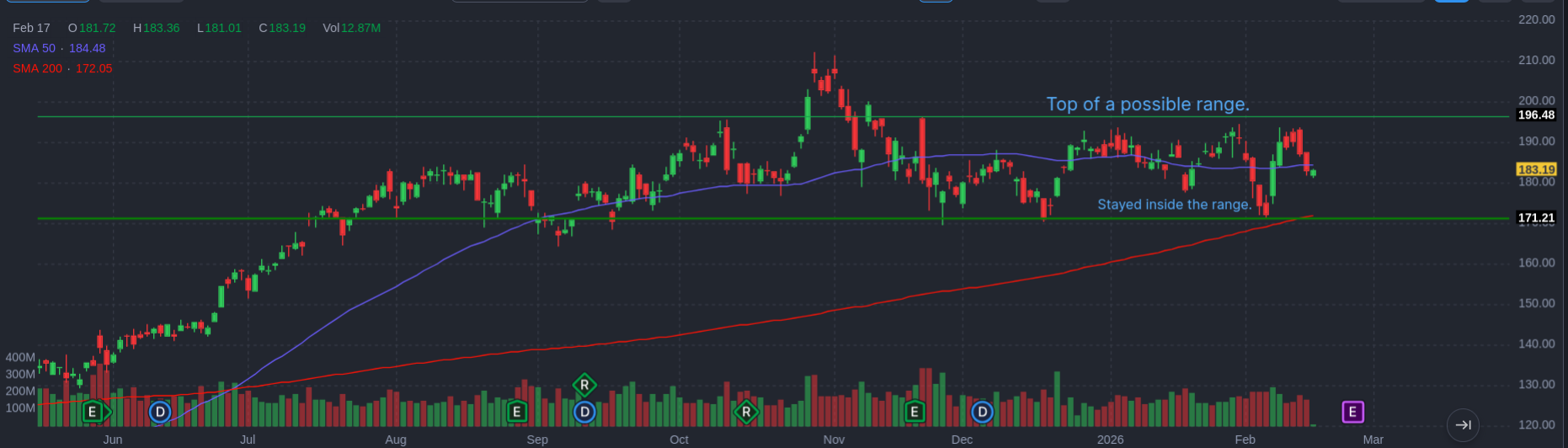
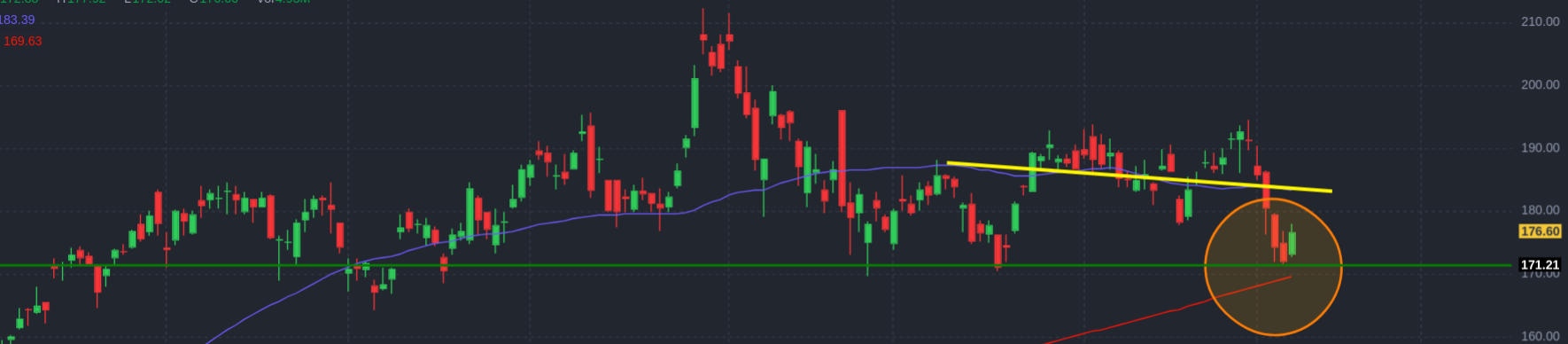
I use the term support line, but I think of it as more of an area. It’s not that buyers come into the market at 170.95 and lift the price. It’s more that when the stock gets to that price, various people are stepping in to buy. And I use the term people here very loosely. It is a combination of ETFs and funds, along with large institutional investors. It used to be that lunch time on say, Wednesday, you could actually put in a trade that would move a sock price. But I don’t think that’s true any more, mostly because trading volumes are much larger.

Anyway, once prices hit a certain zone, buyers seem to step in and keep the price from falling. It may only be a pause on its way to lower levels. Most support lines are found buy simply eye-balling where a series of lows caused the price action to reverse. It may have dropped below that level for a bit, but quickly comes back up. When the price action drops to the support and comes back up that’s called “testing” a support and the more that happens, the more significant the support area becomes. I picked 171 because I see the price approaching that area multiple times and bouncing back. I don’t think exact numbers are particularly useful.

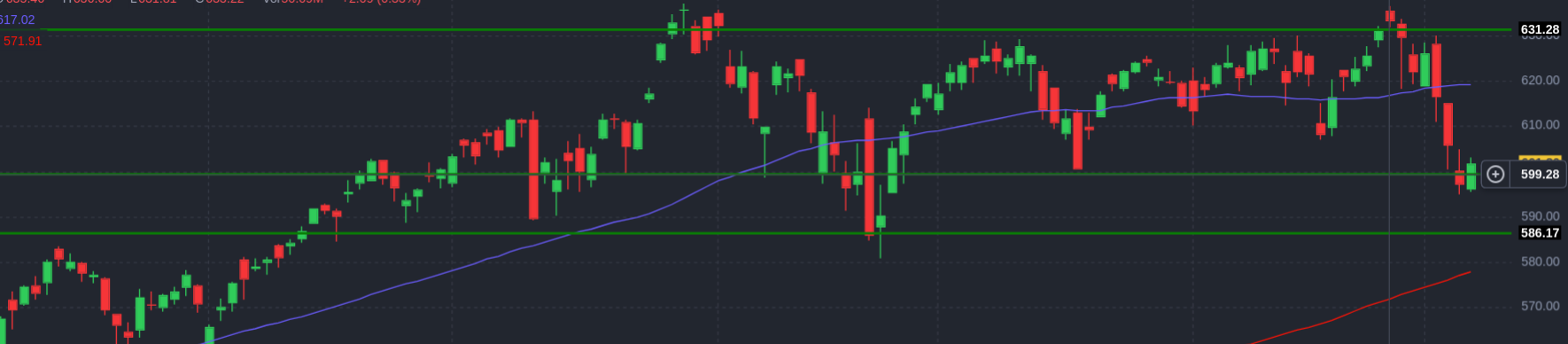
But the whole market is taking a breather in the morning pre-market session. Nvidia (NVDA) is part of the NASDAQ composite index. (Don’t ask me what NASDAQ stands for). It is a significant part of the index, so it’s behavior will impact the broader index behavior. To me there’s a support area extending from about 600 to 585. (This is the QQQ, which is the cash index for the NASDAQ 100). I view the support areas to be less precise on the cash index because it is the byproduct of a lot of buying and selling, both through the index and its individual components. The line on top is not a support line, it’s a resistance line that suggests most market participants decide anything above 630 drives selling.

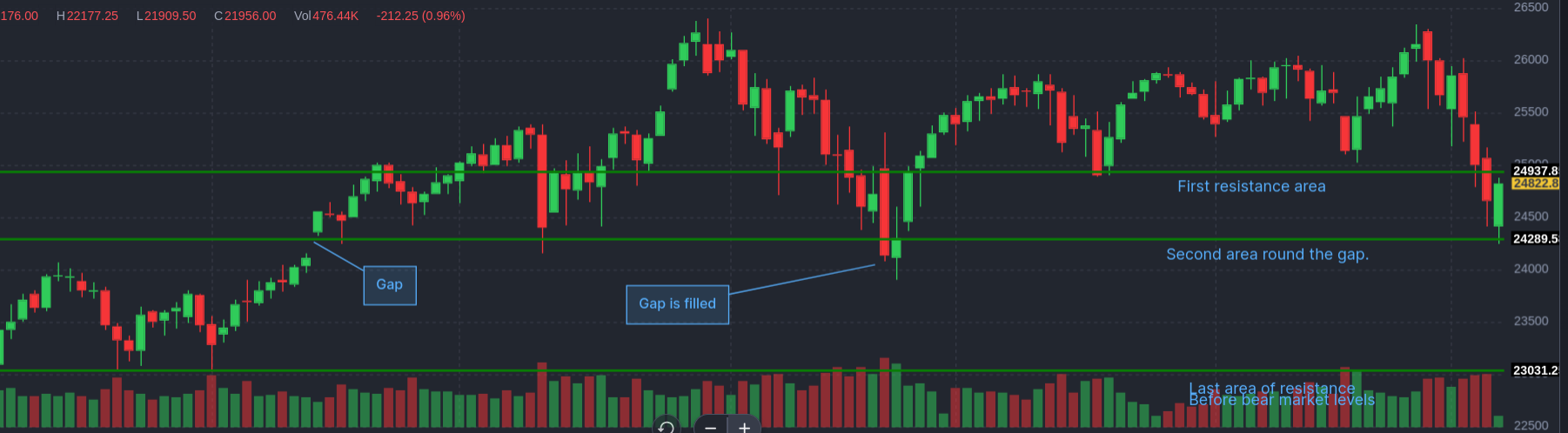
The chart of the cash index is different from what most people look at when they look at the NASDAQ, they look at the futures market, as shown below. It is not the product of buying and selling stocks. It is the the prices of the futures market for the index. A different thing is being traded. In the futures market, we see a gap that doesn’t exist on the cash index, and the prices look almost, but not quite, the same.

On the chart of the NASDAQ futures, I see a similar support area but I think they’re actually two support lines. There’s one at 24,937 (remember – not exact) and one at 24,289 (not exact). Remember, I eye-balled the lines and read the price from there. I didn’t pick the price and draw the line. We ploughed right through the first line (which probably means it wasn’t really an area of support). And today, the pre-market is bouncing off the second line, meaning it’s holding. That second line is formed on the basis of it being the bottom of the gap (which was eventually filled). But again, it’s more that zone around 24,289 where a mix of funds, algorithms, and large institutions will see a buying opportunity.

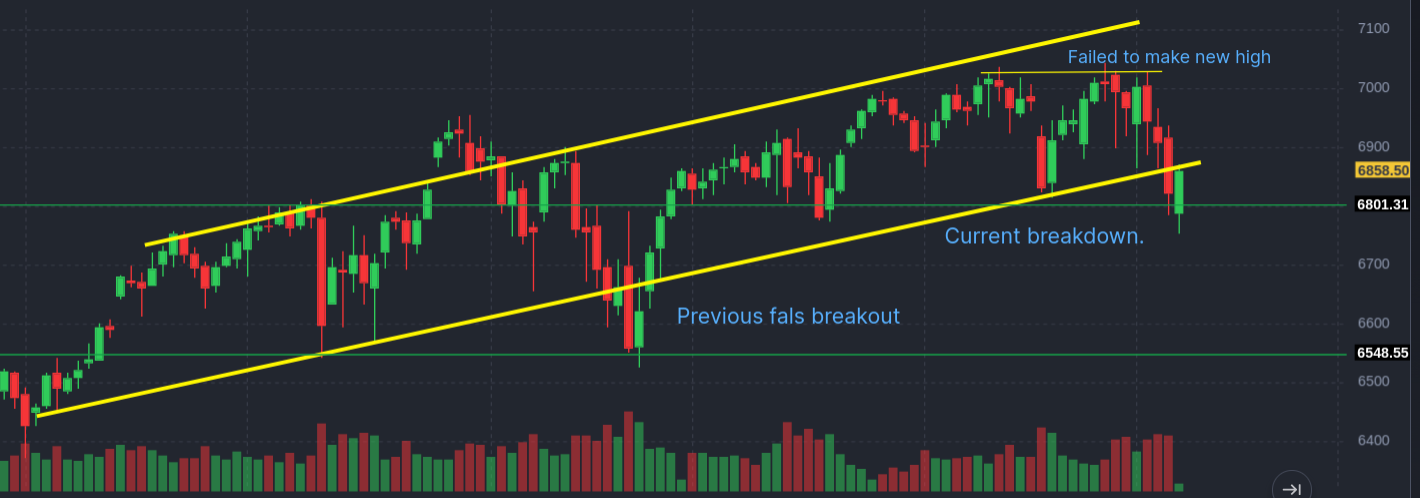
Looking at the S&P 500 Futures I’ve identified what I think is a trend channel. We see a failure to make a higher high at the end of the channel, and a break down from the channel (which we won’t know is significant until we’ve had more than a couple of days trading lower). And we briefly pushed into what I think is a support area. The support area holding means going lower will be a challenge, but the other factors are bearish. (Meaning there’s more interest in selling). But this is just to show the broader market is pausing at some level of support.

To be honest, I have no earthly idea what makes a large fund decide the prices to buy or sell NVDA or the other components of the NASDAQ, a NASDAQ future, or any stock. Maybe they just think we’ve come too far these last couple of days and they’re buying the dip. Maybe it’s just selling or buying to offset options contracts. I really don’t know. And no one knows, except for one thing that investors made clear with Google yesterday and AWS today. They are no longer looking at hundreds of billions of AI investment as paving roads for future growth. They’re looking at it as burning money that may not come back. And because many investors (both small and institutional) use baskets of stocks (like ETFs), stocks are now more likely to move similarly than before.

To wrap this up, I wrote this to clarify my thinking on what’s going on with the market. To remind myself, that even though I drew a line, It should have been a fuzzy, broad line, not a precise, skinny one at a specific number. I also like to see what the giant ball of money is doing today. It’s sloshing away from defensive investments, like consumer staples, and back to risk and tech, now that we had a big move away. That money sloshes back and forth, back and forth, each time allowing the smart money to bleed more and more off retail investors.

And this is not investing or investment advice to you, or anyone. It’s is provided for your entertainment purposes only. And if you are investing, contact a professional before making any decisions. Buying and selling stocks, futures, or any investment is a risky activity and can cause you to lose money, including the principal which you invest.

[Update] The screen shots above are from the pre-market session. The regular session can look a little different, for example, here’s NVDA, note the slightly different representation of today’s candlestick. Which is also a reminder that what you see may be determined by the conditions under which the prices were collected.

Thinking Through NVDA

With the normal disclaimer that this does not constitute investment advice, it is provided purely for entertainment purposes, and contact a tax or investment professional before making any investment decisions, I’ll take a look at a stock.

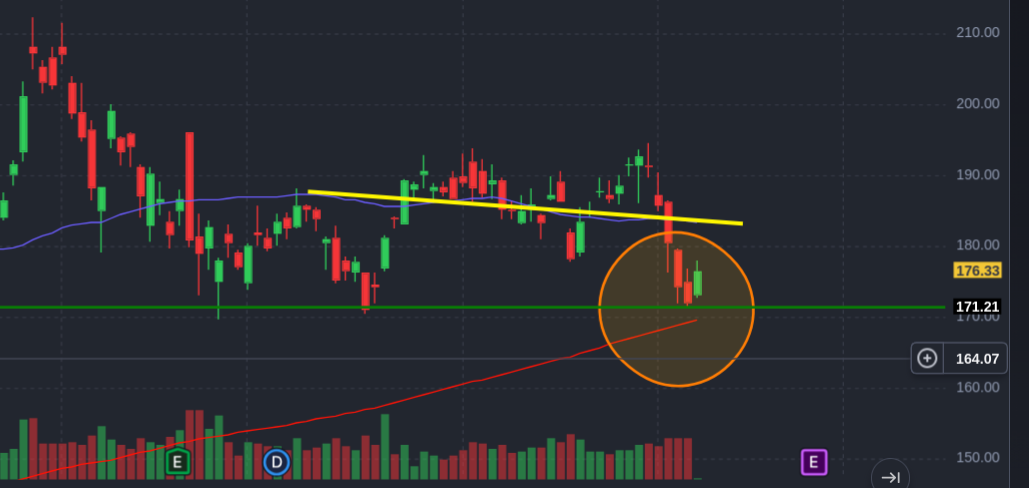
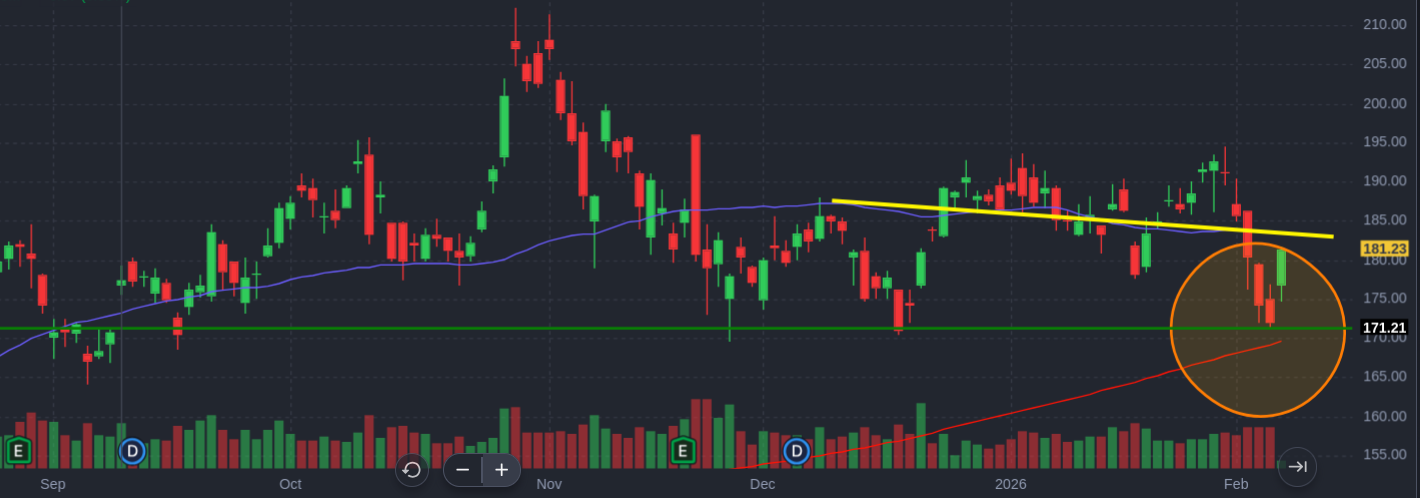
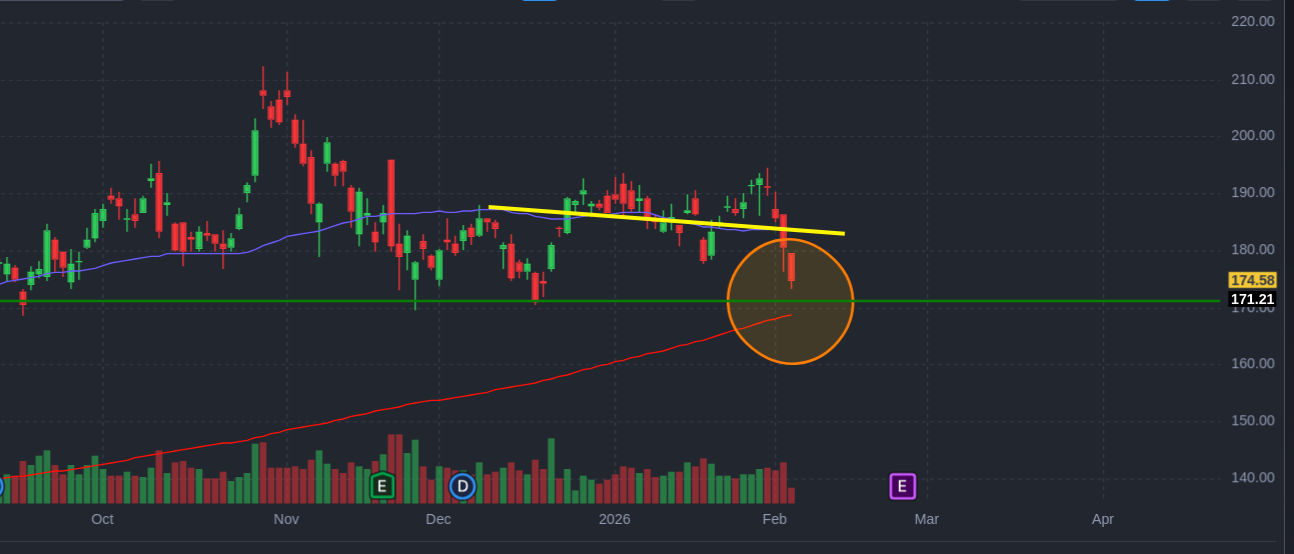
Taking a look at Nvidia, we see the 50 day moving average peaked in December and has started a flat to modestly downward trend (yellow line is an eyeball of the trend). The price is approaching the 200 day moving average (orange circle). There is a floor around 170. So what events would I look at, from a technical perspective?

If the price drops below the support at 170, that is significant. In my thinking it’s more impactful than the price falling below the 200 day moving average. The 200 day average is going to continue to move up, even if the price declines, as it catches up to the historical price action. The violation of support that has been in place since September is more critical, in my opinion. As would as a steeper downward slope on the 50 day moving average.

Technical analysis isn’t just tea leaves for investment bros, if you look at it as a pattern of the expression of sentiment about a stock. What do we know about the broader context? For one thing, the current administration has shown a willingness to step in and make decisions that impact Nvidia’s sales. Second, the broader investment community is getting more concerned about circular deals. Third, investors are starting to ask where’s the beef on AI revenue. In the past, when the price has approached 170, buyers came in because they saw value in the stock. Above 190, more people did not see the value in the stock and sold. That range indicates people may be waiting for more information before making a move.

As we can see, all the revenue bump for Nvidia has been in AI accelerators. I’m assuming there’s a role for LLM style AI in the future. If anything, it makes sense for Microsoft to include it in Office to help with writing e-mails, writing Word docs, Spreadsheets, and Presentations. Likewise, Google’s office offerings would benefit. As would ad generation on Meta. The question is if the amount that needs to be spent in accelerators, data centers, and energy makes sense, given the revenue it produces. If it costs Meta $10 of cap-ex and $10 of lifetime energy costs to generate a lifetime revenue impact less than $20, it clearly doesn’t make sense.

What would happen to Nvidia if the GPU sales are cut in half. First, the multiple needs to come down because the expected future growth in sales is at a much lower sales volume. Let’s say it drops to 20 times earnings. Earnings are cut in half. That would mean a share price of around $45 for Nvidia. What does that do to the mag 7? Well, different parts of the Mag 7 are there for different reasons. Apple is not there because of AI sales. Microsoft, Amazon, Google, and Meta have AI exposure but won’t get destroyed. Tesla is a meme stock so this may not change anything for people who believe humanoid robots are a 10 trillion dollar TAM. But there are other stocks, like Oracle, Micron, and Broadcom that take a big gut-punch. (As is happening as I write this).

What may have an outsized impact is the wealth effect that’s given the top 10% to float half of all consumer spending. A drop in the Mag 7 would pull down the entire S&P 500. But it also flips psychology. It would also have an unquantifiable but negative impact on the private equity and banks that have lent money to AI startups and data center build outs. One estimate puts 20% of PE’s loan book on AI related loans. No bueno. Not to mention the hit to all sorts of venture funds and the investors in those funds.

Again, do your own research, consult a professional, this is only provided for entertainment purposes, and is not investment advice.

I Was Not Alone and ADP

I think I was not alone yesterday in looking at the big blob of money wandering around. At one point it looked like the market was going to be broadly down, because the options are depressing. As the blob of money lumbers out of tech and into not tech, valuations wind up rich, especially given rates. Here’s a way to look at it. Take a company that has about a 3% real long term return through a combination of price appreciation and re-invested dividends. I say “real” to mean inflation adjusted. That means every 24 years, or so, you double your money in real terms. The nominal (or not inflation adjusted) rate of return might be 5% (assuming a 2% rate of inflation).

You could also buy bonds, which might be paying 2% in real terms. (The nominal rate is 4% but there’s 2% inflation). If you reinvest the dividend, you double your money in real terms in 36 years. But the bond is considered near zero risk (given the time horizon) while the stock may or may not pan out. Even a very stable business with a simple and straightforward revenue model may not survive all 24 years. Or, like GM, it may stumble repeatedly. 10 years of bad management and shrinking margins may seriously undermine your 24 year plan. The stock has more risk than the bond (which does have interest rate and reinvestment risk – but we’re eliminating interest rate risk by holding to maturity and assume the the reinvestment risk averages to zero over 36 years).

One way to look at the double your money equation is to say you bought the company for cash, today. Every share. How long would it take to make that money back? Well, your money doubles, in real terms, in 24 years. That means it will take 24 years to make your money back. The company earnings are what provide the price appreciation and dividends (although stock buy-backs are seen by stupid investors as more tax efficient). So how much would you pay for one year of that company’s earnings? It’s simple, 24 times. At that rate you should have accumulated enough to buy the company outright in real terms.

That leads to a fairly simple model of how to anticipate the change in value of the company, given the interest rate. If the nominal interest rate goes down to 3% (but holding inflation at 2%), then we would be willing to pay more for that company. Why? Because it would now take 72 years to double our money with the bond versus 24 years for the company. While the company has more risk, it is is more attractive and we would be willing to pay maybe 36 times earnings. We’re taking higher risk, but more reward than the zero risk option. Likewise, if nominal interest rates go up to 5%, and it now takes us only 24 years to double our money with bonds, the company looks less attractive. It’s worth maybe 12 times earnings, for the given level of risk.

That’s the “perfect world,” thought experiment view of valuing a company. The giant ball of money screws with that by suddenly injecting a ton of buying into that company. CNBC and influencers talk about the massive run up in the company. Other idiots then try to follow the trend. That company should be trading 24 times earnings long term, but the ball of money pushes it to 30 and the idiots help drive it to 35. Retail investors get sucked in because “this time it’s different.” Retail investors are left holding the back when the ball of money chases the new shiny thing. The smart money that owns much of the ball gets out at 35. Retail investors ride it down from 35 times earnings to some over-correction down to 18 time earnings, essentially turning over their wealth to the great ball of money.

Which brings us to the ADP report. Is the ADP report an accurate gauge of employment. Not especially. It is a little erratic. But if we look at it over the last few months, we see it’s trending down. And most of the delta between the expected value and the reported value surprised to the down side. The former is consistent with a slowing job market hypothesis and the latter is consistent with most professionals being over-optimistic about conditions. But the picture is cloudy, not clear. We have the Schrodinger’s job market, that’s both good and bad at the same time depending on which number you look at. And that also feeds in to conflicting data, such as manufacturing in the US expanding, but not manufacturing employment.

There is no one number that tells you how the economy is doing. There is no set of numbers that tell you how the economy is doing. In truth, we’ve had a lot of change and I think some numbers, like first time unemployment claims, are no longer indicative of much. While I used to write off ADP as only useful to get journalists on TV hot and bothered when it dropped a wild number, the government jobs number has had a series of issues with major restatements. Companies (for whatever reason – but in this day and age it could be ideological) are failing to report on time, requiring the economists to produce a less accurate estimate. It has never felt so hard to get a bead on the economy.

[Update] Services PMI came in as inflationary to me. Although employment continues to grow in services (which is much larger than manufacturing). New orders are still growing, but slower.

The Fraud Is Coming

Michael Burry is shorting some tech companies. With the market as frothy as it is, that’s not exactly prescience. Unless you’re as good a market gambler as Burry, I wouldn’t recommend it. (And if you were as good as Michael Burry – you would already have a lot more zeros in your net worth). It is still true the market can stay irrational longer than you can be solvent. But what Burry isn’t just pointing out the emperor has no clothes. He is pointing to financial engineering. Why is that important? Why does presenting the information in a slightly better fashion matter?

The pressure is on to show something. All the public companies in the AI orbit, with elevated stock prices because they’re part of the “AI-play,” need to show earnings. The non-public AI startups do not need to show earnings. Oracle, Broadcom, Micron, etc. need to show revenue. Immediately they do not need to show revenue, as they sign contracts. That’s future revenue, and the stock price goes up as a multiple of earnings. With expected future earnings rising, the value of the company increases, even though current earnings may not have moved. A company that trades at 15 times their earnings begins trading at 30 times their earnings, based on the expectation of making more money in the future. But at some point, the imaginary future money needs to become real money in the present to justify that multiple.

Could companies like Palantir and Oracle be over-stating their income by altering the way they treat depreciation? Maybe as much as 20%? That’s what Burry sees. When companies structure their earnings to provide a better light than what would otherwise be the case, we refer to that as lower quality earnings. It may be legal and within the GAAP (generally accepted accounting principles), but it suggests the actual earnings are inflated. This is completely legal, as long as it is disclosed. Eventually, the lower quality earnings should result in a lower multiple. But in the short term, investors may ignore it or simply accept the statements of the companies that the new accounting practices make more sense. Longer term, investors tend to give companies that do a lot of financial engineering side-eye. Eventually reality will set it and the fundamental reasons they aren’t doing well will overtake the financial engineering.

But where there’s that much pressure to push earnings, it means there is building pressure to fake earnings. This can be done by either aggressively booking sales when the sale isn’t really complete and moving liabilities off the balance sheet. I would suspect the former is already unfolding. When everyone is desperate for more data center space, more power, more networking, and more processors, booking a sale early may not seem like a big deal. You feel the actual sale will almost certainly close in the very near term. Or you can call the next firm in line, waiting to snap up the same scarce resource. So why not report it in this quarter to juice your numbers a little? But it doesn’t take long before some firms start booking speculative sales, to keep the line on the sales chart going up and to the right. One of two things will happen, either the auditors will stumble over this and realize there’s fraud going on, or (more likely) a short seller will sniff it out. The former is bad enough when firms are forced to restate their prior earnings, as some executives go ‘spend more time with family,’ and shareholders bring suits. But the latter is devastating, usually resulting in obliteration, with the fraud investigations coming later.

The other approach is to engage in balance sheet engineering. A loan or an obligation to make payments in the future are recorded as liabilities. There are ways to move the liabilities off the balance sheet of the parent company, for example, by using special purpose vehicles to actually carry the obligation. Company X doesn’t owe the money. The money is actually is actually owed by Able Baker, a joint venture between X and Y. Company X doesn’t record the liability, even though the counter-party (the lender) can collect from Company X, should Able Baker default. The auditors may miss this if Company X misrepresents the true nature of the obligation (commits fraud). No one will notice a thing as long as the market that props up Able Baker is healthy. Once that changes, and Able Baker defaults, Company X may find itself illiquid.

On overstated earnings or engineered balance sheets you can quickly build other frauds. For example, understating the risk of loans to those companies. Lenders may be aware that something fishy is going on, but continue to lend to the companies, collecting fees on deals that should never have been closed. Even in the best possible light, it means suspicious insiders put aside suspicions to chase the deal. After all, the entire market can’t be wrong. And everything looks good for now. If the demand for the underlying market dries up, the loans held either by the direct lenders or the positions investors have in that lender, are worth pennies on the dollar. (Or nickles, now that we’ve stopped minting pennies). Suddenly, the lender (now likely to be a private equity firm rather than a bank) is exposed to losses large enough to wipe out its equity. Investors that invest or lend to the private equity firms suddenly find their positions wiped out as well, creating significant counter party risk. Which can ripple through other sectors of finance through reinsurance products. And liquidity dries up as everyone becomes unsure of any of their counter-parties actual financial health. What threatened to bring down the entire house of cards in 2007/2008 was the overnight lending market between banks was shutting down.

What makes this especially troubling in the current environment is a confluence of factors. First is the inability to actually jail corporate executives of very large companies. Even if there is fraud, we fine the corporation rather than hold its officers criminally liable. Let me do the math for you. Let’s say you put together a 300,000,000 dollar deal where your bonus is 5%. If you commit the fraud necessary to close the deal, you will be paid 15,000,000 dollars. Should you even get caught, you will have to give most of it back but won’t go to jail. And you keep all the other bonuses you also received. It’s likely the government will settle with your former employer. And if you’re not caught, and the company goes under, they still owe you the 15,000,000. You can sue for it in bankruptcy court, or from the company that acquires your old employer. If the company gets bailed out with public money, contractually, they will still need to pay you the 15,000,000. But what if it isn’t fraud and it’s just making a bet you wouldn’t otherwise make? There is are incentives to take outsized risks. After all, they’re losing other peoples’ money. So you will likely make 15,000,000, or maybe as little as 3,000,000 on the off-chance you’re caught. You won’t go to jail. And you won’t lose any of your houses just because you lost your job.

But coupled to that is a president who is willing to pardon anyone who is a supporter. He has commuted or pardoned people for political advantage. Like CZ to make good with the crypto crowd. Or the violent protester from January 6. It could be that even though there is criminal fraud, having donated to the campaign, the ballroom, the inauguration, and made statements pleasing to the ear of the administration, is sufficient to insulate your from Federal prosecution. And if you’re in a state such as Texas, it might also insulate your from state prosecution. We may find that explicit fraud was committed, people knew and traded on the fraud, but the fraudsters supportive of the administration are pardoned. In other words, they get to walk away with a lot of zeros in their bank account and no accountability.

If it were “free money,” I wouldn’t care. But what happens when a PE firm, lending money for data center construction, suddenly finds itself the proud owner of a bunch of half built data centers? Or even finished data centers filled with useless, expensive, and rapidly depreciating assets because AI demand isn’t what many expected? And what happens to the pension fund that put 250 million into that PE firm? And multiple other PE firms who also couldn’t resist deals around AI? Or the bank that provides liquidity for the PE firm? It’s not “free money,” it’s coming from somewhere. And that somewhere could be a wide-spread, systemic problem. How does the Federal government backstop PE firms, who are not insured or regulated like banks? Does the government step in and buy stock in the fraudulent company, injecting good money after bad? How do we put possibly trillions of dollars of bailout into firms but let the fraudsters walk away with all their money? Does the government step in and buy the data centers? Do the fraudsters stay in charge if they made enough dulcet noises of support for the administration?

Let’s put together a package that “doesn’t cost the taxpayers a dime.” It involves backstopping the loans, purchasing shares in troubled companies, and buying some data centers. All with money is effectively printed by the federal reserve or raised from “investors” with guaranteed loans. Essentially, this injects a pile of money into the economy, which will fuel inflation. It would also expand the debt, causing even more worry about the US debt burden. A burden the US has every incentive to ease by devaluing the dollar and inflating its way out of the crisis. And like the COVID relief bills, a lot of that money will go into creating even more income disparity. Not only will the wealthy (including fraudsters) walk away with the money they made on the way to the crash, eventually they will reap the reward of the stimulus injected to moderate the economic damage. And while the previous administrations tried to put some limits on how either the post 2008 or COVID stimulus could be used, I doubt this administration will suffer that burden.

I don’t know if or when the AI trade unwinds. I suspect it’s ‘when,’ and the longer it goes on, the more I suspect it will unwind badly. There is little I’m hearing that makes me sanguine about an orderly end to this. On the spectrum there will be true believers to outright fraudsters. Like flies to shit, fraudsters are drawn to environments where people making money would rather not look too closely as long as money is being made. If anyone did look closely, the party’s over no one is making money. After all, a little ‘wiggle room’ makes the market possible. To repurpose Mao, this is the water in which the fraudster swims. Whether its repacking bad home loans, creating accounting practices at suspiciously rock-star energy companies, or the sales figures at ‘world leading’ telecom companies, no one wants the gravy train to come to an end. But rest assured, the longer the massive (and frankly stupidly large) sums of money are changing hands (or not actually changing hands) over various AI deals, the more openings fraud will find.