Is the Job Market Actually Good?

There is never just one number that gives you the whole economic picture. In some cases the number itself is bogus (CPI) and what we really care about is the change in the number over multiple periods. That’s why policy is rarely made on just one reading. As much as people are complaining about the job market, maybe the actual job market is still in good shape? Today we got the JOLTS (job openings and labor turnover survey) numbers for the last month.

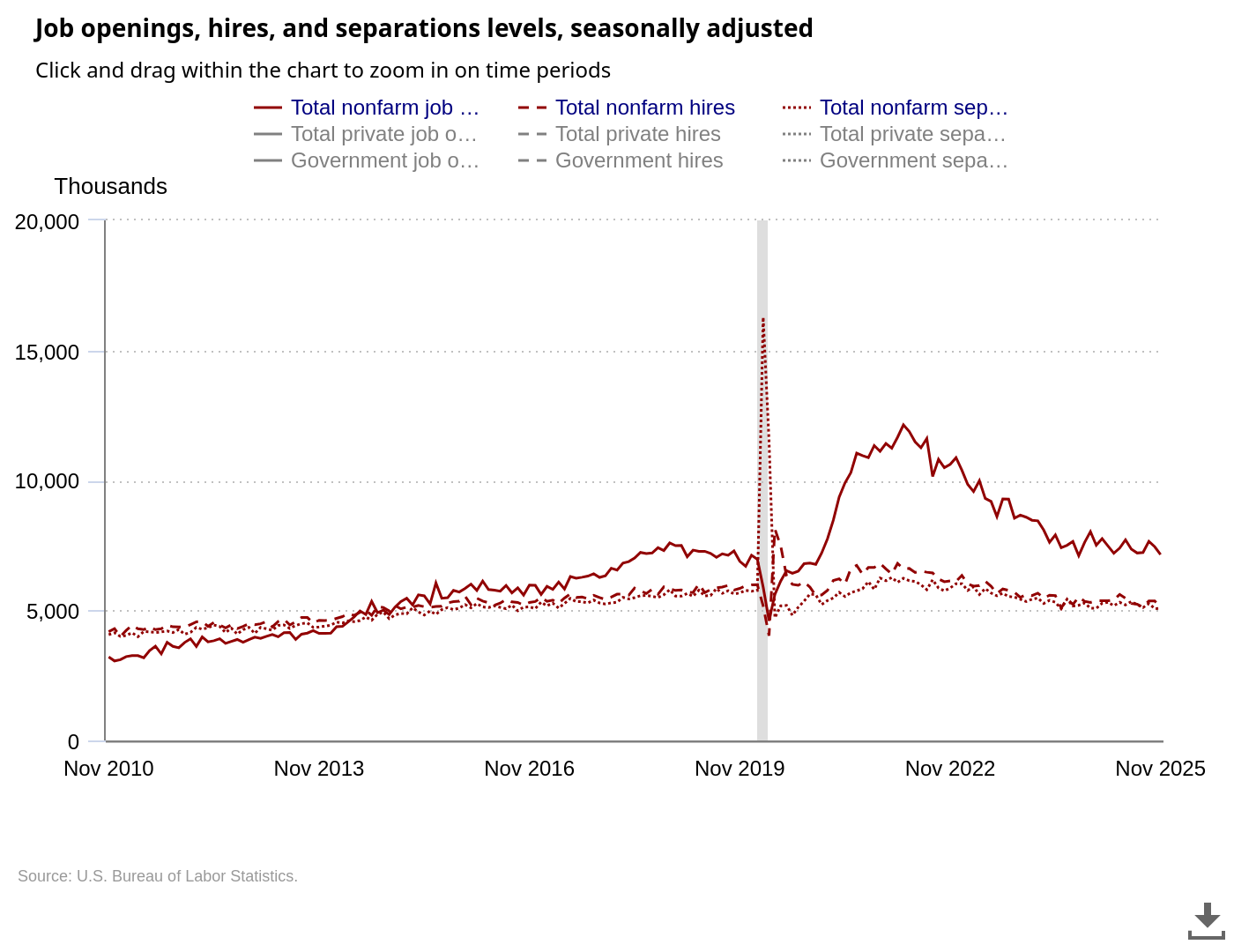
The chart from the BLS looks like it has a lot of openings, with the separations (layoffs and quits) slightly below hires. There is a giant grain of salt on the openings, in my humble opinion. There are a variety of reasons, but what I’ve seen personally are: 1) openings that are just trolling for resumes; 2) openings to justify H1-B visas; 3) ghost jobs; and 4) fishing.

The first are job openings that aren’t for ‘real’ jobs, they’re just to gather resumes from applicants. Who’s out there? What skills do they have? What are their compensation demands? Second are openings to justify H1-B visa requirements by demonstrating it can’t be filled by a current US worker. Third are the jobs posted to show a company is growing and exciting. And finally, they might get lucky and land a person that is way more qualified than they would normally be able to nab. I don’t trust the openings data to reveal important information, and instead I’m just going to focus on separations and hires over the last few months. The pandemic distorts the data.

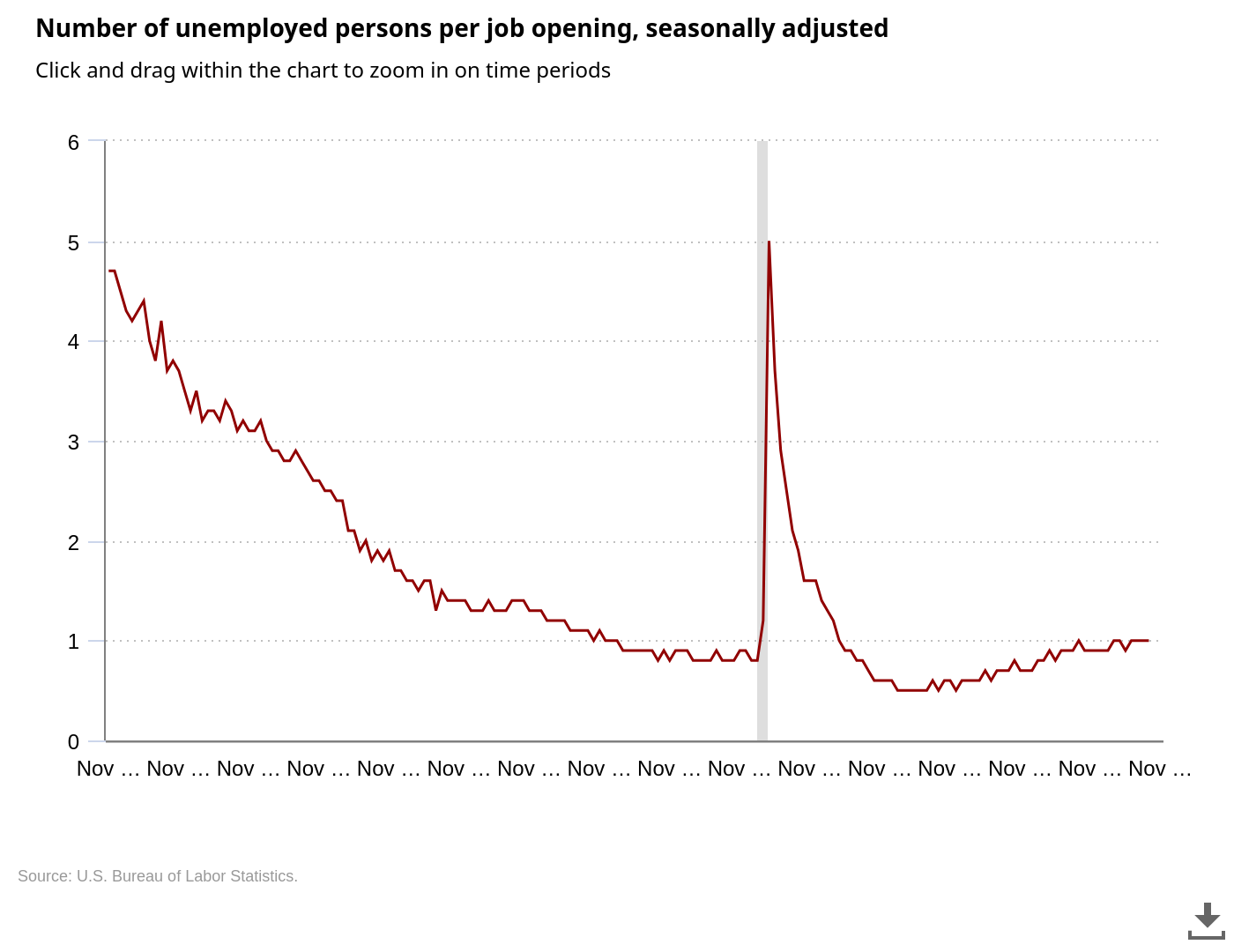
Here we see that both hires and separations are trending down. This would be consistent with the anecdotal stories of job hugging. Note that separations include both quits (which may often translate to an offsetting hire), and layoffs (which do not necessarily result in a hire). Looking at data from FRED, I suspect that quits have fallen off while layoffs are accelerating, but I haven’t done the math to validate that. However, we are pushing back toward more than one unemployed person per opening. And remembering my suspicion that a number of openings aren’t valid job openings, it means we are probably already more than 1 unemployed person per actual, real job openings.

Is the job market in good shape? I’m not sure it is, but I’m far from convinced it’s in bad shape. After all, it still appears we have slightly more hires than separations (which includes quits and layoffs). So if someone (on average) is getting hired when someone quits or is laid off, we are not in a bad state. And if we ignore the pandemic data, we see the number of unemployed people to open positions is much lower than the recovery after the 2008 recession. But we are certainly not in the post-pandemic world where we hit .7 unemployed people per opening. That was nuts. But if that’s all that you remember, and that’s your yardstick for the labor market, this middling to good labor market must seem like hell.

What if Data Center Space Were Free?

First, what is a data center? It’s a slightly archaic term, meaning where the firm aggregated its computer data. It’s from the age of centralized computing. While desktop computers were intended to run on household current, shared computers (mainframes, VAXes, Enterprise databases, etc) were to be installed in rooms with commercial power and air conditioning. These were often installed with special raised floors, allowing cables to run beneath your feet. The space where we put servers has changed, but not radically. Modern servers, although they use processors that are of the same instruction set as desktop and laptop processors, have constantly screaming fans and power requirements that can strain a typical 15 amp household circuit or typical office circuit. And rather than a raised floor, the cabling is now overhead.

The first big change was going from on-premise to hosted infrastructure. Prior to the 2000s, if you went to an internet company, you would likely be taken to their data center. It would be in the same building, or one building over, from their offices. Was there a server problem? Walk over to the data-center and take a look. (Tip: if the servers all looked the same, you could eject the CD ROM tray to help you find it). Starting in the late 1990s and through the 2010s, the data-center moved to a shared facility. Now, the data center might be hundreds of miles away. You might never visit it, or take the tour once before signing up. You ship your equipment to the site and they put it in racks for you, connecting cables as you specify. Or in some cases, lease the equipment from them. From the 2010s on, the move became to the cloud. In the cloud you are renting the equipment in very short time increments. The cloud provider gives you an API to manage the systems.

When you rent space in a data center you are paying for power, networking, and floor space. Power is a combination of the power your draw and some part of the infrastructure, like the backup generator. In a shared data center, you are generally responsible for your own uninterrupted power supplies. Networking is a function of how much of the bandwidth you intend to consume, or you can provide your own network pipe. Within the category of floor space you can add features like physical security, but it is essentially your portion of the footprint of the data center. All the other costs like staff to make sure the physical structure is operational, or someone to attach a cable, are either baked into those costs or billed separately. If you’re a small company looking to host a set of servers, you would likely pay for a rack (a single tower of servers) or a cage (essentially a fenced in area with a lock on it). That square footage combined with the power and network bill is your monthly fee for hosting your servers.

The cloud obscures all that and layers on management. You no longer have to set up your servers, storage, and networking. The cloud provider does that for you. You can still provision a VM or create a virtual (fake) network, but the physical hardware is hidden from you. Your interface to the computers is the API that cloud provider publishes. The costs can be per hour, minute, or gigabyte to seem ridiculously low. How can you justify managing your own servers when it not only involves all the costs mentioned above, but hiring and managing an IT staff, compared to those low costs. There are times when companies have been nearly bankrupted by their cloud spend, but for many it still feels like a deal. And it’s highly flexible, even if getting the costs down means buying into multi-year, inflexible arrangements more akin to leases.

But that’s not the real draw of cloud. Remember floor space, power, and networking? When a data center runs out of floor space, construction time is measured in years. It may not be practical to deliver more power. And even adding more networking always seems to take the networking providers months just to turn on a bit of fiber. God knows why. If you have your equipment in a data center and need to add more, the answer could be ‘no.’ It requires you to figure out where to put the equipment and how to communicate between the two data centers (although some providers had a solution for this). For all intents and purposes, the power, floor space, and networking in the cloud are infinite. And they handle other issues like fail-over, assuming you are willing to pay for it.

But we may be heading to an interesting situation, should the AI hype cycle crash. We will wind up with a lot of data center space heavily over-subscribed with power and networking, with no clients. We might be in a glut of modern data center space that is re-possessed by PE firms and regional banks lending to the projects. This would be like the glut of dark fiber that made YouTube and other social media initially affordable. You might have a group of lenders that’s suddenly trying to get rid of a largely completed data center at a fraction of what it cost to build. All you need to do is walk in and secure agreements for power and networking. The infrastructure will be there in varying degrees of completion. From powered on to cement slab.

What we lack is a view of operating systems that spans multiple computers. The cloud would still have an advantage for many companies that denuded themselves to system administrators to hire cloud administrators. It’s also hard to cost compete with a company that can smear those costs over a much larger number of systems. The idea of companies taking their data centers back in house isn’t what I think is likely. But it may open the door for newer and cheaper competitors. If not general cloud competitors, then maybe specialty providers that provide storage only or back up facilities in case there’s an outage? These new data centers would already have fat pipes to reach out to AWS or Azure.

Maybe another option is to finish the building and bring computer controlled manufacture. You would have plenty of power for laser cutters or mills. Even industrial processes like powder coating or electroplating require a significant amount of power. These data centers are being designed with more than enough power to spare. Like we divide existing data centers into ‘cages,’ these could also be divided up into cages for specific manufacturers. The data centers are also equipped with loading docks for semis. You want to make something like a bed frame that requires a CNC cutting board after board of MDF and grade ‘A’ plywood? No problem. You have a linear, football field sized building, where it gets cut, finished and packaged in one long assembly line. Maybe it would serve high-tech, multi-modal manufacture? You sit in a suburb of DC as you basically run a CNC cutter in Lousiana?

The down side is the AI chips themselves will have a very limited shelf life. Although using firms are extending the depreciation targets, the goal of the chip makers is to produce a chip so much better than the two generations ago, that it isn’t economically viable to operate the old chip. That’s a three year lifespan. Not because it can’t do the work, but because the electricity cost is too high. Maybe some of them could be used to support vision and robotics tasks related to manufacturing, but that may be only a small subset of what’s being purchased today.

Government Handouts are the Exit

It’s almost undeniable that the only reason the US economy has started slipping into a recession, or would have slipped months ago, is that investment in AI has driven about 1 to 1.5% of GDP. That’s an insanely huge figure. Not AI profits – which are years away even in optimistic projections. Unlike investments in roads, for example, about 60% to 70% of the AI investment is in chips that become obsolete in three years, but maybe as little as two years. The growth is happening so fast that power companies can’t keep up, which has lead to basically using old jet engines to turn hydrocarbons into CO2 to power those chips. All to give you an answer that might or might not be right, or just to generate offensive AI videos like Mahatma Gandhi eating a burger. Just to recap: the only thing keeping us from a recession is money being plowed into quickly obsolete “assets” (it’s hard to call them that – they’re almost a consumable), powered by setting even more climate change. The cement buildings, the data centers, left behind have a multi-decade life, but no one needs that much data center capacity. And if they’re unoccupied, they will go to shit.

So far the financing for this has gone beyond traditional investment to weird circular financing where company A invests in company B, who buys products and services from company A. Company A can then point to future orders and sales. Company B points to more investment. Everyone’s happy. Number go up. Company B then makes absurd projections of incomprehensible investments that need to be made, causing investors to snap up associated companies, and everyone happier because more number go up. But that’s okay, Company C promises (not necessarily delivers) future investments in A, making more number go up, after A promises to buy 3 times that much in company C’s products and services. At no point is numbering going up because Company B is anywhere near making back a significant amount of what it spends on short lived assets and jet fuel to power its data centers.

But surely this is good because it will make us all richer, right? Not really. If you think that, you haven’t been following along. I’ll give you a minute to catch up on how wealth inequality is both bad and accelerating. The benefits will be concentrated in the hands of the wealthy. Most of the benefit will be concentrated in the hands of people like Sam Altman or Mark Zuckerberg (who’s been searching for some new idea – any idea – since Facebook). The bonuses to execs and large share holders would be fantastic, if there any real chance of any of this earning back any money.

David Sachs and Sarah Friar made a statements which might indicate how these companies intend to square this circle of constant investment, no profit, and concentrated wealth. They will make the argument that if the government does not step in to support their narrow version of AI, the economy falters, and we go into recession. To keep that from happening, all we need to do is to make people like David Sachs wealthier, by bailing out their AI bets when the start to go bad by backstopping their loans or printing more money by driving down interest rates. (And therefore boosting inflation back up). I don’t think these are isolated musings. I think their air is probably thick with ideas in this vein, and these are just a couple of leaks. Maybe testing the waters? Or just they keep talking about it, so it’s a natural topic of discussion.

They have done everything in their power to make stochastic parrots seem like the next nuclear bomb. The country with the AI lead (whatever that means) will win the next wars. Tell that to Ukraine, who is using very much human piloted drones to attack 60 year old tanks and drones piloted by human Russian pilots. If businesses don’t adopt AI, or find that AI adoption is more limited than what they thought, and the profit potential seems to be a small fraction of what were overly optimistic projections, AWS or Microsoft’s investments in AI won’t seem like a good use of cash. Rather than lighting giant piles of money on fire, they should have bought back their stock. NVDA doesn’t look like a hot stock if the demand for their chips start to sputter. And Broadcom (AVGO) and ORCL start to falter at that point. (ORCL is already about 1/3 down. META – which has been floundering for its next idea – will also be seen to have wasted cash. The only dangers LLM based AI presents to the modern world is its ability to quickly mint disinformation and memes, and the financial crater it will leave when people no longer expect massive (or any) profits from the likes of Open AI. When that happens, and they stop lighting their money on fire, GDP shrinks and the US will probably slip into recession.

I was about to end there, but that isn’t quite the whole story. Because it isn’t just Wall Steet burning cash on stochastic parrots powered by jet engines. I feel like I would be remiss if I forget to mention all the private equity and funds that are investing in data center construction. To build the data center, largely unregulated private equity firms (which can borrow from regulated banks) have been making loans. If this all goes sideways, the 300,000,000 loan held by a PE firm for a data center could go to near zero, the small fraction recoverable only after years of bankruptcy litigation. Maybe there’s enough of these loans to make the systemically important, regulated banks sweat blood as their PE customers start to sputter. As long as number go up, the loan is getting serviced, but once number stop going up, we could have a massive, sudden influx of cockroaches. This includes some funds who buy notes or make loans as part of their income portfolios. You could wake up to read a horrible story that PIMCO is suddenly knee deep in bad loans in what should have been a safe, income generating, portfolio. And just to give you an idea of how poorly people view risk right now, you only need to look at the historically low spread between junk and investment grade bonds.

Your Mind, Their Thoughts

How does a company that’s hemorrhaging money get to profitability, when they offer a free service? You can create tiers or pay walls to funnel users to paying. This model is popular in the SaaS world, where the free version is a loss leader for future sales. But it isn’t a suitable model for every service. The other avenue to monetization is to show advertisements. It isn’t black and white, with some paid services, like Hulu, still show advertisements. The degree to which advertising is permitted is the degree to which the consumers (businesses or individuals) push back on the advertising.

Strictly speaking, Google and Meta are communication service providers on the SP 500 index. Practically all their money comes from advertising and sponsored content. Amazon and Microsoft are also making significant money from advertising and sponsored content. Your feeds on services like Linked In, X, Facebook, Tik-Tok, YouTube and so on are becoming a gruel of actual content and advertisements, either direct ads through the platform or “creators'” own advertising. New and improved with AI slop to foster more interaction and create more engagement. More of our economy is based on putting an ad in front of someone’s eyeballs than you would imagine. It’s easy to spot some advertising, such as a commercial about a laxative in the middle of a Football game. It’s harder to spot other ads, such as an influencer that doesn’t disclose a payment for a “product review.” The adage that if you aren’t paying for it, you’re the product, is ever more true. Have you thought, for five minutes, how the startups offering free access to LLMs are going to make money?

After thinking about it, I realized companies like OpenAI are better positioned to make money than we realize. First, the injection of cash has turbo-charged their data gathering. There is more investor money to harvest more and more data. I suspect this is also where the first moats for legacy chat-bots will happen, inking deals with content companies. New entrants won’t have the pockets or the bandwidth to negotiate a bunch of little deals to avoid getting sued. But that’s another issue. They are hoovering up everything. There is plenty of evidence they, or their agents, are ignoring any ‘ROBOTS.TXT’ entries that disallow scraping. When actual regulation arrives, it serves more as regulatory capture than creating equitable payments to the sources of content.

Second, we have come to accept that they can wrap your prompt in their secret prompt. These additions to your prompt are hidden, to arguably prevent circumvention. The stated reason to inject those prompts is to prevent leaking dangerous information, such as how to make explosives. They are also part of your terms of service. Attempting to circumvent or discover the prompts is a basis for canceling your account. The account that has your obsequious, pleasant friend on which you’ve come to rely. The point is we are now comfortable, or happily oblivious to, our prompt being wrapped in additional hidden prompts. The easiest way to hide advertising is to keep promotional material secret, like the safety prompts. And to make it a violation of the terms of service to avoid promotional prompting, like the safety prompting. You may even be aware that there is promotional prompting in general, but a specific prompt.

Another way is to selectively return supporting links. For example, if you ask about camping, cold weather clothing, or places to visit in Maine, you might get a link to LL Bean. This is relatively harmless, except that it is different from search, where you can move past the initial results. There is a push for search engines to move from search results to AI results. That may mean, in the future, that you only get the handful of links from the paid advertisers along with the chat response. There may be no button to show more results, or you may have to explicitly ask for more results. Combine that with the advertiser’s ability to modify the hidden prompts injected along with your prompt, and you might lose any awareness of other possibilities. And should the LLM lie about one retailer having the best price, or a particularly well-suited product, that’s chalked up to the hallucinations.

There is also the information you are divulging about yourself. Maybe you are spewing information you would never share on Facebook or even Google Search. For free users, the AI companies are likely to mine all prior conversations, building up a detailed profile. For paid users, mining may depend on the plan and the account, such as a corporate account versus an individual premium account. This is already happening through other social media, but the LLMs may have more detailed information about mental state or health. While it may be more a difference of degree than kind, the chats may have richer data. I suspect the need for vast amounts of storage is to handle the influx and processing of the data you are freely giving them about your internal emotional and psychological state.

What I fear, and may be more deeply concerning, invoving the ability of the LLM to prime you over time. In some sense, search is “one shot.” You type in a search, you get back results. Facebook and other social feeds have been shows to influence peoples’ opinion not on just products, but able to alter their mental health. Their advertising can be better concealed. You might have retweeted or re-posted what were ads in the past. To a degree people have unmasked some of the behavior. We might be more inured to it now, and therefore have a bit of a resistance, but the social media algorithmic rabbit hole is alive and well. We know to watch for “radicalizing” content. What we don’t know how to spot are radicalizing outputs from a chat bot.

LLMs and chat bots may catch us in a particularly vulnerable way. We have a bias to believe the computer’s response is a neutral, disinterested party. And the responses from the LLM are private and highly individual. Not like public feeds on various Apps. If a company that sees sufficient lifetime value in a customer, they may be willing to pay over multiple chats. Maybe a $100 for a couple of months of ‘pushing.’ Imagine if the opioid vendors had access to this technology. Paying a few dollars to push someone toward a prescription for their brand of opiate may be worth thousands of dollars per patient. And each future addict’s chats are essentially customized to that person. Remember, we have plenty of evidence that existing social media can shape opinion and even mental health. Show enough people “PSA” style ads about enough vague symptoms and people will, in fact, ask their doctor if that drug is right for them.

But the big hook is the outsourcing of your cognition. Human beings are inherently lazy. If an escalator is present, almost no-one takes the stairs. Go to the airport and watch people, without luggage, queue for the escalator. The stairs are almost empty and there is just one flight. But they will wait in a press of people. Having a tool that allows you to ‘just get the answer,’ is like your brain being given the option to take the escalator. Instead of thinking through even simple problems, you just pose the prompt to the chat bot. And just like muscle gets soft and atrophies with disuse, your ability to solve problems dwindles. It’s like the person who begins to take the escalator not because it’s a little easier, but because they are now winded when taking the stairs. Need a plan for a workout? This shouldn’t be that hard, but you can just ask the LLM. (Ignoring it may actually give you bad advice, or in a world of sponsored chats, push you toward products and services you don’t need). Need a date idea? Just ask the LLM. Is your back pain something to worry about? The LLM has a short answer.

At least reading search results might inadvertently expose you to a knowledgeable and objective opinion between ads. If I search on Google for US passport applications, the first link is actually a sponsored link to a company that will collect all my data and submit my passport application for me. Who is this company? I’ve never heard of them. It ends in a “.us” domain, making it seem US related, but who knows what they do with the data or how they store it. The second link is the state department, but the third link is not. The only reason the state department is there, is because they paid to sponsor a search result. But at least it’s there. And it’s also in the list of general results. Google, Facebook, Tik-Tok, and so on have a track record of taking advertiser money from almost anyone. Amazon’s sponsored content is sometimes for knock-off or counterfeit products. And some sites have absolutely no scruples on the ads they serve, ads which might originate from Google or Meta ad services.

The lack of scruples or selectivity demonstrated by other on-line services that take advertising, combined with the outsourcing of cognition, means you are exposing yourself to some of the shittiest people on the face of the earth. For every time you are pushed toward buying a Honda, you might also be pushed toward taking a supplement that is dangerous to your health. You will likely be unaware you are being marketed to, and in ways that are completely personal and uniquely effective on your psyche. In a state of mind where you’re being trained to expect an objective result, with additional prompts that are invisible to you for “safety,” and a technology whose operation is inscrutable, you have no idea why you are provided with a given answer. Is it your idea not to buy a car at all and just use ride share services every day? If the ride share services want the behavior to stick, they know it needs to feel like it was your idea. Is it your idea to really push your doctor for a Viagra prescription, even though you are an otherwise healthy, 24 year old male? You shouldn’t but those symptoms come to mind…

The possibilities for political advertising and opinion shaping are staggering. The LLM expected to give neutral answers is sponsored to return “right leaning” or “left leaning” answers for months before an election. Or it embeds language also used by framers of important electoral issues, to prime you for other messaging. Unlike the one-shot advertising in a search result, or the obvious ad on the page you ignore, the LLM is now doing your thinking for you. There will be people who will take the mental stairs because they know the LLM dulls their wits. But these will be fewer and fewer as LLMs get better and more common. With no evidence that on line advertisers find any customer objectionable, could Nick Fuentes be paying to inject your responses with pro-fascist content?

It will be impossible for you to determine what ideas are a product of your reason and research. You will still feel like you’re in control. You will still have your mind. But what goes through your mind will be even more carefully and accurately shaped. In a state were a few thousand votes can sway an election, how much would a campaign pay to advertise to specific voters, if they start seeing those voters adopt talking points and slogans from their LLM chats and social media posts? Would it be $500 per voter? Maybe you need to target 50,000 voters at a total cost of $25,000,000? That actually seems affordable, given the vast sums that are spent on some close elections. The free chat bot loses money. The “premium” plan at $20 per month loses money. Even the $200 a month plan loses money. But the advertising may be their pay-day. How much would you pay to get people to think the way you want them to think, each person believing this was the natural evolution of their own thinking. Casually using LLMs is essentially opening your mind to think other peoples’ thoughts.
Yes, But It’s not COBOL

Articles like these point to a multi-decade old language when something fails. Sometimes they don’t even wait for the post-mortem. There’s COBOL involved, so it must be COBOL. It’s old, right? First, let’s get one thing out of the way, and that’s the implication that the language is 60+ years old, so the computer it’s running on is old, right? No, it’s likely running on a modern IBM mainframe with modern tools. IBM makes the promise that if you write a mainframe program today, you can run it on future mainframes, without modification. That’s great for business customers because re-writing working software is expensive and time-consuming. These are highly reliable machines that are intended to run with down-time measured in seconds per year.

But the software failed, right? Because it’s old. That is complete balderdash. If you write a correct program today, it will continue to be a correct program 100 or 1,000, or 10,000 years from now. If you have an interest rate, and an amount, and compound that over a period of years, that answer won’t change. Because the program itself is applied math and logic. The rules of logic and math don’t change over time. Time itself isn’t the issue. What is the issue?

The issue comes back to maintenance. If I write a program that works today, it may not be completely correct. There may be bugs. Those need to be fixed and the effort I put toward fixing the bug impacts the long-term stability of the program. If fixing a bug is done under the gun, or on the cheap, it might cause what’s called “code entropy.” Code entropy is the de-evolution of a well written program into crap. Sometimes the bug fix must be rushed through, as customers are losing money by the minute. After that, we should go back and do a broader fix to the software. That may mean making changes to the underlying logic or other parts of the program. In doing so, we minimize the code entropy problem. But that maintenance cost money.

The next reason for maintenance is a change in requirements. This is especially true for systems that change every time there’s a change in the law. In some cases these changes are retro-active. This creates a lot of churn on short time-lines, and like bug fixes, and also results in code-entropy. The quick fix is rarely followed by the work to refactor the existing code, accordingly. The software entropy increases and the code becomes even harder to fix with the next change. Re-architecture of the old code costs money. Most places just indefinitely defer the maintenance on their old COBOL code.

Many commercial, private sector, companies rely on COBOL for high-volume transaction processing. It has many features more modern languages lack, like it’s English-like structure is legible to non-programming auditors. And modern features have been added to it, even if they have not been adopted by organizations using COBOL (especially the ones likely to skimp on maintenance). But it is not a truly modern language like Rust or Go, or even a middle-aged language like Java. And it exists in a specific computing environment (the mainframe) which is kept artificially expensive thanks to its monopoly supplier and small customer base. Getting trained on mainframe operations isn’t cheap and many companies don’t want to pay for it, as their newly trained people will leave for better offers.

Many of the problems people associate with COBOL are going to re-appear (and have re-appeared) when companies move to platforms like Java. I have been at many sites were Java programs on old, unsupported versions of Java are being poorly maintained. Or running on old, out of support application servers (programs that run Java code on servers). Databases that are so old and out of date that either the vendor has gone out of business or there is no longer a way to upgrade their database to the current versions. When out of date, poorly written Java code crashes, it just becomes a generic, bland, IT failure and mismanagement. But, because it doesn’t involve COBOL, it doesn’t get the headlines that are cheap and easy to score with an old language.

The biggest counter-example of “because COBOL” is the number of banks, brokerages, exchanges, payment processors, and insurance companies that quietly process about 80% of the worlds financial transactions on a daily basis. They have an incentive to perform routine maintenance. They have also quietly off-shored their software maintenance over the last few decades to places where a COBOL coding jobs is a good job. Offer most US software engineers a COBOL job and they will turn their nose up and assume you were joking. But in India, the Philippines, and China, COBOL is not the scarlet A that it is in the West.

I want to address something specific about the article posted above. It stated that because COBOL is by its nature defective or tool old, it cost the US 40 billion in GDP. That sounds like a lot, but in an economy generating trillions of activity, it is a rounding error. Second, re-writing that code has its own costs. That could be even more billions spent getting exactly to the same level of service provided today. There probably isn’t enough money in the world to re-write the existing, mission critical COBOL code into something else. That will take away from other budgets and, if not maintained, will result in the same problem just 10, 20, or 30 years in the future. And where will publications like FT get cheap headlines in the future, if COBOL goes away?

Social Media Is Not the Printing Press

If I read one more op/ed or article where social media is compared to the printing press, I’m going to barf. The latest one is in the NYT, and quotes a number of published important people about the inevitability of all of this. That it’s a fundamental technological change, like the printing press. And who would want the printing press stopped? Sure, it helped fuel hundreds of years of brutal religious wars, but look at where we are today. Mark Zuckerberg is on par with Johannes Gutenberg. We just have to accept the misinformation (also spread by the printing press), libelous material (also spread by the printing press), and the hundreds of years of brutal, bloody, and barbaric religious wars between illiberal regimes to get to something good.

First, let’s get some of the printing press mythology out of the way. Johannes Gutenberg did not invent the printing press. There were presses before Gutenberg, but they were based on techniques such as carving into wood to create images. To publish anything more than pictures with that technology was hard and expensive. Gutenberg’s innovation was to create type from cheap lead and make that type movable (settable) on the page. It was too expensive to make the lettering out of bronze or brass. Lead is plentiful, cheap, and easy to work. If the letters wear down, you melt the lead and stamp more letters using the bronze or brass stamps. It made publishing a book, using a press instead of monks and quills, a commercially viable project.

The internet itself may be the more correct printing press analog. But social media is not. Social media, unlike the invention of movable type, is a creation of law. Prior to the passage of section 230 in 1996, a site like X would have been effectively impossible. Why? Because X would have been held liable for the content of the posts, regardless of the author. Thanks to section 230, X can promote social media posts that libel, slander, threaten, defame, intimidate, or harass individuals with little or no legal exposure. If you want to go after the perpetrator, you have to go after an army of dimwits, hidden behind a degree of anonymity that makes prosecution difficult, if not practically impossible.

Yet many intelligent people confuse this legal loop-hole as a change in fundamental technology. What if the New York Times suddenly started printing non-factual, slanderous content? They would be sued. What if the Washington Post just printed screen shots from the Wall Street Journal as news? They would be sued. What if People magazine suddenly started telling teens that no one likes them and that suicide was a good thing? They would rightfully get sued and maybe criminally investigated. We dealt with this problem long ago with print publishers. It’s not insane to think a place publishing a piece of content or information is liable for that content or information.

But isn’t social media just the stuff regular people post? No, you ignorant fool, it is not. If you believe that lie, you are willfully ignorant of the reality around you. It is a mere fraction of what the rubes and the simpletons post. A large portion is the product of professionals who use features of the platforms to promote ideas. These range from intelligence agencies creating chaos to people trying to sell cosmetics. What you see as the product of ‘just regular folks,’ is a highly curated feed. Imagine a print publication that took submissions from anyone. Then those people vote on the submissions and the print publication goes forward with the issue. Their goal is to aggregate content that gets folks to pick up a copy and look at the ads. They don’t really care what’s in their published material. And the headline is something like ‘Donald Trump has Butt Baby with Satan.’ They would be sued. Because it’s print. If you print it on paper, you are a publisher.

But if you do it on social media, it’s not a problem. X or Facebook can run the exact same headlines. They can promote those same stories for the exact same reason, to push ads (and collect data to better target you in the future). Yet they have a pass. Intelligent people are confused by this, as if there is something inherent in some technology that makes X or Facebook incapable of being stopped. That whatever we do today, we would just wind up with new companies tomorrow. The internet would allow for the passage of information, but it’s the legal structures that have allowed for the creation of these massive, multi-trillion dollar companies that are poisoning democracy with the goal of shoving one more ad in front of your face.

If you took the stance that Facebook is acting as a publisher, with its algorithm to select and promote content, the same way the New York Times acts as a publisher, Facebook would cease. If they could get sued because your grandma re-posted a libelous story, they would not let your Nana do that. And if your rejoinder is that it’s not employees of Facebook that generate the content, well, not all the content in the NYT is a product of its employees. They may pay for Op/Ed pieces, where the person is not a staff writer. Okay, if you don’t pay for it, then it’s user contributed? Social media companies do compensate their “creatives” or “content providers.” X and YouTube, for example, have allowed people to build influence businesses by (in part) direct payments. So the social media companies are paying people for content, selecting which content to show, and collecting money through ad impressions. I really fail to see the legal difference between the NYT and Facebook from a liability perspective, except for the invented shield of section 230.

But revoking section 230 would throw a lot of baby out with the bathwater. What about a small, mom-and-pop site in the American Heartland just hosting Bible verses and some miscreant missuses it for nefarious purposes. You would shut them down? That’s the false choice we are presented. Either continue forward as is, or create legal quagmires on every main street between San Diego and Portland, Maine. We could amend section 230 to put the legal responsibility back on to what are essentially publishers. Or maybe we should amend other laws so genuine mistakes or oversights are not criminalized. We already don’t arrest UPS drivers and executives because they deliver illegal material or contraband. Nor do we throw the bank branch manager in jail because the money in their bank was used for criminal purposes (although they sometimes know – and in that case we do and should).

We act like we can’t possibly learn from the past with a new situation in the present. That we just have to repeat the same problems, over and over again, every time there’s a new change. This is a kind of powerlessness brought on by ignorance. It’s on a computer and it’s done by young, clever people who use words most people don’t understand. And it’s kind of magical, if the typewriter is the last writing instrument whose innards you still understood. Because it’s magic, and the magicians who benefit from it say it has to be this way, then it just has to be this way. Francis Fukuyama may be a genius in his area of expertise, but he bows to technology much the same way your grandma does.

There are other arguments, such as we wouldn’t have such a broad dissemination of information about the sciences, or social, or political events. But we do And with organizations that are subject to standard laws and norms for publishers. The internet drives down the cost of publishing and so opens the ability for smaller publishers to come forward. But they are still publishers. If Scientific American online publishes an article on their site threatening the city manager of Watkins, Illinois, they can be sued. It doesn’t matter if they paid for the article, or it was written by their staff, or it was freely handed to them. They are a publisher and chose to publish it. The same threat on X might go unnoticed as it may not even be in the top 10% of threats against people that day, promoted by the algorithm on X. If I set up a news outlet on the internet, and “publish,” I will be sued for the butt-baby thing. But if I’m “just a platform,” taking submissions from users, then I’m actively shielded. Even if it’s the same butt-babies, poorly veiled death threats, anti-vaccine fabrications and all else.

This collective delusion can’t continue in the context of a vibrant democracy. The more we delude ourselves into believing we are incapable of correcting our own creation, that the things the mind of man hath wrought are as unshakable as the strong nuclear force, and that it is as inevitable as the sun rising, the more we will seem like complete morons to future generations.

I often feel like the one guy point at the naked emperor, parading down the street, and wondering why no one else sees this for what it is. I think other people do. I think they’re afraid that if they do anything about the current situation, then their side gets hurt more. If we take away section 230’s protections, it will be the other side that runs amok. Or it will just be big publishers that squeeze out the little publishers. (As if we don’t already have a handful of social and traditional media companies, all owned by politically minded billionaires). But what if there’s a problem and we need to get our base out to protests? What if the other side comes to rule the information landscape?

So that’s where we are. Ignorance about the thing we created and fear its absence will leave our side worse off. And we have many, many instances in our history where fear and ignorance have ruled us, and maybe that’s the example from which we fail to learn.

Meditations On Infrastructure

I wonder what Charles, son of Pepin the Short, king of the Franks and Lombards, thought as he made his way through Rome to be crowned by Pope Leo. Once a city of over a million souls, Rome had dwindled to between 50,000 and 100,000. Still, Rome was twice as populated as Paris and larger than the (by comparison) hamlets in the Carolingian empire. Most of Rome’s elites and maybe 1 in 7 ancient Romans overall were literate. In Charlemagne’s retinue, only a handful were literate. Almost certainly none of his rank and file soldiers. The great city in the year 800, Constantinople, was roughly half the size Rome was at its peak.

People no longer care for the term “Dark Ages” for the period between the fall of Rome and the more orderly middle to late Medieval period. But it was a step backward. Art, literacy, trade, and culture became smaller, more rare, and simpler. When Rome was briefly re-invaded by the Eastern Roman armies, reestablishing Roman control, it might have seemed that things were on the mend. During those centuries there were good years and bad years. From the summit to the nadir, it would be surprising if people saw the fall of Rome for what it was. I imagine many could not spot the rot from within, and of those who did, some exploited it for their gain, others refused to believe it, and the rest failed to act.

What does this have to do with technology?

Everything.

An empire provides two benefits. The first is trade and the second is communication. Trade allows for greater well-being. You can sell your stuff in more places and you can buy stuff from other places. Your quality of life, including your diet, are much better as goods flow freely through trade networks. Second, is the flow of ideas. You have access to many more thoughts and ways of thinking. Your progress is no longer limited to the smartest person in your village. You have access to the thoughts of the smartest people as far as technological reach allows.

The modern micro-processor the product of vast trade and communication networks. Designers from California, fabricators in Asia, sand from North Carolina, machines from Europe, and tens of thousands of companies. Hundreds of thousands of individuals are necessary to provide you with one modern CPU. Millions more provide the support chips, mother boards, assemblies, designs, and software to make the chip do something useful. The collaboration is possible because of safe networks (ASML can ship a machine to Taiwan without worrying India will steal it on the way), and intellectual goods (you can speed the design of a chip by licensing parts of it from other vendors).

But wait, didn’t the United States make its own chips? Yes, it did. But it wasn’t necessarily cost-effective. When the micro-processor had tens of thousands, hundreds of thousands, or even a few million transistors, they were fabricated in Texas, Washington, or California. But modern CPUs are at the very edge of physics, along with the much larger demand. Complexity and demand have made chip fabrication a highly refined and specialized industry. TSMC amortizes the insane costs of making a modern chip over many customers. Intel cannot amortize the cost of producing Intel chips just over Intel customers. Running a fab profitably means running it near capacity. Intel understands it’s competition is TSMC, not AMD. It is unlikely to succeed.

The modern world that produces an EPYC processor with 128 cores for a reasonable number of thousands (or hundreds) dollars may already be collapsing. We won’t know until we have the benefit of a few hundred years of hind-sight. The United States has been the guarantor of safe trade in goods. The US is stepping back from that role, focusing on a more narrow problem of one island in the Pacific. The Island that fabricates most processors. At the same time, the US has erected trade barriers and tariffs, slowing international trade. For the first time in a long time, there is a prospect the free flow of commerce may become less certain. It won’t be sudden. Like the fall of Rome, it will take decades. For example, the start may be increased insurance, or no insurance. But slowly routes will close.

The current administration is also attacking the free flow of information. This includes an assault on the statistics and information provided by the government itself. Data considered “DEI” related has been scrubbed, and the researchers and teams providing that information fired. We see an attempt to control Universities, which are parts of the flow of information. We even have the prospect that government statisticians will be fired if they announce unwelcome information. Information and research provides our modern life (electronics, medicine, arts, and culture), and freely disseminating that information makes us richer. Along with an attack on research, through lawsuits against news outlets, we are seeing private sector organizations self-edit if not self-censor. Over time, quality information will be more rare and more expensive.

But the current administration won’t live forever, right? Even if repudiated in the next series of elections (and putting aside the slim but credible notion of a coup to stay in power), the population supporting that administration is still there. They are cheering as the existing system is ripped apart. The breakdown of foreign trade and stifling information is a feature. For some it is because parochial, xenophobic, or tribal loyalty is more important than even their own well being. For some it is because the current chaos is hurting the parts of society they don’t like. For some, it will because they profit from the chaos. In that chaos they are free to pursue policies that make themselves richer.

After this administration the people who made it possible are not going away. Charlemagne rode into a long-defeated city not because the invading barbarians were superior to Rome in technology, society, economy, or government. Rome rotted from within. Because the rot was too profitable for some, or the cost of fixing the rot to great for others, or they preferred the rot for other reasons. Once it sets in, the rot may be ultimately irreversible. Nothing else I say will make sense unless these ideas are understood: that the fall is largely invisible to those falling; the fall results in a smaller, sicker, more parochial, less developed world; and that some are incentivized to participate in the fall. I’m not altogether sure any more than a handful (if any) of Charlemagne’s subjects understood how much poorer and smaller their world had become. Or that it would be hundreds of years more before real progress returns to Western Europe.